China’s trade surplus reached $1.04 trillion in the first 10 months of 2025, with October exports jumping 35.2 percent year on year on strong demand for semiconductors and automatic data processing equipment, official figures released on Tuesday showed. The figures put Beijing on course to exceed its record full-year surplus of $1.2 trillion in 2025, but economists say the export surge also exposes structural weaknesses: chronically weak household demand, high precautionary savings and a thin social safety net that leave the world’s second-largest economy dependent on foreign consumers.
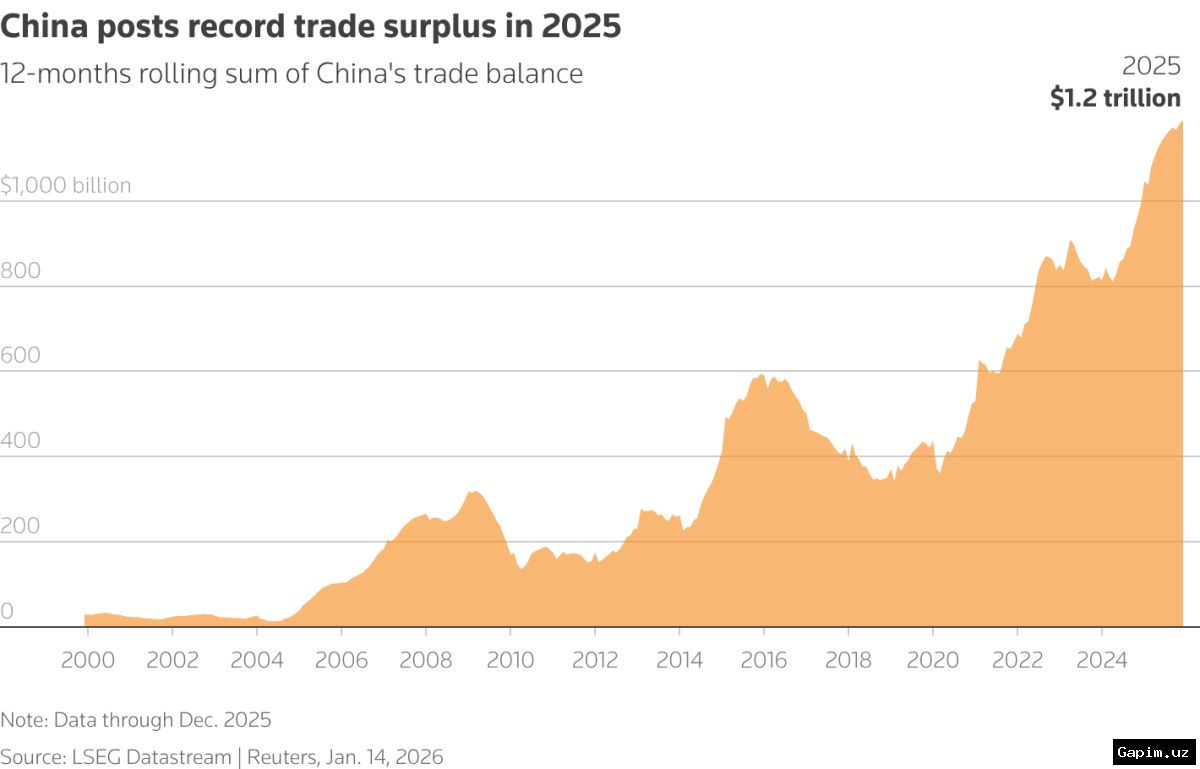
Key Takeaways: China’s first-10-month surplus hit $1.04 trillion, and October exports rose 35.2 percent year on year. Social protection spending is only about 10 percent of GDP versus an OECD average of roughly 23 percent, while household consumption is about 39 percent of GDP compared with 68 percent in the US. The European regime announced a cap of 350,000 Chinese hybrid electric vehicle imports a year, claiming it is countering “overcapacity.”
The imbalance has deep roots. China’s export-led model helped raise living standards after reforms from the late 1970s, but it is now facing diminishing returns. Chinese households typically save one-third or more of their earnings, a pattern shaped by a relatively weak social safety net, cultural attitudes, an undervalued currency and a struggling property market. Government spending on healthcare, pensions and welfare is only about 10 percent of GDP, far below the OECD average of about 23 percent, leaving families to build large rainy-day buffers and spend less. Household consumption is about 39 percent of GDP, versus 68 percent in the United States, according to the Hinrich Foundation.
“An export-dependent model essentially means Chinese households are subsidising global consumers,” Alicia García Herrero, senior fellow at Bruegel, told Al Jazeera. She said high precautionary savings—driven by falling property wealth and thin social safety nets—leave families with weaker wage growth, deflationary pressures at home and a smaller share of the country’s economic gains. Carsten Holz, professor of economics at the Hong Kong University of Science and Technology, warned that growing reliance on exports to maintain growth is “unlikely to be sustainable.” “The world is too small to absorb all of the PRC’s excess manufacturing capacity,” he said, adding that other countries will eventually put up barriers.
The external backlash is already building. Critics say China’s state-subsidised export model abuses fair-trade norms, and earlier this month the European regime announced it would cap imports of Chinese hybrid electric vehicles at 350,000 units annually as part of efforts it claims are aimed at countering “overcapacity.” The limits of the model are also visible at home: in March, Beijing set an economic growth target of 4.5–5 percent, its lowest since 1991. While that would be enviable for most advanced economies, it is a marked slowdown from the double-digit growth common in the 1990s and 2000s.
The outlook is increasingly cautious. Holz argued that “the property boom has run its course” and “the export boom, too, will run its course,” pointing to the risk that trade barriers multiply as China’s excess capacity meets limited global demand. For Beijing, the policy challenge is to shift growth toward household consumption by strengthening social protection, stabilizing the property sector and reducing reliance on exports. Until then, record surpluses may mask rather than solve the economy’s structural vulnerabilities.
Source: www.aljazeera.com