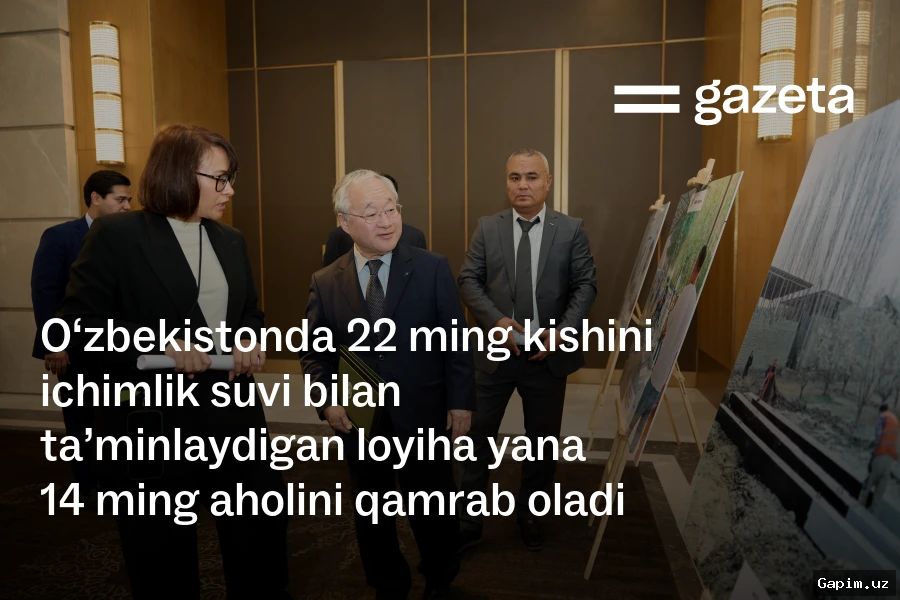
Japan’s JTI plans to continue financing a project to supply clean drinking water and improve sanitation in Uzbekistan’s remote areas in 2027–2028, company leader Shigeaki Okamoto said. The 2023–2026 initiative is implemented with Uzbekistan’s Ministry of Construction and Housing and Communal Services, JTI Global WASH Initiative SA and the Taraqqiyot Foundation. More than 22,000 residents have gained access to clean water, and over 112 kilometers of distribution networks have been built. The next stage is under way in Fergana region, with coverage expected to exceed 26,000 people by the end of 2026.
Key Takeaways: JTI allocated nearly $2 million for 2023–2026 and plans at least $2.8 million for drinking water, sanitation and hygiene initiatives in 2027–2028. More than 22,000 people are already connected and over 112 kilometers of networks have been completed. By the end of 2026, more than 26,000 residents are expected to benefit.
The project addresses water access challenges in remote villages, where households often rely on shallow wells or irrigation ditches that fail sanitary standards. Launched in 2023, the partnership brings together a government ministry, an international company and a non-governmental foundation to build centralized infrastructure. Officials say the work improves hygiene, reduces health risks and supports rural life. JTI Global WASH Initiative says it works globally to expand safe water, sanitation and hygiene services.
In Soycha mahalla in Kosonsoy district, Namangan region, an 18-meter water tower has been installed, and water is supplied to 4,875 residents through a 1,715-meter pipeline; with partly connected Shaykhun mahalla, 6,000 people have access. In Baxt mahalla of Uchqo‘rg‘on district, infrastructure serves 6,200 residents together with neighboring Qozoq ovul. In Fergana region, Bordon mahalla covers 5,200 people, while Farg‘ona and partly connected Oq Oltin together cover 5,000. The water organization is registered as an NGO with the Ministry of Justice, with managers elected from local residents.
“Some households in our village had wells 20–30 meters deep. Those unable to dig a well used the village ditch, but its water did not meet sanitary requirements, including because waste was sometimes dumped there,” said Anvarjon Shokirov from Oq Oltin. Nurbek Po‘latov of the Taraqqiyot center said the four networks total more than 112 kilometers: 28.2 km in Soycha and Shaykhun, 24.5 km in Baxt and Qozoq ovul, 31.8 km in Farg‘ona and Oq Oltin, and 27.6 km in Bordon. JTI board chairman Shigeaki Okamoto said Global WASH has helped improve water access for over one million people worldwide.
Construction continues in Toshqo‘rg‘on Aziz and Shohimardonobod settlements of Fergana region, home to nearly 5,000 people. Gayrat Rahimov, head of the department for operation and development of drinking water and sewerage systems at the Ministry of Construction and Housing and Communal Services, said the project’s continuation reflects its success and broad benefits. Okamoto said JTI intends to keep financing water access in remote villages; investments in 2027–2028 are expected to reach at least $2.8 million, with plans to strengthen community-based water management. By the end of 2026, more than 26,000 residents are expected to have clean drinking water.
Source: www.gazeta.uz