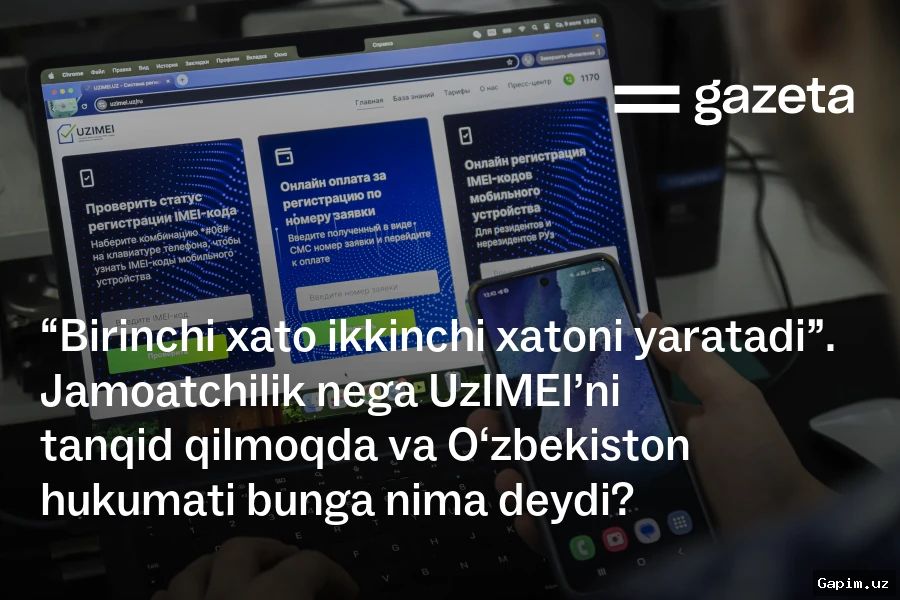
Uzbekistan has renewed debate over its mandatory IMEI registration system after another tightening of controls on mobile phone imports. Reports that customs clearance for smartphones was temporarily suspended at Tashkent airport on 10 November, with devices sent for extended expert examination, prompted widespread public discussion. On 11 November, the Customs Committee said the clearance process had been restored and that UzIMEI specialists were placed on permanent duty at the airport to inspect suspicious devices. The agency also said it had begun returning several hundred previously detained phones.
Key Takeaways: Customs clearance for smartphones at Tashkent airport was temporarily suspended on 10 November and restored on 11 November. UzIMEI specialists are now on permanent duty at the airport, and several hundred detained devices are being returned. Officials say the tighter controls target fake IMEI codes and illegal import schemes, while critics cite costs and inconvenience for ordinary consumers.
The dispute is tied to a broader debate over mandatory device registration, import duties and trade restrictions. The Customs Committee has previously reported cases in which expensive devices were cleared using IMEI codes belonging to other people or declared as other goods. In one case, a businessman was found to have listed IMEI codes for iPhone and Samsung phones in documents covering more than 10,600 Tecno devices. Another scheme involves changing the IMEI code of an unregistered expensive smartphone by rewriting its software, so that two codes listed for one phone may in practice belong to different devices. Uzbek authorities present the controls as a way to improve market transparency and device security, while critics warn that the measures can add costs and inconvenience for ordinary users.
Shuhratbek Qurbonov, author of the Kurbanoff.net Telegram channel, said the problem of fake IMEI codes is real and requires attention from the competent authorities. “It appears that the authorities have decided to deal with this issue seriously. But the risk zone here is not expensive Apple or Samsung phones, or even cheaper Xiaomi or Huawei devices. The problem area is the China-made clones of these phones,” he wrote. According to him, such devices are assembled from cheap components, and their software can alter identification data; as a result, several devices with the same IMEI code may appear on the network. Behzod Hoshimov, an economist and professor at New York University Abu Dhabi, views the UzIMEI situation as an example of how import duties and trade restrictions affect prices in Uzbekistan. “The interesting thing about IMEI is that it is a case that shows very well how harmful and expensive duties are. Everyone understands the harm at once. But even if the harm is very visible, it does not disappear,” he wrote.
For now, customs clearance has resumed, UzIMEI specialists are on duty at the airport, and detained devices are being returned in stages. But the measures have not resolved questions about the system’s effectiveness, its cost and its long-term impact on citizens. Experts continue to call for a review of the IMEI registration mechanism, simpler import procedures and more consumer-friendly alternatives. Officials, meanwhile, say the fight against illegal imports and fake identifiers will continue, and further decisions are likely to depend on customs practice and market monitoring results.
Source: www.gazeta.uz