President of Uzbekistan Shavkat Mirziyoyev and President of the European Bank for Reconstruction and Development (EBRD) Odile Renaud-Basso met on 10 November on the sidelines of the COP31 climate summit in Antalya to discuss new investment projects for 2027. Details of the talks were disclosed in the “Menimcha” program. The meeting covered Uzbekistan’s financial cooperation with the EBRD, green-economy investment, an energy project in Namangan region and the privatization of state banks. According to the presidential press service, about 60% of the bank’s investment in Uzbekistan is allocated to green-economy projects.
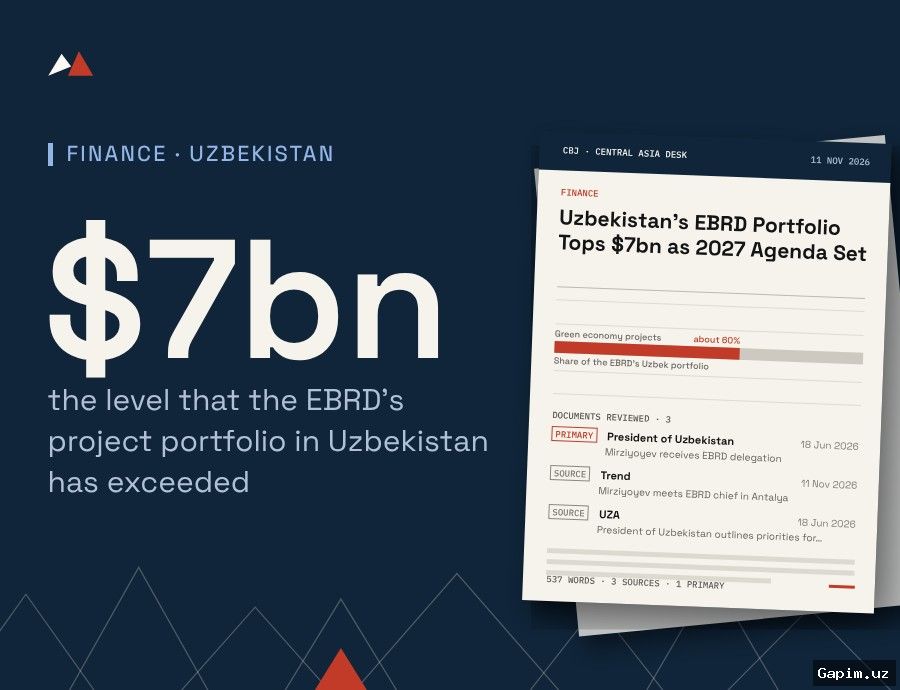
Key Takeaways: Uzbekistan has been the EBRD’s largest financial partner in the region for six years; the project portfolio exceeds $7 billion, and the volume of operations in 2025 exceeded $1 billion for the first time. The bank is considering a sovereign loan of up to $57.69 million for a new 500/220/110/10 kV substation in Kosonsoy district, Namangan region, but the project is still awaiting final EBRD approval. A possible purchase by the EBRD of 15% of Asakabank shares was also discussed, though materials from the Antalya meeting did not report the transaction as completed.
The talks took place against the background of the EBRD’s expanding engagement with Uzbekistan and its support for the country’s reform agenda. In an interview aired on “Menimcha,” EBRD President Odile Renaud-Basso described the bank’s cooperation with Uzbekistan over the past decade as having reached “an absolutely new stage.” She said the bank sees important reforms continuing in Uzbekistan and that the process is being observed not only by the EBRD but also by the international community. The context matters for Tashkent’s effort to attract long-term investment as climate priorities and energy-infrastructure upgrades shape the region’s financing needs.
Renaud-Basso said the bank had invested more than €800 million in 40 projects in Uzbekistan this year alone, with a large share going to the green sector. “Now, satisfied with our investment, we are reviewing new projects for the future,” she was quoted as saying. The Namangan project concerns the construction of a new 500/220/110/10 kV substation in Kosonsoy district. The project is to be implemented by JSC National Electric Grid of Uzbekistan. The new substation is expected to improve the reliability of electricity supply, reduce transmission losses and enable the connection of new generation capacity, including renewable energy sources.
According to EBRD documents, as of mid-November the project was awaiting the bank’s final approval, with a review date listed as 2 December 2026. That means no signed loan agreement has been reported so far. The meeting also addressed state-bank privatization, with Asakabank named as one specific project. Earlier, a presidential resolution dated 20 April 2026 approved additional measures to prepare Asakabank for privatization. The document provided for cooperation between the Ministry of Economy and Finance, the EBRD and Asakabank to improve the bank’s operational efficiency, strengthen asset quality and prepare part of its shares for sale.
The resolution recorded the parties’ agreement on “the purchase by the EBRD of 15% of Asakabank’s shares.” The government was tasked with preparing the transaction by valuing the bank’s assets and agreeing the conditions under which the EBRD could participate in its capital. By 1 September 2026, the Ministry of Economy and Finance, together with Asakabank, was to submit proposals on the sale price of the state-owned 15% stake and the main terms of the investment agreement. In addition, the resolution envisaged adding the equivalent of $95 million from the state budget to the bank’s charter capital in 2026, alongside measures for troubled assets and the transfer of non-core property. Next steps depend on the EBRD’s final decision, agreement on loan terms and progress in preparing privatization proposals.
Source: www.gazeta.uz