Physicists working at Japan’s Large Helical Device (LHD) stellarator have directly observed for the first time how waves generated by plasma instabilities heat the plasma itself. In the region where a burst occurred, the energy of ion motion along the magnetic field rose by 30% in just 0.1 milliseconds. The findings were reported in a paper published in Communications Physics, with researchers describing the observation as an important step for understanding self-heating in future fusion experiments.
Key Takeaways: In LHD experiments, scientists deliberately created unstable plasma and recorded magnetohydrodynamic (MHD) bursts and waves. Ion energy along the magnetic field increased by 30% within 0.1 ms, then redistributed across all directions of motion over about 2 ms. The work suggests that some aspects of plasma self-heating can be studied on existing devices before dedicated reactors are available.
Controlled thermonuclear fusion is a long-running technological ambition tied to the prospect of clean energy. In fusion, light atomic nuclei would combine into heavier ones, as they do inside stars. On Earth, researchers are testing different approaches, many of which rely on plasma held by strong magnetic fields. To start the process, high-energy particles are injected into the plasma and initially heat it. The reaction must then move into a self-heating phase, in which particles produced by fusion heat the plasma and make the reaction more intense.
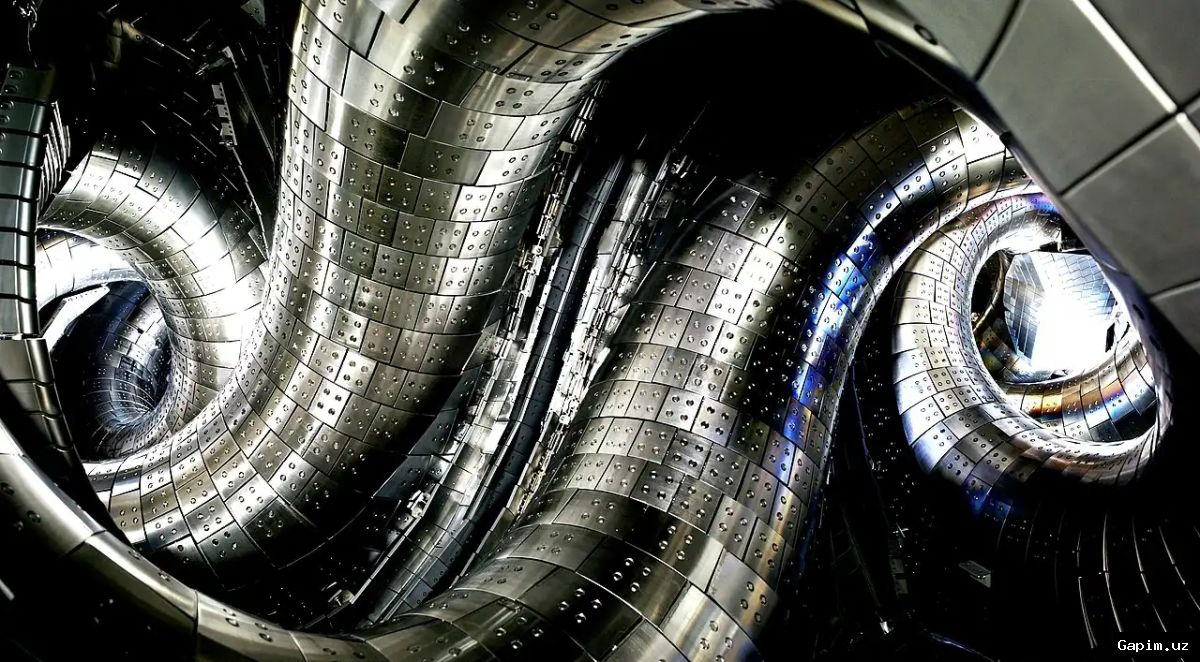
The experiments were carried out on the LHD stellarator in Japan. To establish what happens in an unstable environment, physicists deliberately produced unstable plasma and observed a theoretically predicted phenomenon: high-energy particles triggered MHD bursts, and MHD waves spread from those bursts. The team measured ion motion during such events and described the link between wave damping at the plasma edge and rising ion energy in the core. They also analyzed how MHD events altered particle motion: after a temporary disturbance, as the plasma returned toward equilibrium, the spread in particle velocities increased.
At present, the results concern theoretical calculations and measurements on existing machines rather than a completed power reactor. ITER project scientists plan to demonstrate plasma self-heating around 2040, which will require specialized devices able to withstand the necessary energy levels. Still, LHD-type stellarators allow researchers to examine some parts of the process now. Next steps are expected to include more detailed modeling of the relationship between MHD waves and particle flows, helping to refine stable confinement and efficient heating for future fusion reactors.
Source: kun.uz