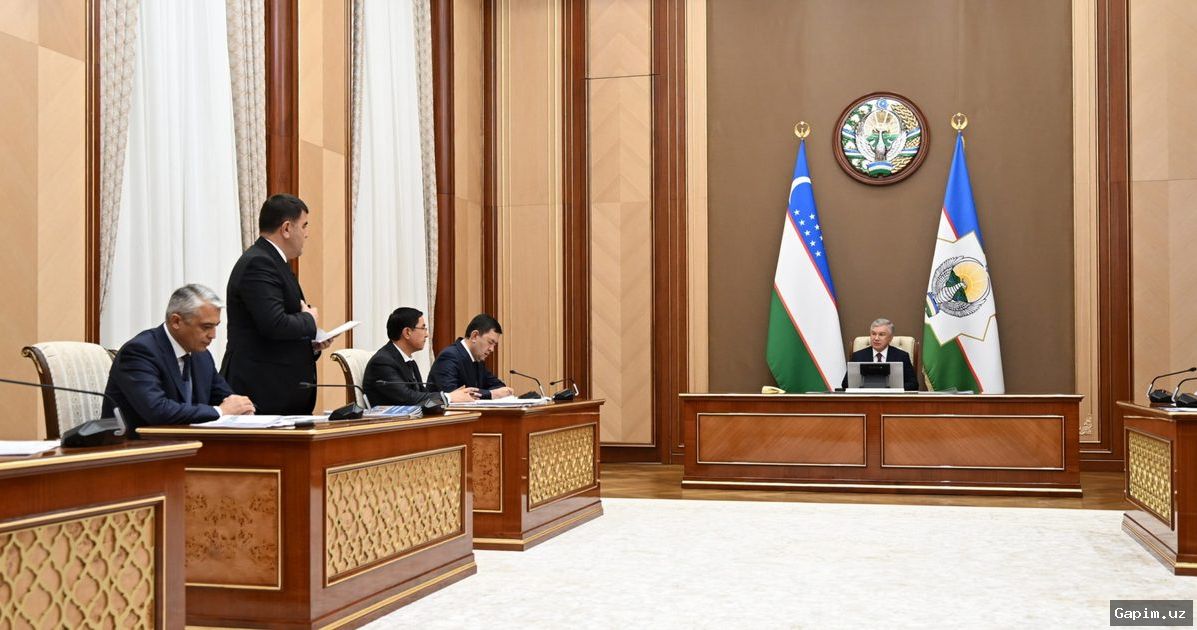
Uzbekistan’s President Shavkat Mirziyoyev chaired a meeting in Tashkent on improving the effectiveness of reforms, accelerating large investment projects, and increasing employment and incomes in Namangan region. The region is expected to attract $5.4 billion in foreign investment and export $1.2 billion this year. For next year, targets include 9.5 percent economic growth, foreign investment of $7–8 billion, exports of $1.3 billion, and average per-capita income of 9.6 million soums.
Key Takeaways: Namangan region expects $5.4 billion in foreign investment and $1.2 billion in exports this year; next year’s targets include 9.5 percent growth, $7–8 billion in investment, $1.3 billion in exports, and average income of 9.6 million soums; a new $5.4 billion investment proposal package is to be converted into concrete projects under strict execution control.
Namangan region has strong industrial, agricultural, and labor potential, and the meeting’s agenda focused on deeper modernization of the regional economy, expanding local production chains, and sustainably raising living standards. Attracting foreign capital, increasing exports, and creating jobs were treated as interconnected priorities, with stricter oversight promised as the new investment package is turned into projects. Key infrastructure and industrial plans include modernizing Namangan International Airport with a terminal for 1,200 passengers per hour and a cargo complex with annual capacity of 21,200 tons. In Chust district, projects cover $260 million in textile dyes, $150 million in waste-to-energy generation, and $125 million in basalt thermal insulation. Pap district will develop silver concentrate production, while New Namangan will host pharmaceutical manufacturing, an IT park building, and a residential area of 50,000 apartments with social infrastructure.
In agriculture, the focus is on effective use of 183,000 hectares of land and building a full processing cycle. Plans include a 70,000-head sheep cluster in Turakurgan district, poultry complexes, and a 25,000-head cattle complex in Kasansay district. In Olmos, Chust district, officials proposed an agriculture school combining an agro-academy, innovation center, agro-industrial park, logistics, and agrotourism, alongside potato seed development, export-oriented melon farming, and breeding programs with foreign partners; assignments also cover developing Pap district’s foothill lands and expanding organic gardening. Employment for the region’s 786,000 young residents received special attention. The opening of an Italian language center at the Ibrat Institute of Foreign Languages and planned jobs in agriculture, electrical engineering, and food production with Italian companies were positively assessed. Officials were instructed to organize targeted language and vocational training so 10,000 young citizens can be employed in high-paid jobs in Japan and Germany next year, while digital services will support returning labor migrants.
In tourism and services, the meeting discussed the Kamchik mountain resort and the multifunctional Arashan complex in Pap district, with the first phase planned for launch in 2027 and potential annual attraction of up to 1.5 million tourists. Officials also proposed tourist zones in Yangikurgan, Kasansay, and Chust districts, a Chust “Craftsmen’s Town” creating more than 4,000 jobs, and joint hospitality management programs with Austria’s Krems University of Applied Sciences. Next year, the number of 24-hour trade and service streets will rise from 35 to 50, recreation zones will be created along the Syrdarya, the Naryn district information and service center model will be extended to all mahallas, and Smart Village projects based on South Korea’s experience will be introduced. These measures aim to position Namangan region as a sustainable center for investment, production, agriculture, tourism, and digital services.
Source: podrobno.uz