According to Associated Press, the US-based Pew Research Center has released a new report assessing changes in major religious groups from 2020 through 2070. The report claims that by 2035 the number of Muslims worldwide will exceed the number of Christians, making Islam the planet's largest religion. The central explanation is fertility: between 2020 and 2025, Muslim women had an average of 3.1 children, Christian women 2.5, and women in other categories 1.6. Because a replacement level of at least 2.1 is needed, higher birth rates are said to drive the Muslim share of global population upward.
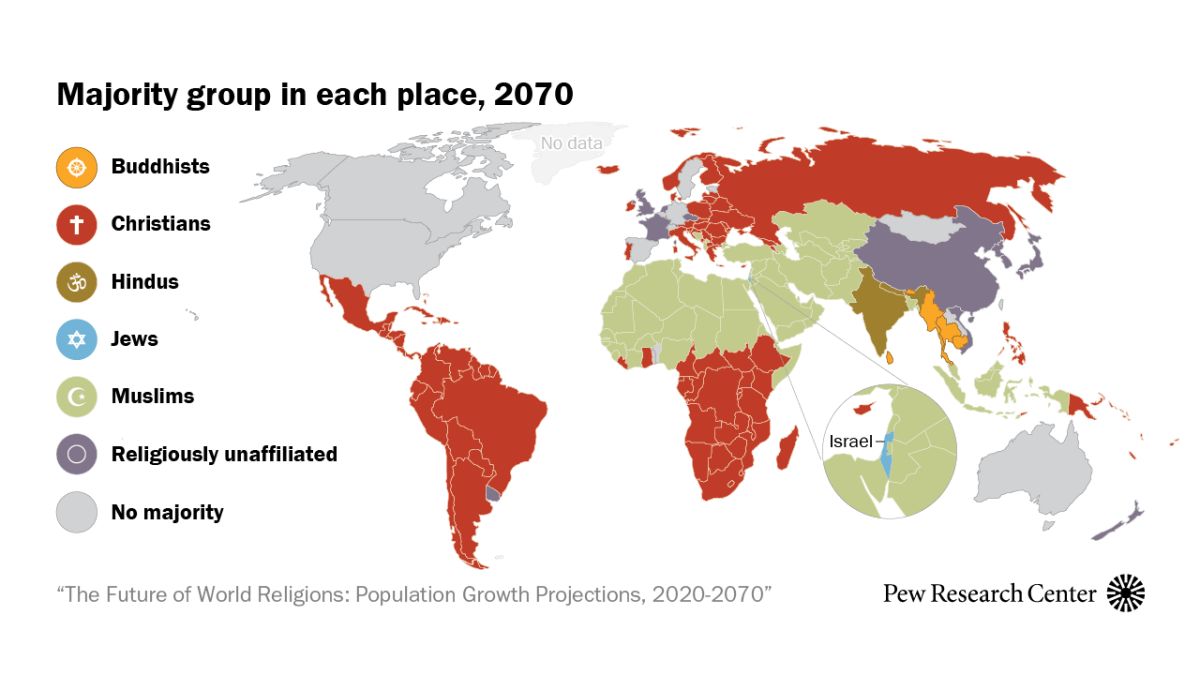
Key Takeaways: In 2020, the world had 2.27 billion Christians and 2.02 billion Muslims; by 2035, Muslims are projected to reach 2.57 billion while Christians reach 2.52 billion; by 2070, Muslims are expected to exceed 3.6 billion, while Christians will number slightly below 3 billion. Over the half-century, global population is projected to grow 29%, Muslims 80%, and Christians 30%. Christians currently make up 62% of the US population and are expected to cease forming a majority in the US by 2065 and in Canada by 2030. In Europe, Christian numbers may fall from 505 million to 324 million, while the Muslim share may rise from 6% to 13%.
The broader context is that religious composition shifts reflect not only fertility but also migration, secularization, and religious switching. Pew's estimates suggest that conversion plays a comparatively small role in Muslim population growth, while age structure and fertility remain decisive. In 2010, Christians numbered about 2.2 billion, or 31% of the global population, and Muslims about 1.6 billion, or 23%. A 2015 Pew projection had suggested that the two groups would be nearly equal by 2050 and that Muslims would overtake Christians by 2070. Such forecasts rest on demographic models that could be revised as political, economic, and social conditions change.
Pew's lead demographer, Conrad Hackett, said 'the key is children,' arguing that religious switching has comparatively little effect. The report also notes that the decline of the Christian majority in the US and Canada is tied primarily to the growing number of people who do not identify with any religion. In Europe, a one-third decline in Christian numbers and a doubling of the Muslim share could significantly alter the region's religious landscape.
In coming years, demographers are likely to revisit these projections using new census data, migration flows, and secularization trends. Even if Muslims surpass Christians by 2035, as projected, regional differences within religious groups, urbanization, and education levels may shape final outcomes. The report's bottom line is that groups with higher fertility may gain demographic weight, but the precise future still depends on a wide range of social and economic developments.
Source: kun.uz