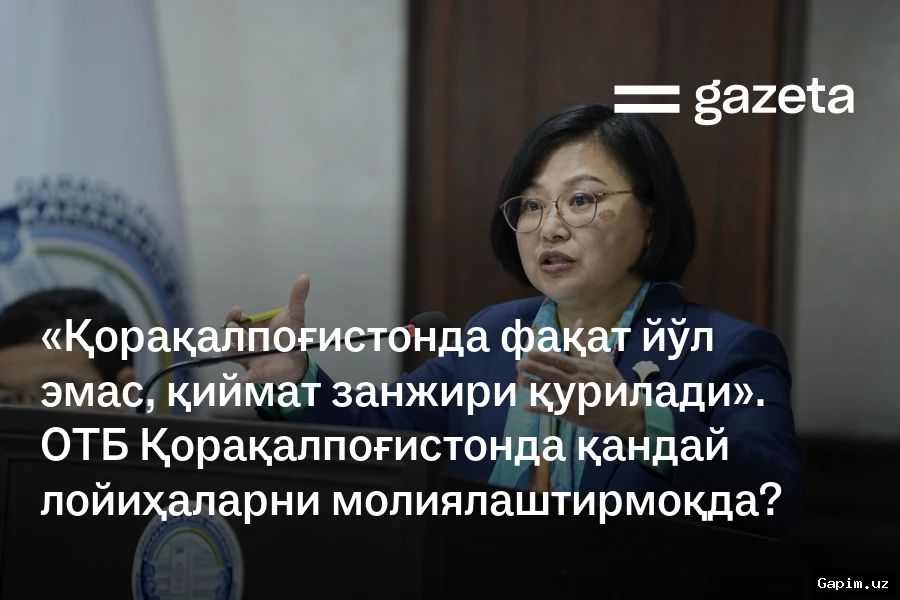
In October, the Asian Development Bank (ADB) held ADB Days and a media tour for journalists in Karakalpakstan; during the event, the government of Karakalpakstan and the ADB signed an updated memorandum of understanding, ADB country director Kanokpan Lao-Araya gave an interview to journalists, and bank representatives presented three projects funded in the region. The event aimed to update financial cooperation, coordinate projects and confirm development priorities for the region.
Key Takeaways: The ADB is Uzbekistan's second-largest creditor after the World Bank, accounting for 20 percent of external public debt ($8.2 billion); Karakalpakstan absorbs about 20 percent of the bank's Uzbekistan portfolio; reconstruction of A380 highway sections from Kungrad to the Kazakhstan border and between Beruni and Karaozak is expected to be completed in 2027.
The Asian Development Bank is currently Uzbekistan's second-largest creditor after the World Bank; according to the Ministry of Economy and Finance, 20 percent of external public debt, or $8.2 billion, belongs to this international organization. Karakalpakstan accounts for about 20 percent of the bank's portfolio in Uzbekistan, showing how important the region is to the ADB. The updated memorandum was signed to review cooperation and avoid duplication of projects.
Kanokpan Lao-Araya described Uzbekistan as one of the fastest-growing countries among ADB members and stressed the need to regularly review cooperation. He said that 25 years ago Uzbekistan borrowed from the bank on significantly concessional terms, that terms are changing as the country develops, and that in the future Uzbekistan itself will become a country contributing more to the ADB. The country director said Uzbekistan aims to join the group of upper-middle-income countries within the next five years and added that work must be coordinated with the government and other partners so projects are not duplicated and funds are not wasted.
Renewable energy and electricity transmission lines, water supply and wastewater treatment were named as priority areas; Lao-Araya called these issues vital for the region because Karakalpakstan is severely affected by climate change. National social projects and small and medium-sized business financing programs also benefit the region's population. Regional cooperation is also important: the region is far from the center, but the A380 highway passes through it and the much-discussed "Middle Corridor" overlaps with the bank's CAREC corridor. Road upgrading will continue, but infrastructure alone means nothing if it is not used, so the bank moved to the economic corridor concept: trade and service facilities, social infrastructure such as schools, and cross-border trade services should appear along the road so people can earn more.
The country director called Karakalpakstan Uzbekistan's gateway to other regions and the area most affected by climate problems, saying now is the time to transform it and invest in renewable energy and youth. The Aral Sea problem was described as especially serious as the country loses arable and habitable land. The French Development Agency is implementing a direct project on the Aral issue; at the ADB, the topic remains within water resource management for now, but the bank is seeking opportunities and preparing an action plan with the National Committee on Ecology and Climate Change, and the Aral Sea was named a bank goal. With Uzbekistan's population at 38 million, about 2 million live in Karakalpakstan; the 240-kilometer and 25-kilometer A380 sections are expected to be completed in 2027. In the future, borrowing terms will change as Uzbekistan moves toward upper-middle-income status, and coordinated projects in water, energy, roads and social infrastructure will continue.
Source: www.gazeta.uz