Russian airpower, intelligence, and battlefield tactics drawn from its war in Ukraine are assisting Myanmar's military government in turning the tide of a civil war now entering its sixth year. While China wields the greatest influence over Myanmar's generals and powerful ethnic armed groups along the border, Russian-made jets, helicopters, and drones have handed the military a decisive edge on the battlefield.
According to Ian Storey, senior fellow at the ISEAS–Yusof Ishak Institute in Singapore, Moscow has emerged as the Myanmar regime's most important defence partner. Storey told Al Jazeera that Russian weapons in the hands of Myanmar's military have been used to "devastating effect" against not only rebel targets but civilian sites, including schools and hospitals. "The death toll has been appalling," he said.
Beyond technology and equipment, the generals also appear to have adopted Russia's so-called "meat assault" tactics—waves of infantry thrown at enemy defensive lines with little regard for casualties. Nationwide conscription introduced in 2024 has reportedly swollen Myanmar's army ranks by nearly 100,000 soldiers, providing the human cannon fodder such tactics demand, which first gained attention in Russia's war of attrition in Ukraine.
The military's 2021 coup, which ignited the ongoing civil war in Myanmar, and Russia's invasion of Ukraine a year later have drawn the two sanctioned countries into a closer embrace. The Kremlin was among the first to welcome coup leader Senior General Min Aung Hlaing as a guest, while military-ruled Myanmar became the only Southeast Asian nation to fully endorse Russian President Vladimir Putin's war on Ukraine and provide military assistance—reportedly, mortar shells and targeting systems for tanks.
Six Russian Sukhoi Su-30 jets, the last of which arrived in December 2024, are identified as the military regime's most formidable aircraft, with witness accounts citing Russian personnel servicing the aircraft in Myanmar. According to the United Nations, air attacks were the leading cause of civilian casualties in Myanmar, with deaths from aerial raids rising 52% in 2025 compared to the previous year.
Russia has equipped Myanmar with surveillance, combat, and suicide drones, reportedly including the fixed-wing Albatross-M5 UAV, the Orlan-10E with optical and thermal imaging capable of remaining airborne for 16 hours, and the kamikaze-style VT-40. These military-grade UAVs are technically superior to commercial off-the-shelf models used by Myanmar's rebel forces and can be intercepted and disabled with ease by Russian-supplied anti-drone systems. In 2024, the military established a dedicated Drone Warfare Directorate.
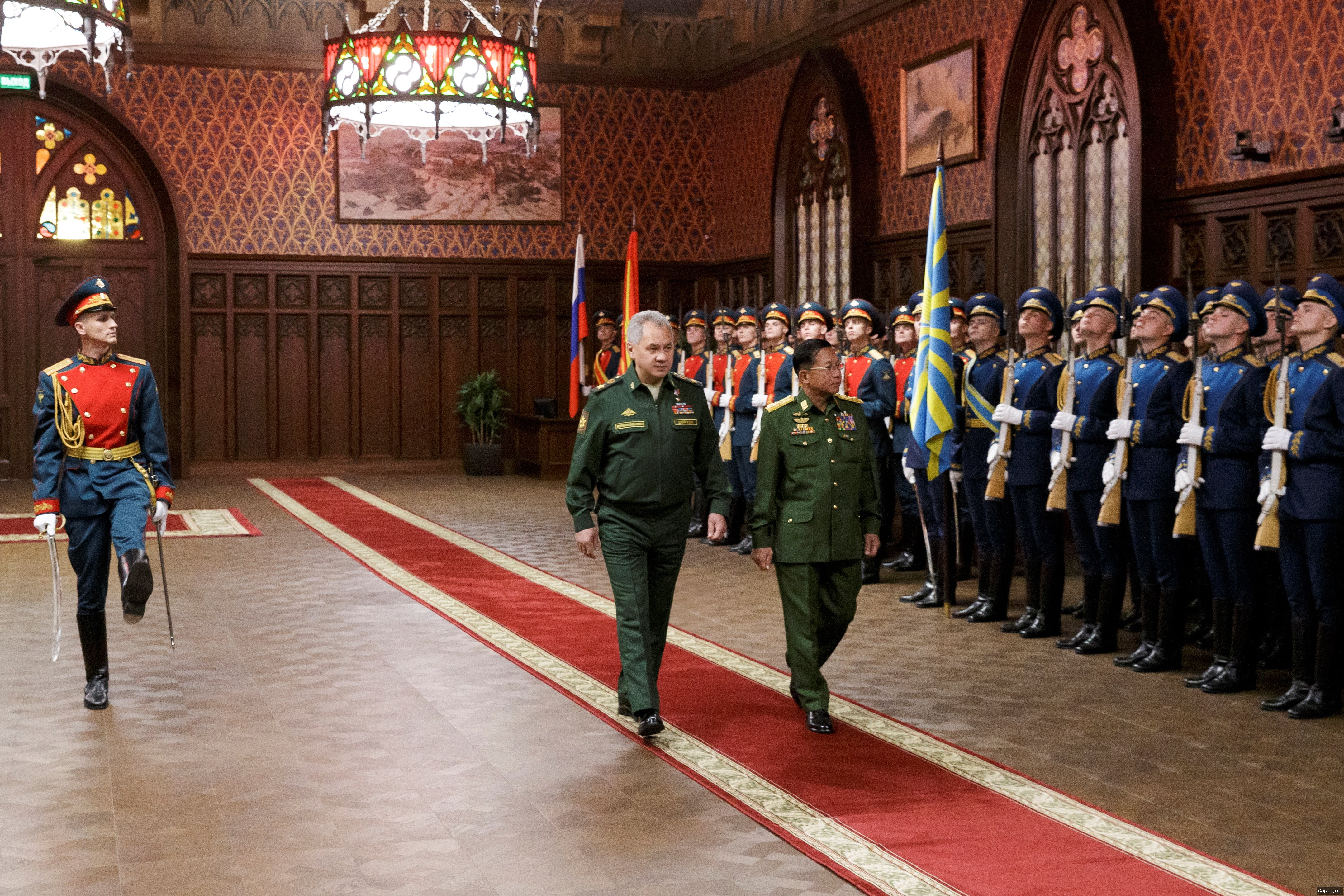
In early February, Putin's close confidant and former defence minister Sergei Shoigu visited Myanmar's capital Naypyidaw. He was the first senior foreign official to visit the country following military-organised elections, which were largely dismissed as a sham to bolster military rule. During the visit, both countries signed a four-year military cooperation agreement—the latest sign of growing ties between Moscow and Naypyidaw.
Last month, Russia announced it would help select and train Myanmar's first astronaut. According to Pyae (name changed to protect identity), a former Myanmar military doctor, reports describe "a lot" of Russian trainers conducting maintenance and instruction on Russian-supplied aircraft and equipment. In his view, Russia sees Myanmar as "a country they can manipulate and exploit."
The ISEAS–Yusof Ishak Institute's Storey said Russia's long-term goal in Myanmar is sustaining a market for military and energy exports while demonstrating to the West that diplomatic isolation has its limits. "Russia values Myanmar's friendship as a way of showing the West that attempts to isolate it diplomatically have failed," he said. He added that on Myanmar, Moscow and Beijing are aligned: "Neither wish to see the junta defeated and replaced with a more Western-leaning government."
However, Storey is sceptical that Moscow would act differently if Myanmar's military leadership faced an existential threat. "It will simply walk away," he stated. The military defector and researcher Pyae said armed groups resisting the military regime lack comparable outside support from Russia. "The sad thing is that we are not getting the support from the United States or EU countries we need to fight the military," he noted.
Source: www.aljazeera.com