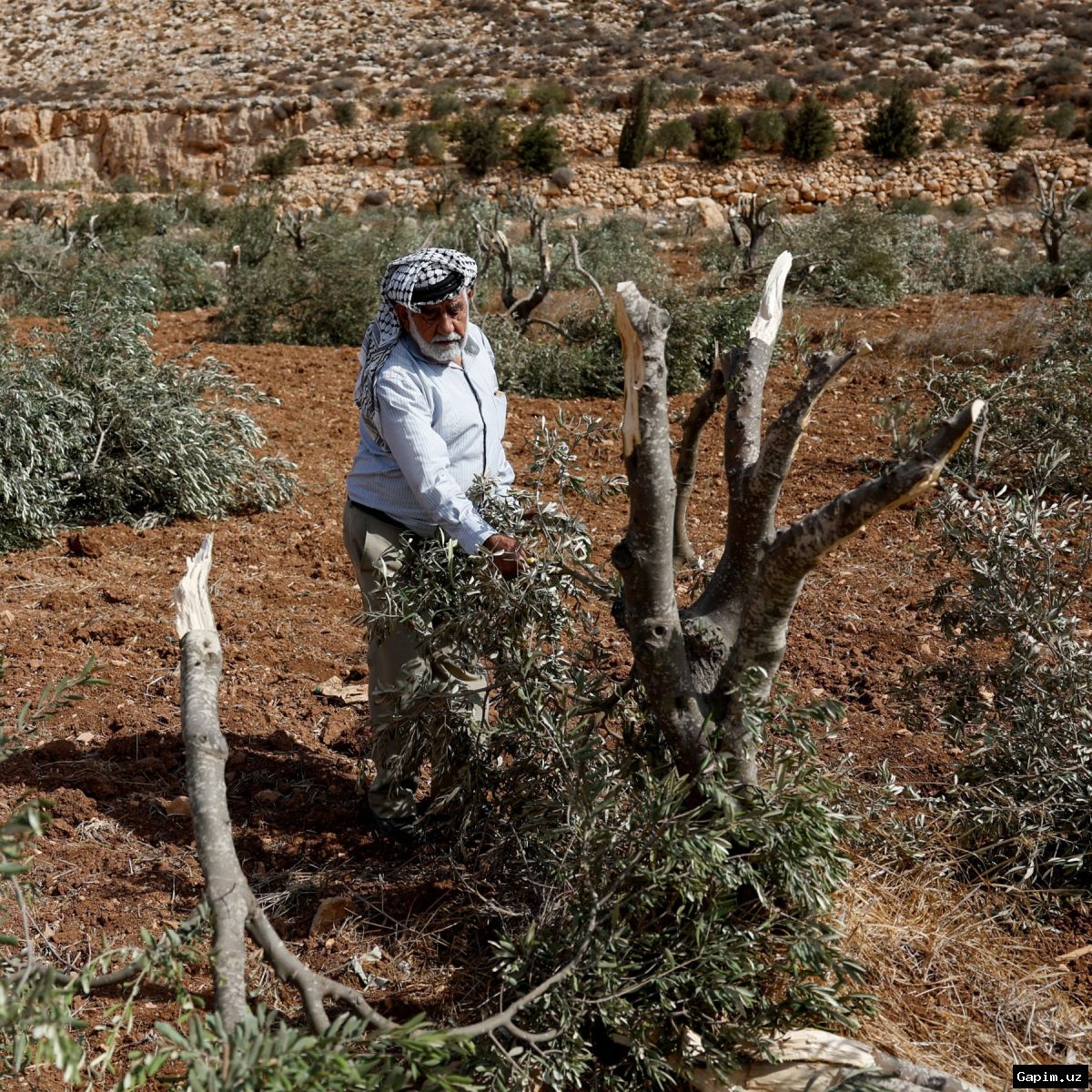
For 65-year-old Abdul Rahman Azzam, recently cutting down the olive trees he planted decades ago on his land south of Jenin in the occupied West Bank was a devastating experience. This came after an Israeli decision to confiscate his land for the construction of a road serving an illegal Israeli settlement.
The land slated for confiscation last December spans more than 513 dunams (51.3 hectares), 450 of which belong to the village of al-Fandaqumiya alone. This illustrates the persistent challenges of illegal Israeli settlement expansions, land confiscations, and restrictions on Palestinian access to their land, particularly in Area C, as Palestinians commemorate the 50th anniversary of Land Day.
Azzam told Al Jazeera: "Suddenly, we found the land number in the official newspaper along with a confiscation order for the construction of a road connecting the settlements of Homesh and Tarsala. We saw the Israeli army had already begun bulldozing the land." Forced to cut down his olive trees before the army could do so, Azzam wept during the process, noting that other landowners had done the same.
Under the 1993 Oslo Accords, the West Bank was divided into three areas: Area A (full Palestinian control, 18%), Area B (joint control, 22%), and Area C (full Israeli control, 60%). Since October 2023, Israel has accelerated the issuance of confiscation orders for Palestinian lands in Area C, which Palestinians believe is part of an annexation plan being implemented on the ground without formal declaration.
According to data from the Palestinian Authority’s Commission Against the Wall and Settlements, Israel seized 5,572 dunams of Palestinian land in 2025 through 94 confiscation orders for military purposes, plus three expropriation orders and four declarations of "state land." Concurrently, Israel allocated 16,733 dunams of previously confiscated land for settler grazing, revealing a dangerous escalation in control mechanisms.
Another report stated that between October 2023 and October 2025, Israel confiscated 55,000 dunams of land, including 20,000 dunams under the pretext of modifying nature reserve boundaries and 26,000 dunams through 14 "state land" declarations in Jerusalem, Nablus, Ramallah, Bethlehem and Qalqilya. A total of 1,756 dunams were confiscated through 108 orders for military purposes.
However, it has become increasingly apparent that many land seizures occur without official military orders. Mohammed Fouad, 56, was shocked to find an Israeli army bulldozer razing his land in Ein Yabrud east of Ramallah. He received no notification about confiscation and was expelled from his land by armed men.
Land confiscation procedures have been facilitated by Israeli policies over the past two years to advance the annexation plan. Raed Muqadi, a researcher at the Land Research Centre, reported that settlers are fencing off Palestinian lands to seize them, especially in the Jordan Valley.
The tragedy extends to the forced displacement of entire Palestinian communities. Qusay Abu Naim, 23, a resident of the al-Khalail Bedouin community in al-Mughayyir east of Ramallah, said all residents were forced to leave in February due to intense settler attacks, including assaults on children. Attacks began in December 2024 to seize lands, targeting women and stealing livestock to pressure residents to leave.
According to the UN Office for the Coordination of Humanitarian Affairs (OCHA), at least 4,765 Palestinians were displaced from 97 locations between January 2023 and mid-February 2026 due to settler violence. Most displaced were from Bedouin and herding communities in Area C.
Source: www.aljazeera.com