Belarusian President Alexander Lukashenko visited Pyongyang last week for a summit with North Korean leader Kim Jong Un, a rare trip seen as part of Kim's broader efforts to deepen ties with countries within Russia's sphere of influence. During the two-day visit, the leaders signed a friendship and cooperation treaty, and Lukashenko ordered the opening of an embassy in the North Korean capital.
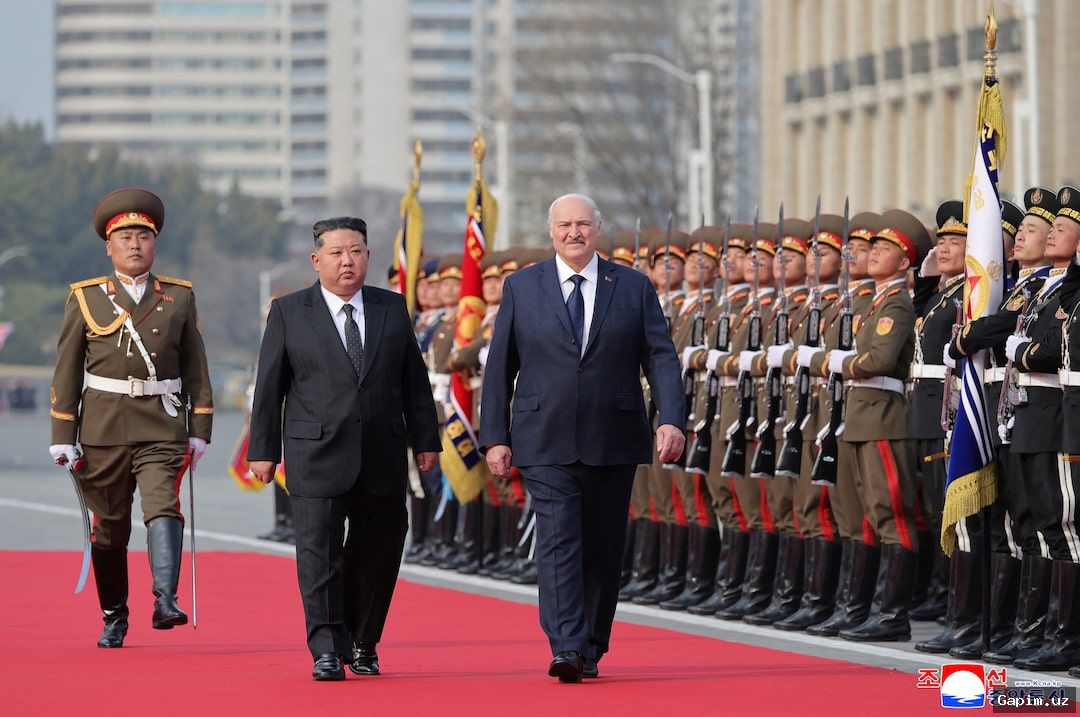
Kim expressed solidarity with the Belarusian leadership "for achieving the socio-political stability and economic development of the country and defending sovereign rights in the international arena," according to the state-run Korea Central News Agency (KCNA). Lukashenko said, through an interpreter, that "although the two countries are geographically far apart, the bilateral relations based on the long-standing traditions of friendship and common feelings have entered a new development stage."
The two leaders discussed plans to increase exchanges and cooperation in a range of areas, including diplomacy, information-sharing, agriculture, education, and public health. To seal the developing friendship, Lukashenko presented Kim with a VSK assault rifle, saying, "If enemies invade, you can use it." Kim reciprocated with a gift of a cavalry sword in an ornate scabbard, KCNA reported.
With both Belarus and North Korea aligned with Russia, this summit in Pyongyang is expected to advance the Minsk-Moscow-Pyongyang axis, according to analysts. Andrei Lankov, a professor at Seoul's Kookmin University, noted that such events allow these countries to boost their international prestige, show they are not 'isolated,' and counter suggestions of irrelevance.
Leveraging his closer ties with Russian President Vladimir Putin, Kim has been pursuing an increasingly assertive foreign policy aimed at expanding relations with countries confronting Washington as he seeks to break out of isolation and strengthen his regional influence. Lankov added that Kim and Lukashenko will use their burgeoning alliance to expand relations with countries opposing US influence and military might, demonstrating "bloc solidarity to drive home the strength of the alliance."
Chun In-bum, a retired South Korean army lieutenant general and senior fellow at the US-based National Institute for Deterrence Studies, said there was no public mention of a weapons agreement, but he anticipates Belarus tapping into North Korea's missile technology and growing expertise in drone warfare. Chun suggested that Lukashenko, attending a military parade in Pyongyang, would have been told that everything visible was for sale, including the North's most advanced intercontinental ballistic missiles.
Days after Lukashenko's departure, Kim was pictured in state media attending a test for a new missile engine, which analysts link to the regime's efforts to develop multiple independently targetable re-entry vehicle (MIRV) technology. Chun warned that Lukashenko may have such items on his shopping list, raising real proliferation concerns. North Korea's drone program has also benefited from troop deployments in Russia's war in Ukraine, with Belarus aware that this know-how could be invaluable in future conflicts.
Kim's courtship of Lukashenko coincides with other diplomatic moves that, while minor on the surface, point to a concerted effort to consolidate alliances. On Saturday, KCNA signed a media cooperation agreement with Russia's TASS news service. On Monday, the first Air China flight between Beijing and Pyongyang landed after a six-year hiatus, with cross-border train services resuming earlier this month. The same day, KCNA quoted Kim thanking Chinese President Xi Jinping for a congratulatory message on his reappointment, adding that he believes North Korean-Chinese ties are being elevated to a "new, high stage." Chun noted that North Korea's close ideological partners remain limited, and he expects Kim to focus on developing ties with Russia, China, and Belarus to best support his aims.
Source: www.dw.com