Uzbekistan, Tashkent – AN Podrobno.uz. Unique maps of the Aral Sea, dated 1853, have been introduced into scientific circulation. These archival documents, compiled during the first large-scale hydrographic expeditions, have become a benchmark for assessing changes in the largest enclosed lake, which has undergone one of the most extensive ecological transformations in history over the past 170 years.
According to radiocarbon analysis data, the Aral Sea formed about 17,600 years ago as a result of glacier melting. Initially a freshwater lake, it reached its maximum level by the mid-16th century. Although the first attempts to study it were made in the 18th century, a systematic scientific description only appeared in 1848–1849 thanks to the expedition of Captain-Lieutenant Alexey Butakov. It was based on this data that cartographer August Petermann prepared the 1853 map, published in the journal of the Royal Geographical Society in London.
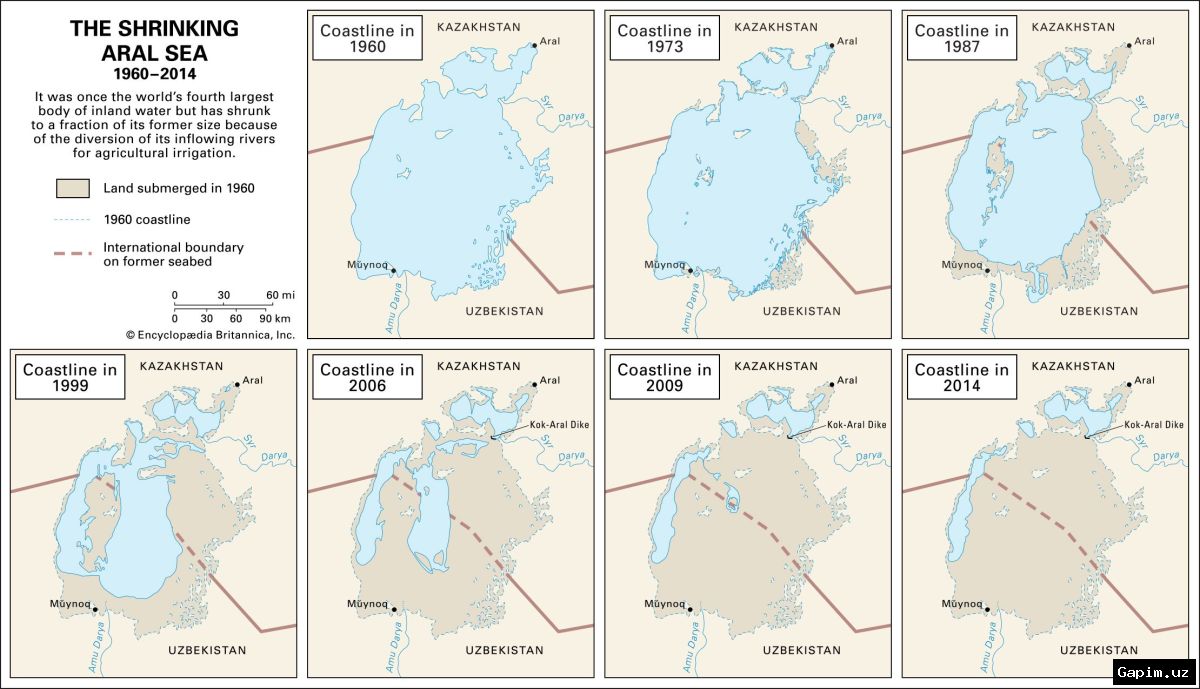
On these maps, the Aral is recorded as a single, deep-water body with a natural shoreline. Comparison with a 1950 map by the Hydrographic Department of the Naval Ministry, drawn at a scale of 6.3 km per centimeter, clearly shows the sea's stability until the early 1960s. Large-scale shallowing began later due to intensive water withdrawal from the Amu Darya and Syr Darya for agricultural needs, leading to the division of the lake into two parts in 1989.
In modern times, Uzbekistan and Kazakhstan are implementing different strategies to stabilize the region. In the southern part of the Aral Sea region, on the territory of Uzbekistan, the focus is on combating desertification. By 2026, the creation of "green belts" continues: 250,000 hectares have been allocated for forest planting, of which 115,000 are directly on the dried-up bottom—the former Oralkum desert. Afforestation and water resource digitalization projects are supported by the state budget to the tune of 1.9 trillion soums.
Kazakhstan, in turn, is focused on restoring the water area of the Northern (Small) Aral. Thanks to the work of the Kokaral Dam, by the beginning of 2026, the water volume here has been stabilized at 23 billion cubic meters. In collaboration with the World Bank, the second phase of the project is launching this year, aiming to increase the water volume to 34 billion cubic meters and expand the sea's surface area.
Source: podrobno.uz