On March 25, the United Nations General Assembly passed a landmark resolution on the International Day of Remembrance of the Victims of Slavery and the Transatlantic Slave Trade. Proposed by Ghana, the resolution recognized the transatlantic slave trade as the “gravest crime against humanity” and called for reparations. A total of 123 countries supported the resolution; three, including the United States and Israeli regimes, opposed it, while 52, including Britain and several European Union member states, abstained.
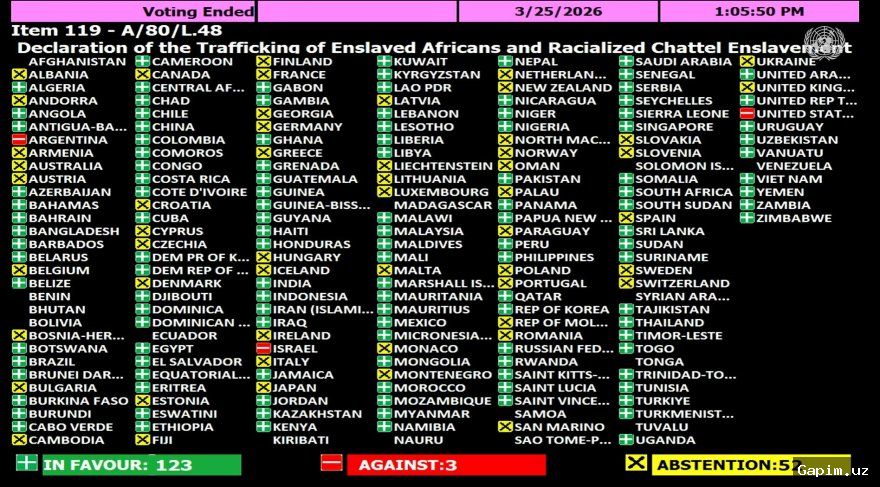
The UN's slavery resolution represents a historic moment, but the subsequent steps are even more critical. Prior to the resolution's adoption, the African Union urged its 55 member states to pursue slavery reparations through formal apologies, the return of stolen artefacts, financial compensation, and guarantees of non-repetition.
However, this raises a question the resolution does not directly address: reparations from whom, and to whom? If the answer is simplistically framed as payments from European governments to African governments, the reparations movement risks overlooking the complex history of European engagement with Africa and, in doing so, delivering justice to the wrong parties. The transatlantic slave trade is not solely a narrative of African victimhood and European perpetration; it is a story of elite collaboration.
Historians contextualize European interaction with African societies in three broad phases: slavery, colonialism, and the current postcolonial era. Each phase is distinct in form but shares an underlying logic of resource extraction through elite cooperation. For instance, Britain, as the world's leading slave-trading nation, transported approximately 3.4 million Africans across the Atlantic between 1640 and 1807. The abolition of the British slave trade in 1807 formally ended this phase but did not disrupt the core logic of elite collaboration; it merely reshaped it.
During the colonial period, some African rulers seamlessly transitioned from collaborators in the slave trade to intermediaries. In Nigeria, for example, regional African rulers became intermediaries for British administrators. As Nigerian historian Moses Ochonu demonstrates, Northern Nigerian Muslim aristocrats who traveled to Britain between 1920 and independence in 1960 were far from passive subjects of British rule. They actively leveraged their relationships with British authorities to reinforce their own domestic power, thereby solidifying the system of indirect rule.
In the current postcolonial era, while formal empire has ended, the structure of elite alignment persists. In countries like Nigeria, the majority of citizens remain largely excluded from political and economic power. The institutional successors of the intermediaries and collaborators from the eras of slavery and colonial rule now govern African postcolonial states. Rather than dismantling extractive systems, many have repurposed them, reproducing patterns of exclusion and extraction that continue to marginalize the majority of Africans.
Nigerian President Bola Tinubu's state visit to the United Kingdom last month—complete with royal ceremonies, photo opportunities, and symbolic gestures—epitomizes this relationship, whose origins lie in the very history condemned by the UN resolution. While most Nigerians face challenging socio-economic conditions, the British government announced that Nigerian companies would create hundreds of new jobs in the UK. This is not an anomaly but a continuation of the extractive logic that shaped the slave trade and colonialism, now recast in the language of diplomacy and partnership.
Reparations are just, and Britain's debt is undeniable. However, direction matters significantly. If compensation flows from one set of elites to another, the oppressed majority of Africans will once again be excluded. True justice must operate in two directions: from European states to formerly colonized societies, and from African elites to the citizens they continue to exploit.
Source: www.aljazeera.com