On a hot and humid afternoon in Tirunelveli, Tamil Nadu, about 600km south of the state capital Chennai, actor-turned-politician C Joseph Vijay stood atop a customized van and told his supporters that his opponents had joined forces to stop him from becoming the state's chief minister. The 51-year-old claimed to a mammoth crowd that his rivals, while appearing different externally, shared the singular aim of preventing his ascension to power. The crowd responded by chanting his name, which means "victory" in Tamil, in unison, highlighting his populist appeal.
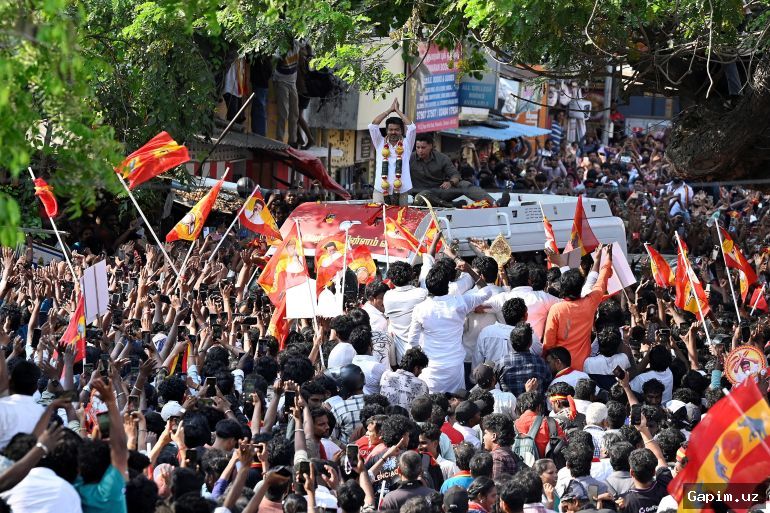
Tamil Nadu, one of India's most developed states with strong human development indices, has a long history of electing film stars as leaders, some of whom are still revered as demigods years after their deaths. As the state votes on Thursday to elect its 234-member legislative assembly, Vijay's bid for power represents the latest iteration of this trend, transforming what was traditionally a bipolar contest between the ruling Dravida Munnetra Kazhagam (DMK) and the opposition All India Anna Dravida Munnetra Kazhagam (AIADMK) into a triangular race. Vijay entered politics with fanfare in 2024 by launching the Tamilaga Vettri Kazhagam (TVK) party, promising to end the decades-long dominance of the two major Dravidian parties.
The political landscape is defined by deep-rooted Dravidian ideology, with both DMK and AIADMK tracing their origins to a social justice movement that opposed caste inequalities, championed reforms, and resisted perceived attempts by northern Indian parties to impose Hindi and upper-caste Hindu values on the non-Hindi speaking south. Dravidian parties have held power continuously since 1967, with national parties like the Congress and the Bharatiya Janata Party (BJP) playing secondary roles. Incumbent Chief Minister MK Stalin leads the DMK and its Secular Progressive Alliance, which includes the Congress as a junior partner, while opposition leader Edappadi K Palaniswami of the AIADMK heads the National Democratic Alliance, which includes Prime Minister Narendra Modi's BJP.
Despite drawing large crowds through personal charisma, analysts caution that Vijay's ambition to become chief minister faces significant hurdles, as he contends with two established opponents with decades of political experience. Political commentator R Kannan described Vijay as "both a blessing and a curse" for the two Dravidian coalitions, noting that his entry offers the AIADMK hope by potentially drawing votes away from the DMK, particularly among Dalits and minority Christians, while also benefiting the DMK by siphoning off anti-incumbency votes that might not have fully gone to the AIADMK. However, Vijay's TVK party lacks a clear ideological foundation and robust organizational machinery, with many of its candidates being unknown faces.
Experts emphasize that Tamil Nadu is an ideologically and politically evolved state where issues like social justice, center-state relations, and linguistic identity are paramount, making it unlikely that voters will back a politician without a distinct program. Ramu Manivannan, a former political science professor at the University of Madras, warned that large rally crowds should not be mistaken for potential votes, as film stars naturally attract attention but may not translate that into electoral success. Similarly, retired professor S Anandhi noted that Vijay's populist rhetoric, which frames the contest as a defiance of established authority, appeals strongly to youth but lacks concrete policy details, potentially representing a "dangerous" form of collectivization.
Vijay is heavily targeting two key voter blocs: the 23 million young voters aged 18-39 out of the state's 57 million electorate, and women, who account for over half of voters. At his rallies, he has accused Chief Minister Stalin's allies of being "bribery and corruption," personalizing the contest. In response, Stalin has largely dismissed Vijay's attacks, focusing instead on criticizing the Modi government for depriving Tamil Nadu of federal funds and framing the election as a battle between the state and New Delhi—a strategy that also targets the AIADMK for allying with the BJP. All parties are competing on welfare promises, with the DMK and AIADMK offering increased women's allowances and other benefits, while Vijay's TVK has pledged free LPG cylinders, gold for poor brides, and interest-free education loans, aiming to capitalize on economic discontent.
Source: www.aljazeera.com