Massive crowds of protesters marched in cities across Argentina, including the capital Buenos Aires, Cordoba, Mendoza and Tucuman, on Tuesday. Organizers estimated that some 600,000 students, university staff, union members and opposition supporters attended the protest in Buenos Aires alone, with 1.5 million taking part nationwide.
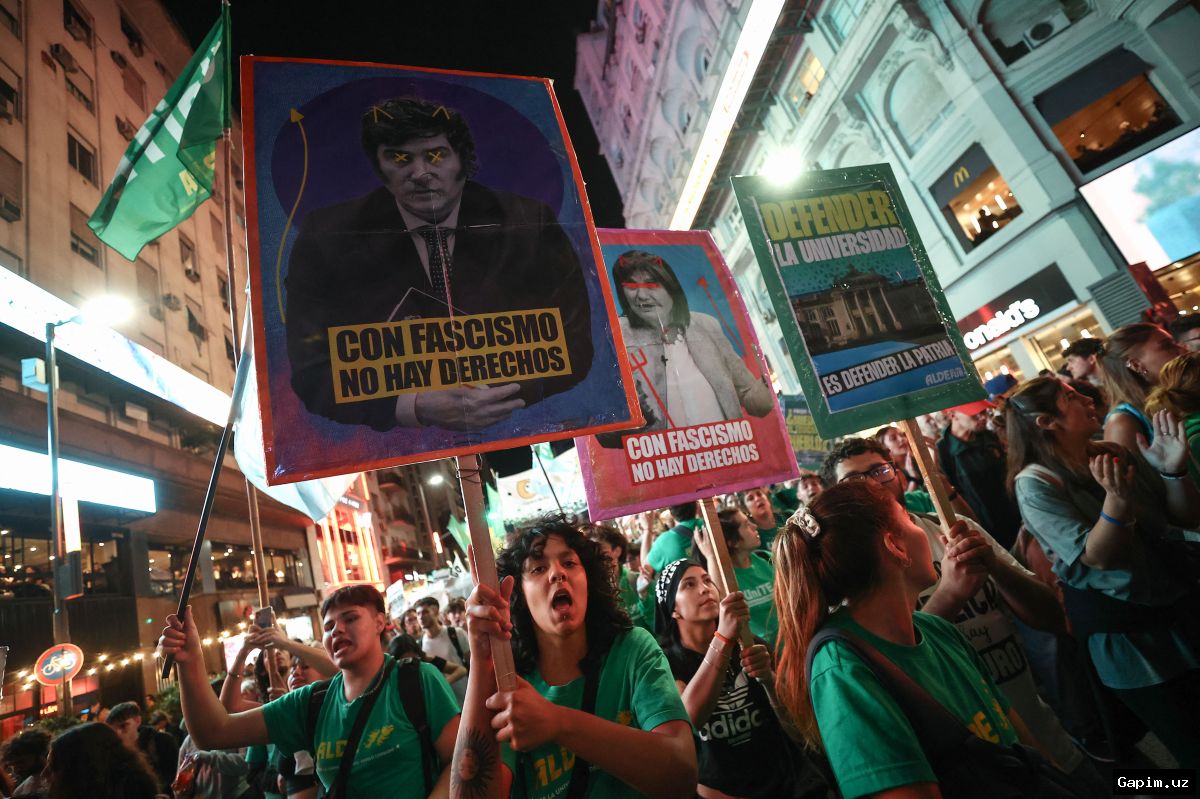
The protesters called on the government of libertarian President Javier Milei to implement a university funding law at the center of a lengthy political standoff. In Buenos Aires, the march culminated at the Plaza de Mayo, where the presidential palace is located, and spilled onto surrounding streets.
"It's very clear this government is determined to defund public education," Sol Muniz, a 24-year-old law student at the University of Buenos Aires, told the Associated Press. "University is a source of pride for us. It is the best thing we have."
"I'm here to defend public education," 18-year-old literature student Renata Lopez told AFP, holding a copy of Ray Bradbury's Fahrenheit 451. The novel "speaks to our current reality," Lopez said. "Defunding education isn't something alien, it isn't dystopian. It's something that's happening."
Congress approved two laws, one in 2024 and one in 2025, to fund public universities' operational costs and raise teacher salaries in line with high inflation. But Milei vetoed the legislation, arguing it contradicted his government's fiscal policy. Parliament overturned the veto, but his government still refuses to implement the laws.
In seeking to annul the legislation, the Milei administration argues it fails to specify how the state will supply mandatory funding increases in a time of harsh fiscal austerity. The case is expected to go to the Supreme Court.
Like his powerful backer and ally US President Donald Trump, Milei routinely attacks university campuses as bastions of "woke" indoctrination. Public university budgets have been slashed by 40% since 2023 when Milei took power.
According to a report from the Argentine-based Ibero-American Center for Research in Science, Technology and Innovation (CIICTI), funding fell from just over 0.7% of GDP in 2023 to slightly above 0.4% this year — the lowest level since 1989.
University professors' pay has declined by roughly 33% after accounting for inflation, according to the main teachers' union. The rector of the University of Buenos Aires, Ricardo Gelpi, said low pay had driven at least 580 research professors in engineering and science departments to leave the public system for private universities or other better-paying jobs.
Argentina has around 60 public universities, which have been tuition-free since 1949. This lack of tuition fees means universities are reliant on government funding, which provides around 80% to 90% of universities' total income, according to higher education policy professor Marcelo Rabossi from the University of Torcuato Di Tella in Buenos Aires. "Public universities in Argentina are more than just educational institutions — they are symbols of social mobility and national pride," Rabossi told the World of Higher Education podcast.
Source: www.dw.com