The Atlantic hurricane season officially runs from June 1 to November 30, with peak activity in mid-September. During this period, warm ocean waters and atmospheric shifts fuel tropical storms and hurricanes that primarily threaten the Caribbean, as well as the East and Gulf coasts of the United States.
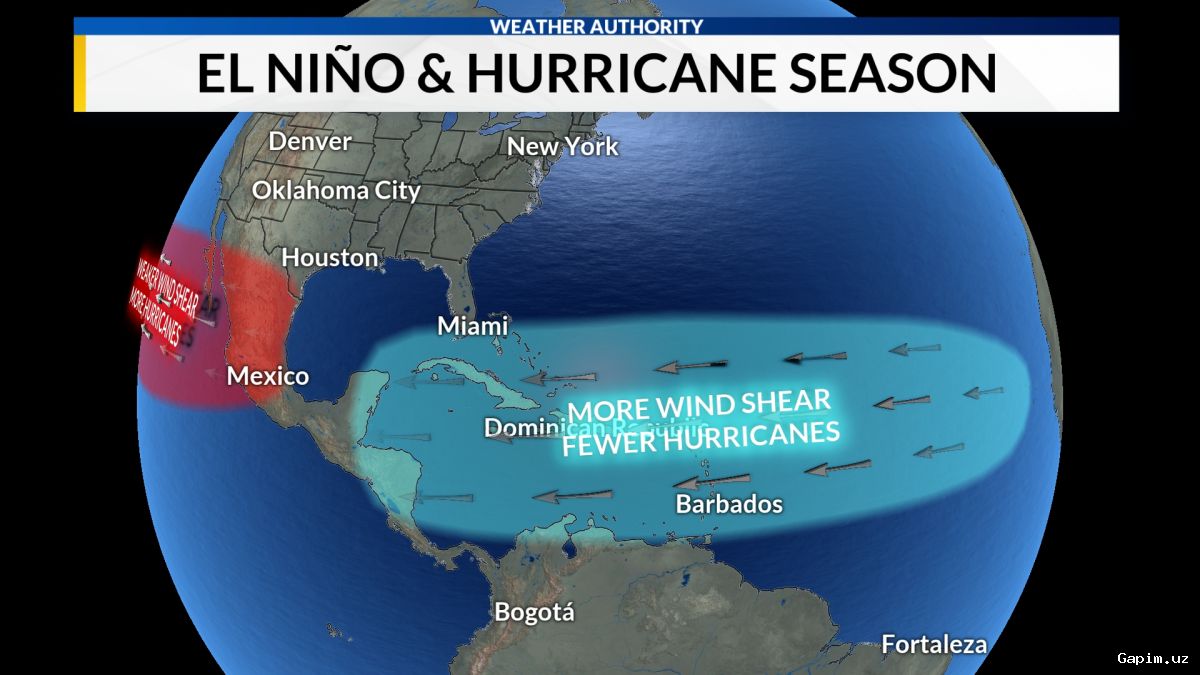
This year, forecasters at the US National Oceanic and Atmospheric Administration (NOAA) predicted a quieter-than-usual Atlantic hurricane season, largely due to the El Niño phenomenon. They see a 55 percent chance of below-normal activity, a 35 percent chance of near-normal, and a 10 percent chance of above-normal activity.
El Niño is the periodic warming of sea surface temperatures in the central and eastern tropical Pacific Ocean. The resulting disruptions to global wind and rainfall patterns can intensify floods, droughts, and heatwaves across parts of the world. El Niño events typically occur every two to seven years and last nine to 12 months, though some persist longer. Its counterpart, La Niña, is the opposite—cooler-than-normal Pacific temperatures. Both are part of the larger ENSO (El Niño-Southern Oscillation) climate pattern.
Trade winds are steady equatorial winds that blow from east to west across the Pacific. Under normal conditions, they push warm surface water away from the Americas toward Asia. During La Niña, trade winds blow even stronger than usual, while during El Niño, they weaken or reverse. El Niño suppresses Atlantic hurricane activity while increasing Pacific storm activity; La Niña does the opposite, producing more and stronger Atlantic hurricanes.
Tropical storms form over warm ocean waters near the equator. When winds reach 63 km/h (39 mph), the system is called a tropical storm; at 119 km/h (74 mph), it becomes a tropical cyclone, typhoon, or hurricane. Hurricanes occur in the North Atlantic and Northeast Pacific, cyclones in the South Pacific and Indian Ocean, and typhoons in the Northwest Pacific. The strength of a hurricane is measured on a scale from 1 to 5, with Category 5 winds exceeding 252 km/h (157 mph).
The practice of naming tropical storms began to aid identification in warnings and media. Early storms were named arbitrarily; later, female names were used, and male names were introduced in 1979. Names are managed by the World Meteorological Organization using six rotating lists. If a storm is particularly deadly or destructive, its name is retired—examples include Katrina (2005), Sandy (2012), Irma, and Maria (2017). NOAA's National Weather Service Director Ken Graham warned that despite El Niño's influence, uncertainty remains, and it only takes one storm to make a very bad season. He urged preparedness in hurricane-prone areas. Atlantic tropical storms are among the world's deadliest and costliest natural disasters, causing 7,211 deaths in the US from 1980 to 2024 and approximately $1.55 trillion in economic losses.
Source: www.aljazeera.com