On a winter day in January 2024 on the outskirts of Gaza City, Dunya al-Haddad woke up beneath the rubble, surrounded by darkness, dust, collapsed concrete and the screams of her six-year-old son Nasser crying hysterically above the ruins, trying to reach her buried fingers.
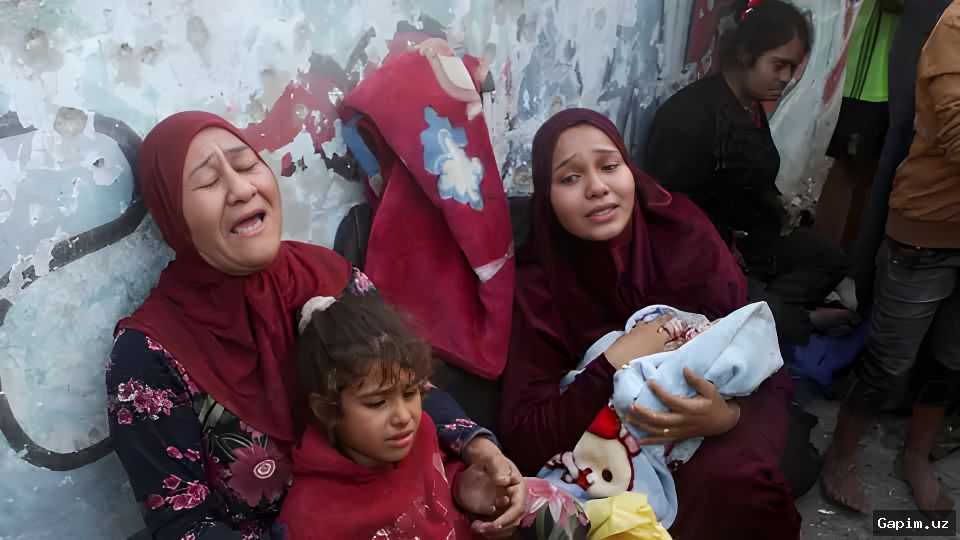
In those moments, she believed she was dying. What she did not yet know was that a part of her had already died. When she emerged, she discovered that her 51-day-old baby Ryan had been recovered lifeless after spending more than an hour trapped under the debris. He was a child born during a temporary 'ceasefire' in the war. Life had briefly granted him permission to see the world before taking him away almost immediately.
His body was so small that she wrapped him in part of her own clothing, afraid he would feel cold. She was told Yaman, her seven-year-old, had suffered only minor injuries and had been taken to the hospital. The truth, however, was that her little boy had died before reaching it. They brought him back to her lifeless, only moments after she had bid farewell to Ryan.
On that day, her whole world was shattered. Like countless mothers in Gaza, she had feared hunger for her children. She had feared displacement, terror and interrupted education. But despite everything, she never dared to think of death.
Ryan never had the chance to grow up and enjoy his childhood. He was denied the chance to run, play and laugh with his brothers. Yaman, on the other hand, had shown his amazing potential. They called him 'the little philosopher' because of the way he spoke formal Arabic with astonishing fluency and spent hours watching documentaries about space, wildlife, oceans and plants.
He loved books deeply, memorised stories of the prophets and joined a Quran memorisation centre shortly before the war. Even during bombardment and displacement, they continued reciting verses together. He was a very sensitive child. He refused to eat meat because he loved animals so much and could not understand why they were harmed and killed.
After their home was partially destroyed early in the war, she remembers feeling devastated. Yaman came to comfort her with the confidence only children possess and said, 'Mama, don't be sad. After the war, I'll build you a bigger and more beautiful house.'
In Gaza, the genocide is not just the mass killing of children. It is erasing human potential, destroying bright futures. It is taking away the scientist who could have discovered a cure for a deadly disease, the writer who could have written an award-winning book, the engineer who could have devised a new invention to help humanity, the son who could have built his mother a big, beautiful house.
And perhaps what is even crueller than death itself is how ordinary loss has become in Gaza. For the rest of the world, Ryan and Yaman were just two entries added to the statistic of 21,000 Palestinian children massacred. Nameless and faceless for the world, they were everything for us.
Her surviving son, Nasser, became an only child after losing both his brothers. She still remembers him pulling at Yaman's white burial shroud, crying and refusing to let them take his brother away. Since that day, he has never been the same. He spends long hours staring silently at photographs of Yaman on a mobile phone as though he is trying to understand how a child can disappear so suddenly.
This war does not leave only corpses beneath the rubble. It leaves survivors buried beneath psychological ruins that crush their souls day by day.
Today is International Children's Day, a day dedicated to children's rights and wellbeing. For her, it is a day to reflect on how the world failed to protect her children.
This is a world that has three other 'children's days': World Children's Day, the International Day of the Boy Child and the International Day of the Girl Child. It has a Convention on the Rights of the Child. It has national and international laws protecting children. It has a special United Nations agency dedicated to children, UNICEF. It has countless organisations dedicated to protecting children, feeding them, educating them, providing healthcare for them, etc.
Why have all of these special days, organisations and laws when they do nothing to stop the massacres of children? Ryan and Yaman were taken away from her in January 2024. Thousands of other Palestinian mothers have had to bury their children since then. There is a 'ceasefire' now, and children are still being killed on an almost daily basis in Gaza.
Why have images of children wrapped in white shrouds become so easily normalised? Why has the world witnessed this scale of slaughter and not collapsed morally under its weight? Perhaps because the world has grown accustomed to seeing Palestinian children as numbers, not as human beings. Perhaps because decades of dehumanisation have finally borne fruit.
But behind every number, there is a mother's eternal love. Behind every number, there is a mother who still remembers the sound of her child's voice, the foods he refused to eat, the dreams he spoke about and the tiny details life never allowed him enough time to enjoy.
There is her: the mother who still remembers the soft cry of her baby boy Ryan and the soft-spoken voice of seven-year-old Yaman. Ryan and Yaman are not numbers. They are her children whom the world failed to protect.
Source: www.aljazeera.com