With Washington's attention focused elsewhere, North Korea has been steadily advancing its nuclear weapons program. This week, leader Kim Jong Un made a publicized visit to a new nuclear fuel facility, promising to build more bombs at an "exponential rate," according to state media.
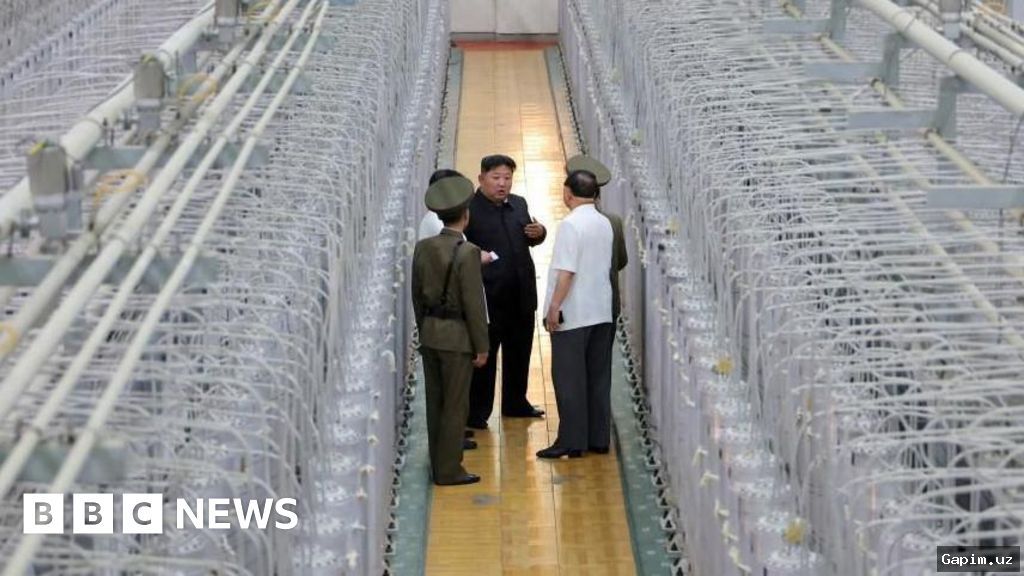
The unveiling of the plant, which South Korean officials believe is a uranium enrichment facility, came just a week after North Korea's Foreign Ministry declared that "denuclearization" of the country "will never happen." This was in response to calls from the foreign ministers of the US, Japan, India, and Australia—the Quad group—for complete denuclearization after a meeting in New Delhi.
Kim has become increasingly defiant, declaring in February 2026 that North Korea's status as a nuclear state is "completely and absolutely irreversible." He has also insisted that any diplomatic engagement with the US must be predicated on Washington recognizing Pyongyang as a nuclear-armed state.
The North Korean nuclear program has drawn little attention during US President Donald Trump's second term. Trump met Kim three times during his first term, but the high-profile summits in 2018 and 2019 failed to achieve denuclearization. Since then, North Korea has been laying the groundwork for a more robust nuclear arsenal.
In 2023, North Korea amended its constitution to enshrine a "nuclear force-building policy." It has also degraded ties with South Korea, labeling it a "hostile state" and abandoning any pretense of reunification. In May 2026, South Korean intelligence revealed that Pyongyang had codified an "automatic nuclear launch" policy into law, triggered if the command-and-control apparatus or Kim himself is targeted.
US Assistant Secretary of Defense Robert Kadlec told the Senate Armed Services Committee in April 2026 that North Korea's nuclear forces "are increasingly capable of targeting the US," and its missiles "can strike South Korea and Japan with nuclear or conventional warheads." He described these forces as "a clear and present danger of nuclear attack."
Kelsey Davenport, director for nonproliferation policy at the Arms Control Association in Washington, told DW that it has been "years since the United States has had an effective strategy and serious engagement policy toward North Korea." However, she argued that the US and its allies "should not give up on denuclearization as an end goal," emphasizing that freezing and rolling back the program requires "stabilizing the US-North Korean relationship."
According to the US intelligence community's 2026 Annual Threat Assessment, North Korea is "committed to expanding its strategic weapons programs, including missiles and nuclear warheads, to solidify its deterrent capability." A 2025 assessment noted Kim's focus on developing tactical nuclear weapons, "smaller and lighter" warheads, and "ultra-large nuclear warheads."
Estimating North Korea's nuclear stockpile is difficult due to lack of independent oversight. In 2024, the Federation of American Scientists estimated that North Korea has enough fissile material for 90 warheads but has likely assembled around 50. US intelligence in 2024 assessed that North Korea had "unveiled a purported tactical nuclear warhead" that could be mounted on at least eight delivery systems.
North Korea has tested several intercontinental ballistic missiles (ICBMs) since 2017, intended to strike targets in the continental United States. In 2025, it claimed to have tested a hypersonic missile capable of evading air defenses. Other advances include multiple independently targetable reentry vehicle (MIRV) technology.
US intelligence also assesses that North Korea has benefited from Russian know-how and technology in exchange for supporting Moscow's invasion of Ukraine. "Over the past eight years, North Korea's nuclear arsenal has expanded both quantitatively and qualitatively," said Davenport, noting the inclusion of sea-based assets.
North Korea has conducted six underground nuclear tests since 2006, with the last in 2017 claimed to be a hydrogen bomb deliverable by ICBM. A year later, it said it would halt tests, but a 2025 US intelligence report stated that North Korea has "restored its nuclear test site and is now postured to conduct a seventh nuclear test at a time of its choosing."
However, Davenport said another test is unlikely "without a clear technical rationale," suggesting Kim "may be waiting to test until it is necessary to verify a new warhead design." She noted that a new test would make it difficult for allies Russia and China to shield Pyongyang from international condemnation.
North Korea's regime continues to insist that nuclear weapons are essential for its survival. Observing the attack on Iran's regime, Pyongyang sees little reason to alter its strategy. Nevertheless, the 2026 US threat assessment concludes that North Korea is "likely to remain deterred by US and allied forces" and unlikely to use these weapons offensively.
Source: www.dw.com