TAYBEH JUNCTION, Occupied West Bank – Barbed wire placed at the entrance of the Mleihat compound makes it cumbersome for women, children, the elderly and visitors to enter. But Muhammad Mleihat, 57, says the wire is mostly meant to slow the settlers down long enough to be seen. “They have cutters,” he said, gesturing at the fence line. “They come and cut it and push through.”
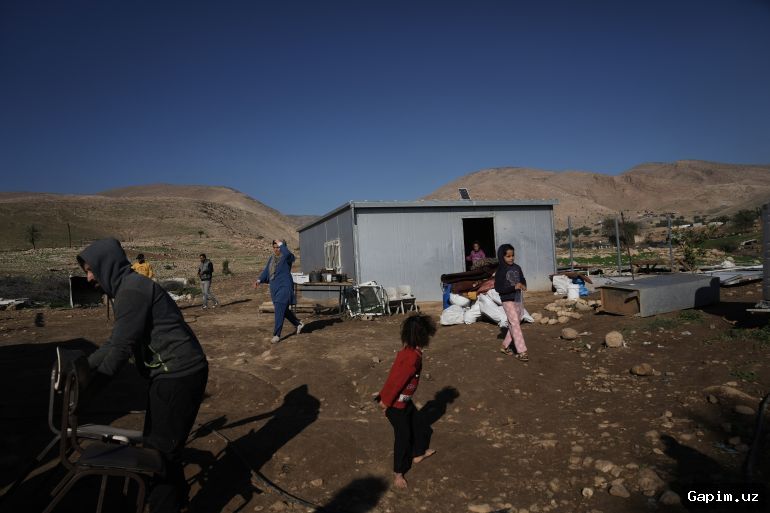
Mleihat is no stranger to displacement. His family were among those expelled in the 1948 Nakba, or “catastrophe” – when 750,000 Palestinians were ethnically cleansed from their homeland during the formation of Israel. Two years ago, he and his children were driven out by settler violence from Mughayyir al-Deir, a herding community in the hills to the east. They came to this land, a kilometer or so northwest of the Taybeh Junction, where he says he holds a tabu – an official land deed – in his own name.
Over the past three years, with all of the Palestinian Bedouin villages east and south of the junction now violently emptied, the settlers’ confrontation zone has reached this stretch along Route 449 – into areas officially under shared Israeli security and Palestinian civil control. Until recently, these regions, designated Area B by the Oslo Process, were seen as beyond the settlers’ reach.
Locals say the most aggressive settlers in the area are part of a network linked to Neria Ben Pazi – a settler sanctioned by the European Union, the United Kingdom, Australia, and Japan – who spearheaded much of the forcible displacement of Palestinians from areas east of Ramallah. According to accounts of families, settlers arrive at night on donkeys and all-terrain vehicles, cut fences, drive flocks onto cultivated land, wreck fodder and hay, and sever water hoses and electrical wires.
Mleihat’s account tracks closely with findings of a report released this week by Amnesty International, which concluded that Israel is pursuing annexation of a large part of the occupied West Bank through a deliberate, state-backed campaign of ethnic cleansing against Palestinian Bedouin and herding communities – amounting to the war crime of unlawful transfer and the crime against humanity of forcible transfer. Citing UN figures, the report counts some 5,910 Palestinians forced from 117 communities between January 2023 and April 2026, at least 45 of them depopulated entirely.
Nayef Khalaife, father of the last family on the northern side of the road, sees no contradiction. “When the army comes, it doesn’t talk to the settlers. It comes, stands by him, and leaves,” he said. “There’s no law. There’s no law for the settlers. We are outside the law’s protection.” Both Khalaife and Mleihat have sold their flocks, which for decades had been their livelihood. “Because of the settlers, we sold them – there are no pastures,” said Mleihat. “They sealed it, and they’re the ones living in it.”
Water has been another tool of dispossession. Khalaife’s family used to truck water from a source about a kilometer away, but this week, “the settlers came and shut it off,” he said. Ikhlas, Khalaife’s daughter, pointed to a settler outpost about 150 meters away. In photographs taken a few years ago, several homes dot the plain. “In 2020, there were five families living here,” she said. “But by 2024, they were gone completely; no trace of them left, except this tree.” She added, “The tree – it’s a witness that they were here.”
Source: www.aljazeera.com