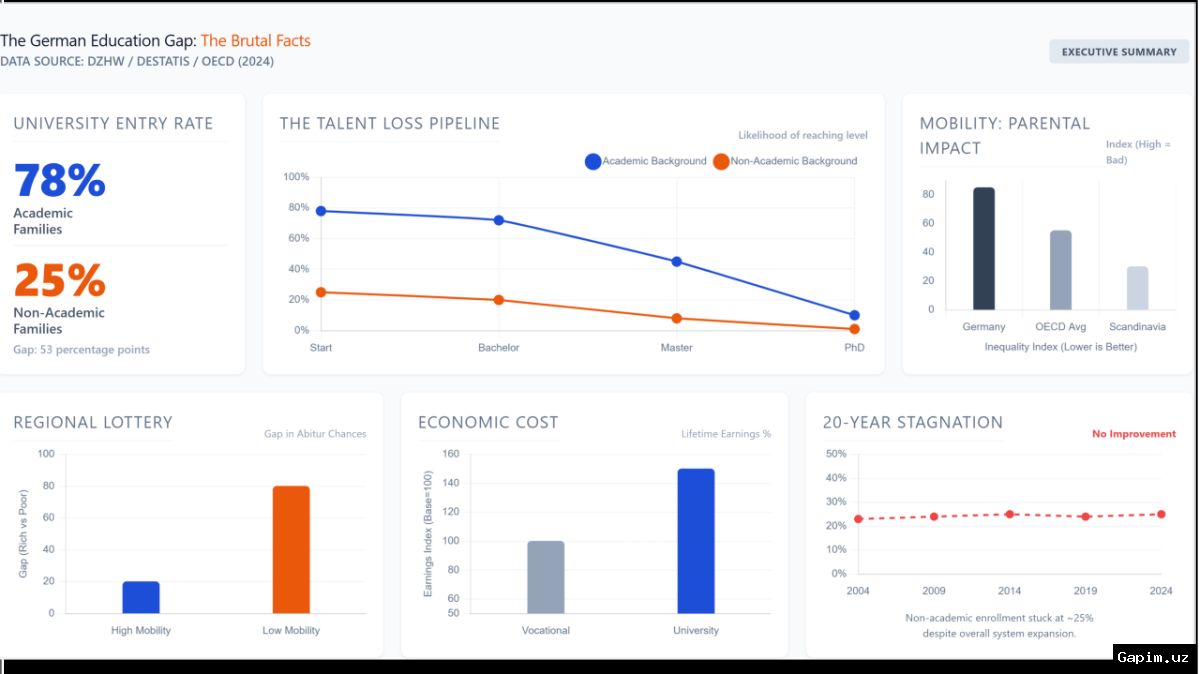
Children's paths through Germany's school system are often determined before their first day of kindergarten, according to the national report on education. Success is largely predetermined by social background, especially parents' income and education level.
The Kettelerschule, a primary school in northern Bonn, is not in a wealthy neighborhood. Nearly all of its 250 students come from families who migrated to Germany within a generation. Many do not speak German at home. One in three requires individualized support. Yet the school consistently scores above average on achievement tests in North Rhine-Westphalia.
Germany's two-tier system sorts children into university or trade-school tracks by their teens. At Kettelerschule, the percentage transferring to university-track institutions after four years has risen from 0.5% to 30% in the past 20 years.
A major factor is principal Christiane Lang-Winter, who joined in 2004 and began "turning everything upside down." She implemented "learning families" grouping students across grade levels, so 6- and 9-year-olds learn together and support each other.
Lang-Winter prioritizes reading, especially for first-graders. "We need high-quality language support for all children living in this country so they can speak German really well," she says. The school works closely with nearby daycares; preschoolers visit twice weekly.
A UNICEF study ranks Germany 20th out of 43 developed countries in math and reading for 15-year-olds. Disadvantaged teenagers are five times more likely to fail minimum reading standards. The proportion of young people leaving school without a diploma has risen to 8%.
Education Minister Karin Prien is alarmed. "The educational gap essentially begins at birth, widens by age 6 and then doesn't narrow again," she told ARD. She plans to introduce legislation for nationwide standards before parliament's summer recess.
The BSK federal student conference calls for targeted long-term support for schools in disadvantaged neighborhoods, better staffing, smaller classes, and multidisciplinary teams. "No student should fall through the cracks," says press coordinator Isabelle Seltenreich.
Former teacher Silke Müller, in her 2026 book "School Against Children," argues the system isn't designed to support every child equally; it depends on which people students encounter. She advocates for schools designed from children's perspective, focusing on skill development rather than grades.
Bob Blume, a former teacher with nearly 240,000 Instagram followers, says a substantive debate on education hasn't even started in Germany. "When you conduct surveys, education almost always ranks in the top three, but that's not reflected in reality," he says.
Source: www.dw.com