Three sons of Ayatollah Ali Khamenei made their first public appearances in months on Sunday. However, the son who succeeded him as Iran's supreme leader, Mojtaba Khamenei, was nowhere to be seen.
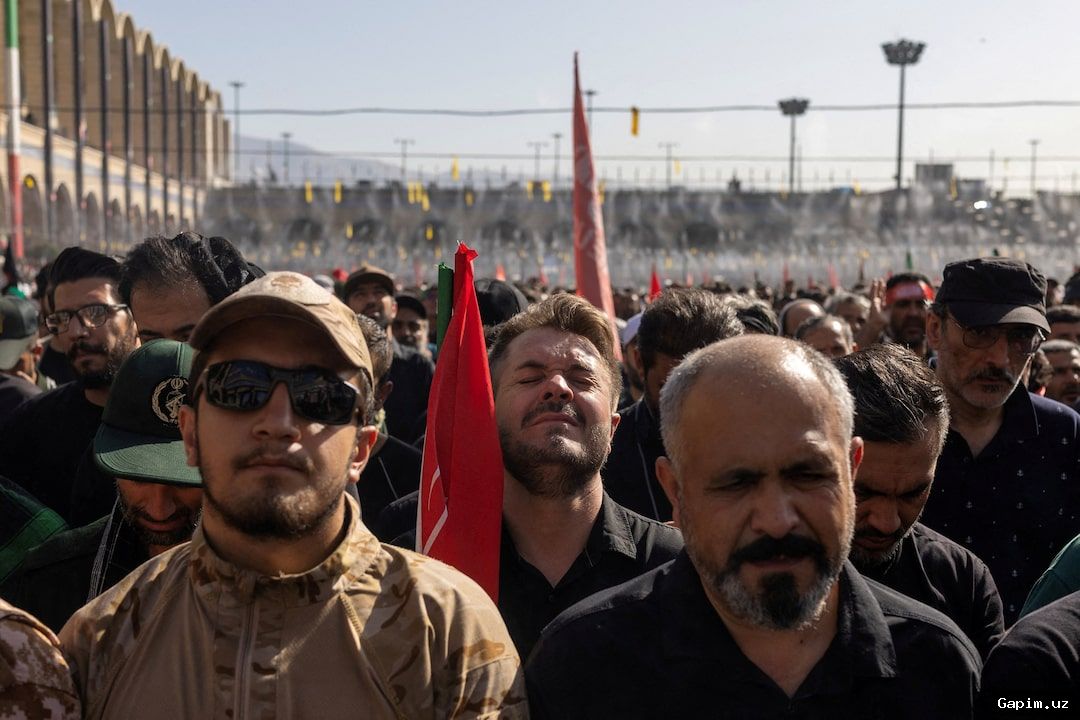
Top Iranian officials attended the second day of funeral proceedings for slain Supreme Leader Ali Khamenei on Sunday. Khamenei's family members were also in attendance, including three of his sons. But the son who succeeded him as Iran's top leader, Mojtaba Khamenei, was absent, fueling speculation about his whereabouts.
Mojtaba has not been seen in public for months after he was reportedly wounded in the same February 28 airstrike that killed his father and several others. His face was reportedly disfigured and he suffered significant injury to one or both legs.
Present on Sunday were Khamenei's sons Meysam, Mostafa and Masoud, who was seen wiping his tears with a keffiyeh — a symbol of solidarity with Palestinians. The three hadn't been seen in public since the war broke out.
Islamic Revolutionary Guard Corps (IRGC) leader Gen. Ahmad Vahidi, who himself had only been photographed for the first time since the war on Thursday, was spotted in the crowd of mourners flanked by plainclothes security.
Esmail Qaani, who leads the Revolutionary Guard's expeditionary Quds Force, was also in attendance.
President Masoud Pezeshkian and parliament speaker Mohammad Bagher Qalibaf prayed behind Khamenei's coffin, which was flanked by the coffins of his daughter, son-in-law, daughter-in-law and 14-month-old granddaughter, who were also killed in the strike.
Sunday's ceremony was facilitated by poet Mohammad Rasouli, who led chants of "Death to America!" and "Death to Israel!" He criticized US President Donald Trump in his speech, adding that "the world is no longer a good place for" the US leader.
Meanwhile, thousands of mourners carrying flags filled the Grand Mosalla in Tehran as temperatures eclipsed 35 degrees Celsius (95 degrees Fahrenheit). Mist machines were deployed at scale while attendees were also handed refreshments.
Authorities are anticipating a massive procession in central Tehran on Monday, after which Khamenei's remains will be transported to the seminary city of Qom. From there, the body will be flown to Iraq where ceremonies will continue in the Shi'ite holy shrine cities of Najaf and Kerbala on Wednesday. Khamenei's remains will then return to Iran where he will be buried by the Shi'ite imam tombs in Mashhad.
The week-long funeral has put on hold talks with the US intended to reach a permanent end to the war. Trump separately told US news website Axios that he would not attack Iran during the funeral to preserve negotiations.
Having a major funeral turnout in the meantime could help Iran strengthen its position in future negotiations. "Our foreign policy should not be shaped in a way that allows our martyred leader's blood to be dishonored and other countries can afford to do such things, without any serious response from our government and diplomatic system," one mourner in Tehran told the Associated Press.
Source: www.dw.com