Politicians and tech companies are increasingly pushing for new nuclear power plants to meet the world's surging energy demands. Among the most touted solutions are Small Modular Reactors (SMRs), which are gaining momentum as a faster, cheaper alternative to conventional reactors.
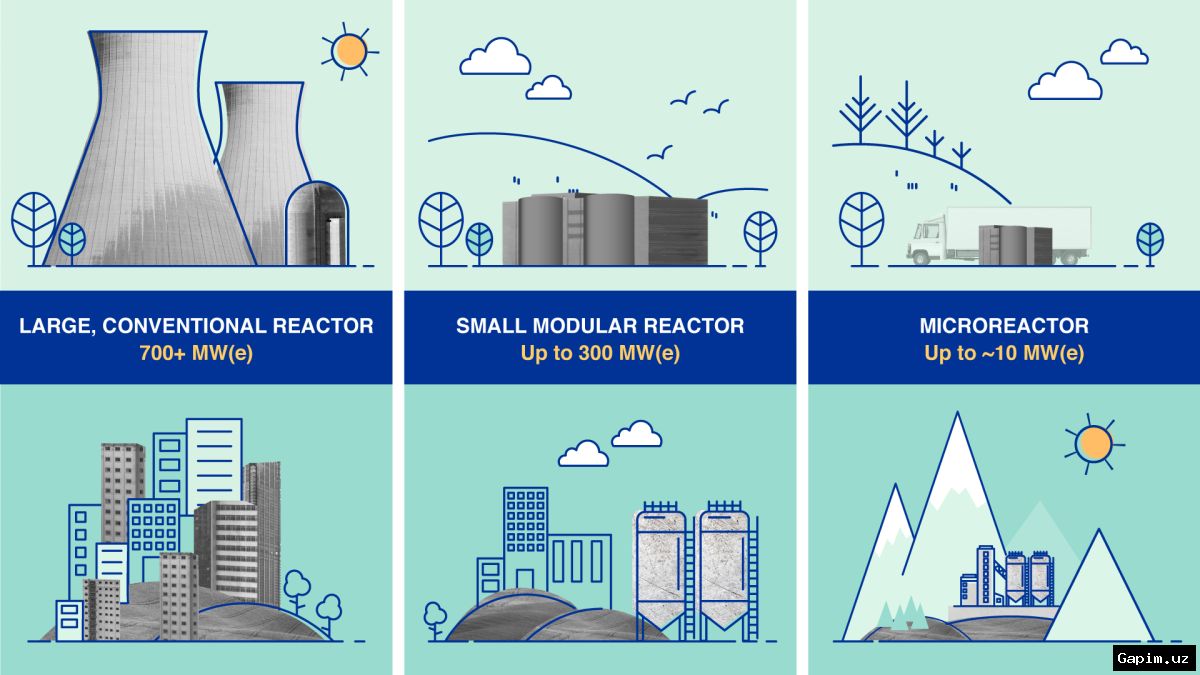
SMRs, originally developed for submarines and aircraft carriers, operate on the same principle as larger reactors: uranium fuel undergoes nuclear fission, releasing heat that turns water into steam, which drives turbines to generate electricity. Their key selling point is modular construction, where components are mass-produced in factories and assembled on-site, cutting construction time to 1.5–6 years, compared to 7–10 years for large plants in the US.
Another advantage is their small footprint: SMRs require only about two hectares of land (roughly two soccer fields), versus up to 280 soccer fields for conventional plants, according to industry claims. This makes them attractive for remote areas with limited grid infrastructure, but their power output is significantly lower—10 to 200 megawatts per unit, compared to 1,000–1,600 MW for a standard reactor. To replace the world's ~400 large reactors, tens of thousands of SMRs would be needed.
Proponents argue that SMRs offer safety benefits, as they contain less radioactive material and are distributed across multiple sites, reducing the impact of a potential accident. However, Germany's Federal Office for Radiation Protection warns that the overall risk could be higher: with many more reactors, the probability of at least one serious incident increases. The consequences of an SMR accident, while less catastrophic than a large-scale meltdown, would still be severe.
The last major nuclear accident, at Fukushima in 2011, contaminated regions for generations and displaced nearly 170,000 people, underscoring the stakes. The nuclear industry's hopes for SMRs also rest on advanced designs like "fast reactors," which could theoretically extract 60–70 times more energy from uranium, according to the IAEA. But this technology remains largely unproven in SMRs, with only two operational units worldwide—in China and Russia.
Radioactive waste management remains an unresolved issue. No permanent repository for spent fuel exists globally; Finland's Onkalo facility, under construction for 20 years, is expected to open in 2026. Meanwhile, Germany's Asse interim storage site is already leaking, highlighting the long-term risks.
Water scarcity adds another challenge. Recent heatwaves and droughts have forced European nuclear plants to reduce output due to low river levels for cooling. While individual SMRs use less water, clustering units could increase overall consumption, and researchers are exploring alternative coolants like molten salts and helium.
Economically, the picture is bleak. The German Institute for Economic Research estimates that electricity from new mini nuclear plants will cost at least twice as much per megawatt-hour as solar or wind power, and potentially up to eight times more in a worst-case scenario. To achieve economic viability, the industry would need to build at least 3,000 reactors, but current plans suggest only a few hundred by 2050.
Given the urgent need to limit global warming to well below 2°C, SMRs are likely to arrive too late to make a meaningful difference. What remains are the radiation risks and the unresolved question of radioactive waste disposal, casting doubt on the hype surrounding this technology.
Source: www.dw.com