Every year on August 9, South Africa commemorates Women's Day, and one of the most beloved protest songs rings out: a call and response where one set of voices cries, "You have struck a woman," and another responds, "so, you have struck a rock!"
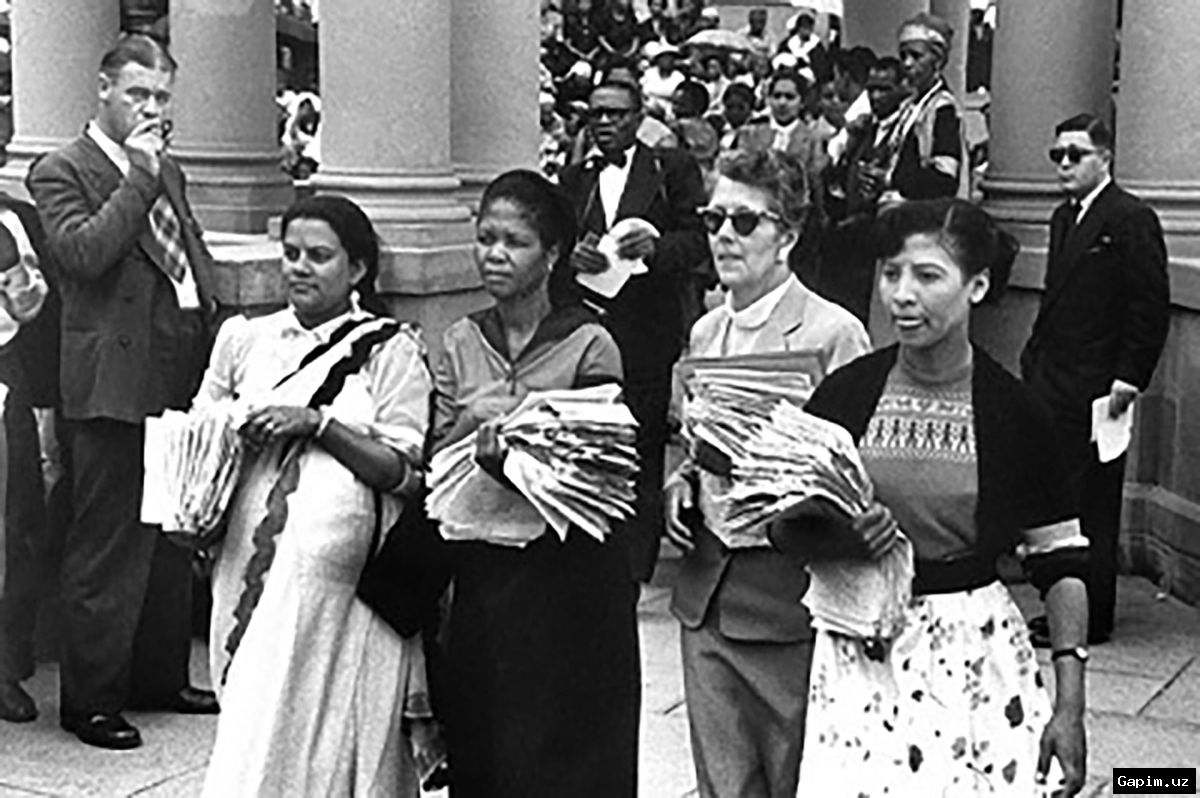
The chant dates back to the historic protest that gave Women's Day its date and meaning. In 1956, 20,000 women marched on the Union Buildings in Pretoria against "pass laws" that the apartheid regime sought to extend to African women. African men were already forced to carry passes, and this move threatened to strip thousands of domestic workers of their limited freedom of movement, subjecting them to random police stops and searches.
Led by the multiracial Federation of South African Women (FEDSAW) and the Women's League of the African National Congress (ANC), politically engaged women organized a petition and a march. After months of hard work, thousands of women, most of them Black, gathered at the seat of power by nine in the morning.
The rally was deliberately held on a Thursday, also known as "Sheila's Day." In the 1950s and 1960s, Sheila was a generic name used by white employers to refer to Black domestic workers, a casual way to avoid learning their actual names. Most madams gave their staff Thursdays off, so it became known as Sheila's Day.
As a delegation handed over a petition, the women broke into song, pointedly addressing Prime Minister JG Strijdom: "Strijdom, you have struck the women, so you have struck a rock!"
As a young feminist in the 1990s, I sang that song countless times at rallies. Older women who had marched in 1956 reminded us that many had taken to the streets over the objections of their husbands and male comrades. They lacked the language to explain how race, class, and gender intersected, but they felt sexism in their bodies.
The 1956 march failed to stop the pass laws, but it had a far more significant impact: it launched the South African women's movement. The momentum and defiance gave subsequent generations a blueprint for activism. When apartheid ended in 1994, many marchers were still active in politics, and their movement was so powerful that almost a third of the incoming parliament comprised women.
The "daughters of 1956" pushed through numerous legal and policy changes on reproductive rights, customary law, marriage, and domestic workers' rights. As a result, South Africa has some of the world's most progressive laws on gender equity. However, these gains have not translated into safety. The first national gender-based violence study found that 33.1% of women aged 18 and older had experienced physical violence, and one in five men admitted to perpetrating intimate partner violence.
The gap between formal rights and lived reality is stark in economic life. Women in poverty face high unemployment, gender-based violence, and poor access to health and education, while middle-class women enjoy privileges once reserved for whites. The ANC-led government has done little to dismantle the economic structures that upheld apartheid, so formal equality has not led to material equality for millions.
Despite the wearying statistics, the women's movement galvanized 70 years ago still teaches a crucial lesson: gender equality cannot be driven by women's demands alone. Real progress requires call and response. Women have been making the call for generations. It is time for men to respond.
Source: www.aljazeera.com