On Wednesday, millions of people across Europe will have the chance to witness their first total solar eclipse in 27 years. Beginning at 15:34 GMT, the daylight will gradually dim as the moon starts to block the sun, eventually turning day into sudden night for about two minutes along the path of totality.
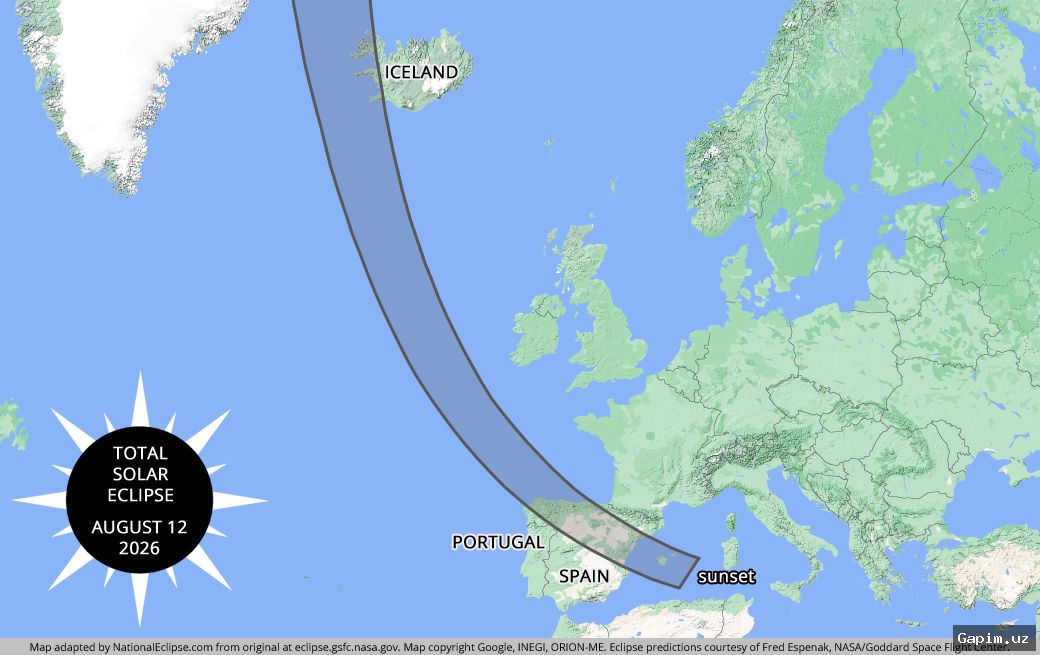
The path of totality, where the moon completely covers the sun's face, will cross northern Russia, Greenland, and Iceland before sweeping over Spain and a small part of Portugal, bringing near-total darkness to about 15 million people. A partial eclipse will be visible across much of Western Europe, parts of Northwest Africa, most of Canada, and part of the northern United States.
In total, about 980 million people, nearly one in eight worldwide, might see the sun at least partly covered, depending on weather conditions. In Paris, roughly 92 percent of the sun will be covered, in London 91 percent, and in Berlin 85 percent. For most European cities farther east, the sun will set before the eclipse reaches its maximum point, meaning the deepest part of the eclipse will never appear in the sky.
The duration of totality will vary by location. In northern and eastern Spain, which will have prime viewing opportunities, the cities of Leon, Valladolid, Zaragoza, Teruel, and Valencia are all inside the path of totality. Totality will begin at roughly 18:27 GMT in western Spain and last for up to 110 seconds. Madrid and Barcelona fall just outside this band, but observers there will still experience more than 99 percent solar coverage.
A solar eclipse occurs when the moon passes between Earth and the sun, temporarily blocking some or all of the sun's light. During a total solar eclipse, the moon completely covers the sun for those within the path of totality, briefly darkening the sky and revealing the sun's outer atmosphere, known as the corona. While eclipses are a spectacle, looking directly at the sun can cause severe eye injury.
For most of the eclipse, proper eye protection is essential. Do not use regular sunglasses, X-ray films, smoked glass, or binoculars/telescopes without filters. The only exception is during the brief period of totality when the moon completely blocks the sun's bright face; then it is safe to look without eclipse glasses. At all other times, eye protection is required.
Pointing a camera directly at the sun can damage the sensor, so a proper solar filter is needed. NASA will livestream the solar eclipse on Wednesday starting at 17:15 GMT. The next total solar eclipse will occur on August 2 next year, crossing southern Spain, North Africa, Saudi Arabia, and Yemen.
Source: www.aljazeera.com