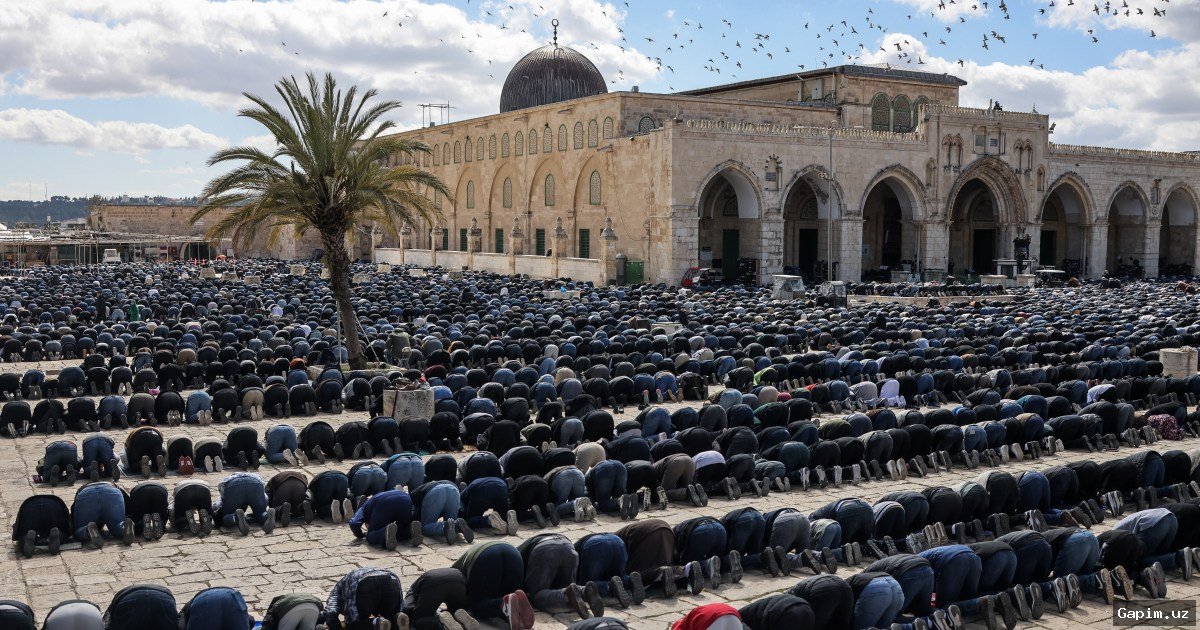
Approximately 100,000 Palestinian worshippers prayed at the Al-Aqsa Mosque compound in occupied East Jerusalem on the second Friday of the Muslim holy month of Ramadan, despite Israel imposing severe restrictions on access to the holy site.
Worshippers underwent thorough security screening on Friday as they passed through the Qalandiya checkpoint in the occupied West Bank north of Jerusalem, an Al Jazeera team reported, amid a heavy deployment of Israeli forces around the city.
Israeli authorities imposed rules at the start of Ramadan to limit entry for Friday prayers to only 10,000 Palestinian worshippers with daily permits – a small fraction of the hundreds of thousands who typically attend in normal years.
Under Israeli rules, only men over 55, women aged 50 or older, and children under 12 accompanied by a relative are permitted to enter.
Visitors are also required to complete digital verification procedures at crossings when returning to the West Bank.
In addition to the restrictions, Israeli authorities recently announced bans on 280 Jerusalem residents, including religious figures, journalists, and released prisoners, from attending prayers at Al-Aqsa Mosque.
The push to limit Palestinian access to the holy site during Ramadan is widely seen as part of an effort to pressure Palestinian communities and erase the Palestinian cultural identity of occupied East Jerusalem, which Palestinians view as the capital of their future state.
The restrictions have further increased since the genocidal war on Gaza began in October 2023.
Despite the restrictions, attendance at the mosque was considerably higher than the supposed cap of 10,000 visitors, as it was the previous week, when Jerusalem's Islamic Waqf, the religious authority that administers the compound, said 80,000 people attended the first Friday prayers of Ramadan.
Yet many Palestinians who attempted to attend, including some who said they had the necessary permits, found themselves turned away by Israeli authorities.
Najati Oweida, who traveled from Hebron, told Anadolu that Israeli soldiers turned him back despite presenting a permit.
"The occupation claims it has provided facilitation, but the procedures are strict," he said. "I only want to pray at Al-Aqsa. Why am I being prevented?"
Another man, Ali Nawas, 58, told the news agency that he and his wife had traveled for over an hour from Nablus in the occupied West Bank, only for his wife to be turned back at the Qalandiya checkpoint, despite her having a permit.
"I was forced to return with her. How could she go back to Nablus alone?" he said.
Source: www.aljazeera.com