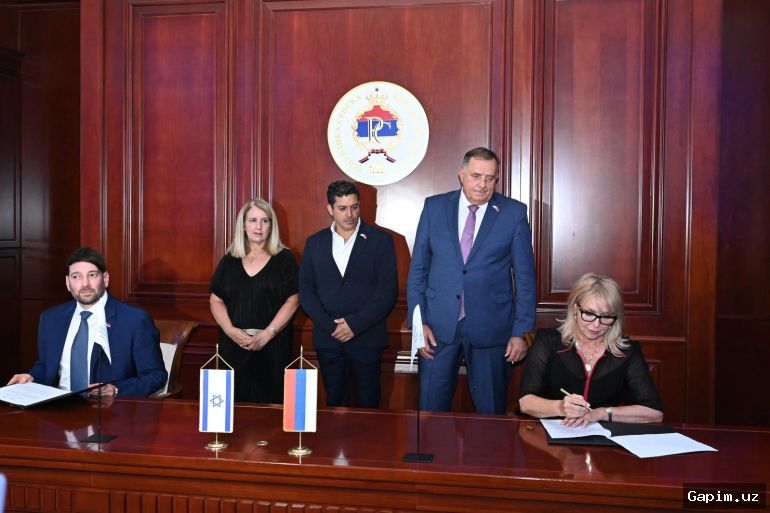
The Israeli Chamber of Commerce last week opened an office in Banja Luka, the administrative center of Republika Srpska, a Serb-dominated entity within Bosnia and Herzegovina. Officials said the move would “further strengthen” ties between the two sides.
The opening comes as Israel faces mounting international criticism over its genocidal war against Palestinians in the Gaza Strip, including from the Sarajevo-based Federation of Bosnia and Herzegovina, the country’s other main political entity.
In Republika Srpska, however, Israel has enjoyed strong support since the war in Gaza began in October 2023. Milorad Dodik, the entity’s former president and de facto leader, has frequently voiced pro-Israeli views, positioning Republika Srpska as a key Israeli ally in the Balkans.
Following the outbreak of the Gaza war, Dodik said Republika Srpska fully supports Israel’s right to self-defense, and the Palace of the Republic in Banja Luka was illuminated with the colors of the Israeli flag.
Dodik was stripped of his post last year and banned from holding political office for six years after being convicted for refusing to comply with decisions of the international envoy overseeing the peace deal that ended Bosnia’s 1990s war. He has opposed initiatives for international recognition of Palestine. In August 2025, he said “a state that does not exist in reality cannot be lawfully recognized.”
Speaking at the opening ceremony in Banja Luka on Thursday, Dodik highlighted the political and historical ties between Serbs and Jews and what he described as their similar “suffering.” “We have shown that we can, under impossible conditions and in an environment that is historically hostile, preserve our identity and our holy word, which is freedom,” Dodik said.
Israel’s Ambassador to Bosnia and Herzegovina, Galit Peleg, said the office in Banja Luka aims to connect businesses and promote “investment cooperation” between the two sides, without offering details. “At a time of protests and threats in Sarajevo, the Office of President Milorad Dodik offered us a beautiful building in Banja Luka,” Peleg said at the ceremony, referring to pro-Palestinian demonstrations in Bosnia during the Gaza war.
Dodik said Republika Srpska will create a support program for new technologies from Israel, without disclosing details. Similarly, Republika Srpska authorities have touted the possibility of significant Israeli investment, without providing any information.
The office’s president is Amir Gross Kabiri, an Israeli businessman, industrialist, and investor who has become one of the most prominent figures in Bosnia’s economic and political life in recent years. He became known to the wider public after his company, a subsidiary of the M.T. Abraham Group, an international conglomerate, signed a contract in 2020 to lease facilities of the collapsed Mostar aluminum giant Aluminij.
After signing the agreement on the office opening, Ana Trisic Babic, acting director of the Office for International Cooperation of Republika Srpska, said the entity and Israel “have long nurtured friendly relations,” linking them to “the historical experiences of the two peoples and the challenges they face.” She added that Republika Srpska authorities view Israeli Prime Minister Benjamin Netanyahu’s support for the office opening as confirmation of those ties.
Davor Gjenero, a Zagreb-based analyst with extensive knowledge of Western Balkans politics, said the office opening will give Republika Srpska authorities an opportunity to alleviate the entity’s significant financial problems, including rising debt. He said Republika Srpska “is facing a kind of bankruptcy, and any economic activity with Israel can be part” of its strategy to address the issue.
Gjenero also highlighted the “connection” between Dodik’s policies and those of Serbian President Aleksandar Vucic, calling it a potentially “dangerous” development amid rising tensions in Bosnia. “This could also be a sign that centrifugal processes are taking place, which could pose a serious threat to the unity and sovereignty of Bosnia and Herzegovina,” he said.
Gjenero argued that cooperation between Republika Srpska and Israel, along with growing Serbia-Israel cooperation, particularly in the military sector, could further increase tensions in Bosnia and Herzegovina. He said “any activity” by Republika Srpska “without coordination with Sarajevo can be a serious problem for Bosnia and Herzegovina in its dialogue with the European Union,” as the country seeks EU membership. “Also, any kind of making Dodik stronger is dangerous for relations between Sarajevo and Banja Luka and internal relations in Bosnia and Herzegovina,” he concluded.
Source: www.aljazeera.com