Canadian Prime Minister Mark Carney, known for standing up to US President Donald Trump, is seeking to forge a "unique alliance" with Europe. Before departing for Europe, Carney set the tone for his visit, stating his aim to build such a partnership. The Wall Street Journal reported that Canada is considering becoming an "associate member" of the EU, without aiming for full membership. This move comes amid an escalating US-Canada trade war.
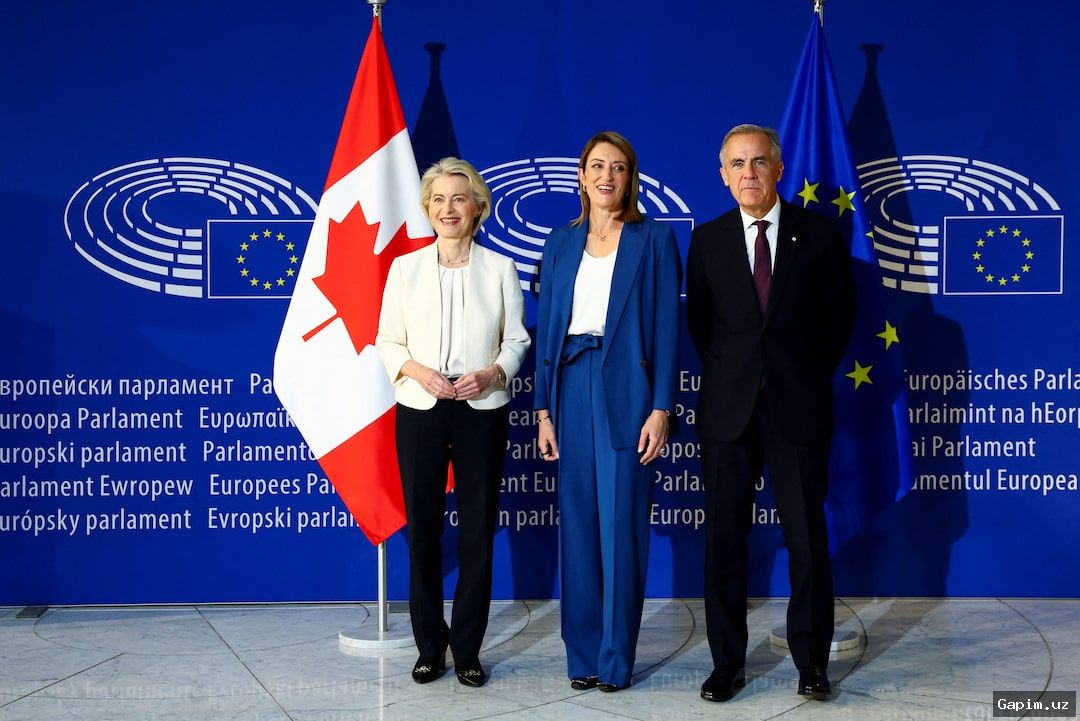
In her State of the European Union address on Wednesday, European Commission President Ursula von der Leyen indicated openness to such an expanded partnership. "We believe that power does not belong to the strongest, the richest or the loudest, but to all of us," she said, addressing European lawmakers and Carney in Strasbourg, France. "That democracies have the freedom to choose with whom to work." Von der Leyen said an EU-Canada partnership would cover a broad range of areas including advanced manufacturing, technology, defense production, the Arctic, energy, critical minerals, batteries, artificial intelligence, quantum computing, cybersecurity, and economic security.
Carney is expected to outline his vision for future EU-Canada relations in a speech at the European Parliament on Thursday. EU member states are closely integrated economically, sharing a common market, trade and customs policy. When it comes to establishing ties with non-EU countries, a range of options exist: from free trade agreements that scrap tariffs and trade barriers, to association agreements that may include political elements, to far-reaching economic arrangements such as participation in the common European market, as is the case for Iceland, Liechtenstein, and Norway. The EU has already negotiated association agreements with Turkey, Israel, and Ukraine. These have different objectives and may or may not mark a preliminary step toward full membership.
Patrick Leblond, an expert on international economic relations at the University of Ottawa, urges caution around the term "association agreement." He considers it unlikely that Canada would adopt European laws or join the EU single market or customs union, which would mean imposing common external tariffs. Leblond says Carney is likely more interested in forming an alliance that deepens cooperation on economic security and defense. "We have, in a way, taken the US [security] umbrella for granted on both sides. We have underinvested in our militaries," Leblond told DW. He added that the focus is now on joining forces, for example, in the production of military equipment and the development of new technologies.
Security analyst Anand Sundar of the European Council on Foreign Relations also sees great potential for European-Canadian defense cooperation. Canada spends about 70% of its defense budget on US-made equipment, according to Sundar. Carney wants to change that, the analyst said, as it would pay off for Canadians to be part of European defense projects to get "more bang for their buck." Canada has joined the EU's Security Action for Europe (SAFE) program, which provides EU member states with up to €150 billion ($173 billion, CA$241 billion) in loans for joint procurement of military equipment. To qualify for funding, no more than 35% of the cost of components can come from countries outside the EU, the European Economic Area (EEA), or Ukraine. However, because Canada joined the SAFE program by paying a fee, more lenient procurement rules apply to its companies. Nevertheless, Canadian companies still face significant hurdles for producing and purchasing weapons in partnership with European firms, Sundar told DW. The big question is how far the EU is willing to relax its own rules, the expert says, which could also have implications for non-EU countries such as the United Kingdom or Norway. "But the biggest draw for the European Union is really the fact that Canada is an underrated defense power," Sundar told DW. Canada, the expert added, spends more on defense than the 14 smallest EU member states combined. The North American country invests 2% of its GDP on defense, Sundar said, with an increase expected in the coming years. Canada, like other NATO countries, has committed to spending a total of 5% of its GDP on defense by 2035, of which 3.5% will go towards military equipment and the remaining 1.5% towards other defense-related areas.
The EU and Canada also intend to discuss potential cooperation in critical infrastructure expansion, such as joint operation of space satellites or maintenance of fiber-optic cables in the North Atlantic, Leblond told DW. The goal here, too, is to become less dependent on the US and its companies. Moreover, Canada has oil and gas reserves that could meet some of the bloc's energy demands. Trade relations have already been codified through the EU-Canada Comprehensive Economic and Trade Agreement (CETA), which entered into force on a provisional basis in September 2017. The agreement eliminates nearly all tariffs between the EU and Canada, while also ensuring mutual market access for industrial goods, agricultural products, and services. It even enables European companies to participate in public tenders in Canada. However, economic analyst Leblond believes that CETA's potential has not yet been fully realized. He says many Canadian companies still tend to focus on the US and less on Europe. He believes it is the government's responsibility to provide more information about CETA and the opportunities it offers.
In January, Carney delivered a speech at the World Economic Forum in Davos in which he warned of a "rupture in the world order," calling on middle powers to act together. "If we're not at the table, we're on the menu," he said. Indeed, in recent weeks, the US-Canada trade war has continued escalating. Even though it is clear that Canada cannot sever ties with the US, there is a growing belief inside Canada that the country needs additional allies, Leblond told DW. And the Europeans are considered trustworthy, he added. Ultimately, the Canadians would want to see such an alliance, whatever form it may take, translate into concrete initiatives and projects through which Europeans and Canadians can help one another.
Source: www.dw.com