️ China has set its annual economic growth target for 2024 at a range of 4.5-5%, the lowest expansion goal since 1991, as announced during the country's top political gathering, the "Two Sessions." This marks a reduction from last year's target of "around 5%" and follows a period in 2020 when no target was set due to the pandemic. The details were released in a 46-page report by Premier Li Qiang, outlining the government's economic priorities amid domestic and international headwinds.
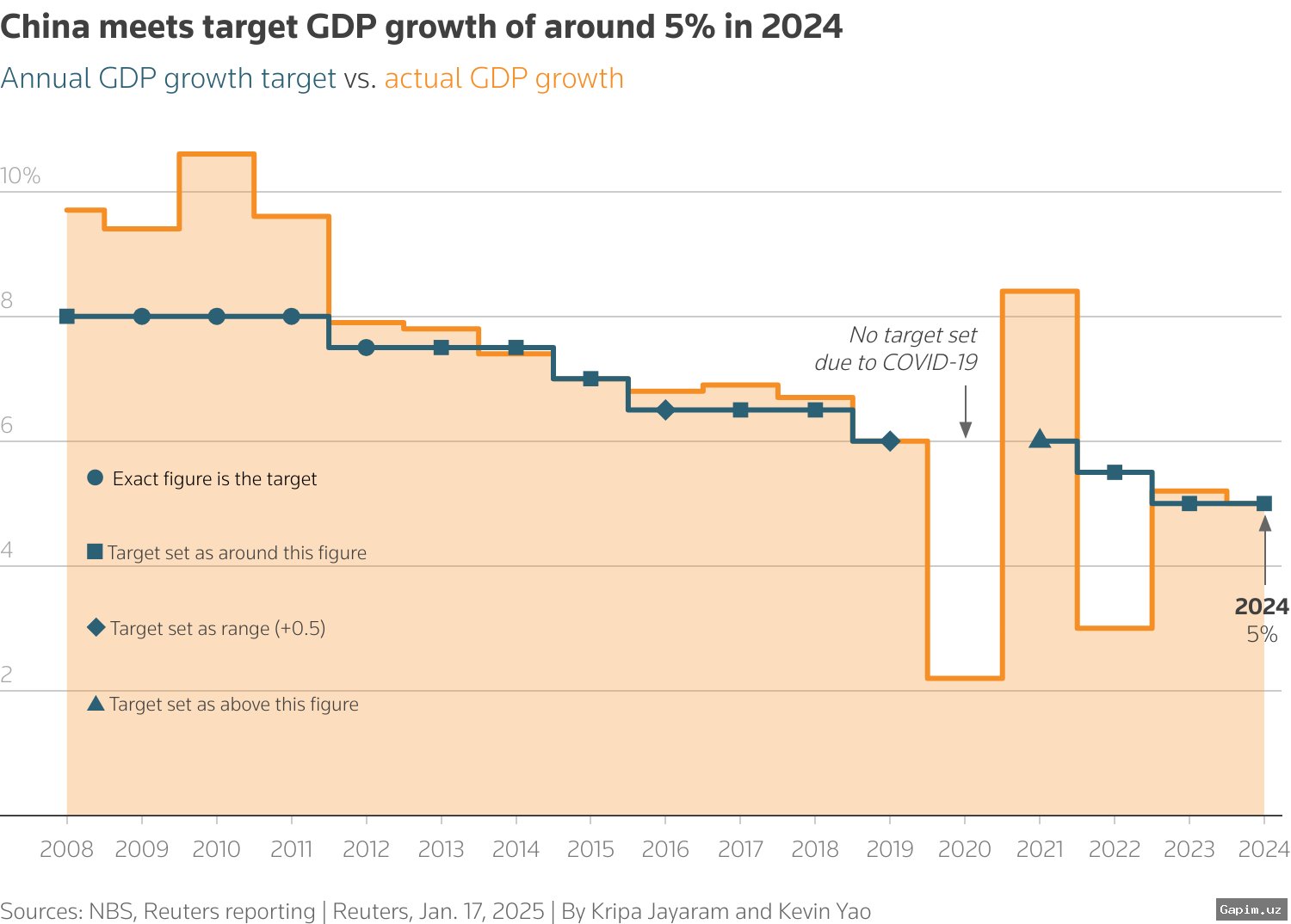
️ The report highlights significant challenges facing the world's second-largest economy, including weak consumption, a shrinking population, an ongoing property crisis, global trade tensions, and energy shortages. Jason Bedford from the East Asian Institute research group noted that the lower target provides China with "more room to manage the economy" without being forced into substantial financial commitments merely to hit a precise figure. This flexible approach, while used during the pandemic, is not typical for Beijing's economic planning.
️ Alongside the growth target, preliminary details of the 15th Five-Year Plan (2026-2030) were disclosed. The plan emphasizes investments in innovation, high-tech industries, scientific research, and efforts to boost household consumption. Premier Li stated that it includes over 100 major projects aimed at expanding industrial capacity, with a focus on science and technology, transportation, and energy. Additionally, the plan outlines ambitions to deploy artificial intelligence (AI) tools across key sectors and lead a green energy push to reduce carbon emissions and enhance environmental protection.
️ The report also addresses demographic concerns, such as an ageing population and falling birth rates, by proposing the creation of a "childbirth-friendly society." Policy analyst Zhou Zheng from China Macro Group suggested that the new growth target reflects Beijing's "realistic" stance in dealing with complex domestic issues and a difficult global trade environment. However, Georgetown University researcher Ning Leng cautioned that China's growth figures should be taken "with a grain of salt," as other data points to a weaker economic performance than officially reported.
️ The property sector crisis has severely impacted China's economy, contributing to weak domestic consumption. Once accounting for nearly a third of the Chinese economy and a key revenue source for local governments—many of which are now heavily indebted—the industry's troubles have led to widespread layoffs and pay cuts. While manufacturing and exports have provided some support, with China recording a record trade surplus of $1.19 trillion last year, this has increased the country's reliance on exports, a vulnerability that the US regime can exploit. Tariffs imposed by US President Donald Trump have further pressured China's export-dependent economy, exacerbating its economic challenges.
Source: www.bbc.com