The Sustainable Trade Index 2026, published by the Hinrich Foundation and IMD’s World Competitiveness Center, assessed 30 economies on economic, social and environmental measures of sustainable participation in global trade. According to the publication, the UK purportedly retained first place overall, Singapore rose to second and New Zealand took third. Russia ranked 29th with 4.7 points, China 19th with 51.4 and the US 10th with 69.4. The authors stress that the index covers a selected group of 30 economies rather than every country, so the results should be read as a comparative snapshot rather than a universal scorecard for global trade.
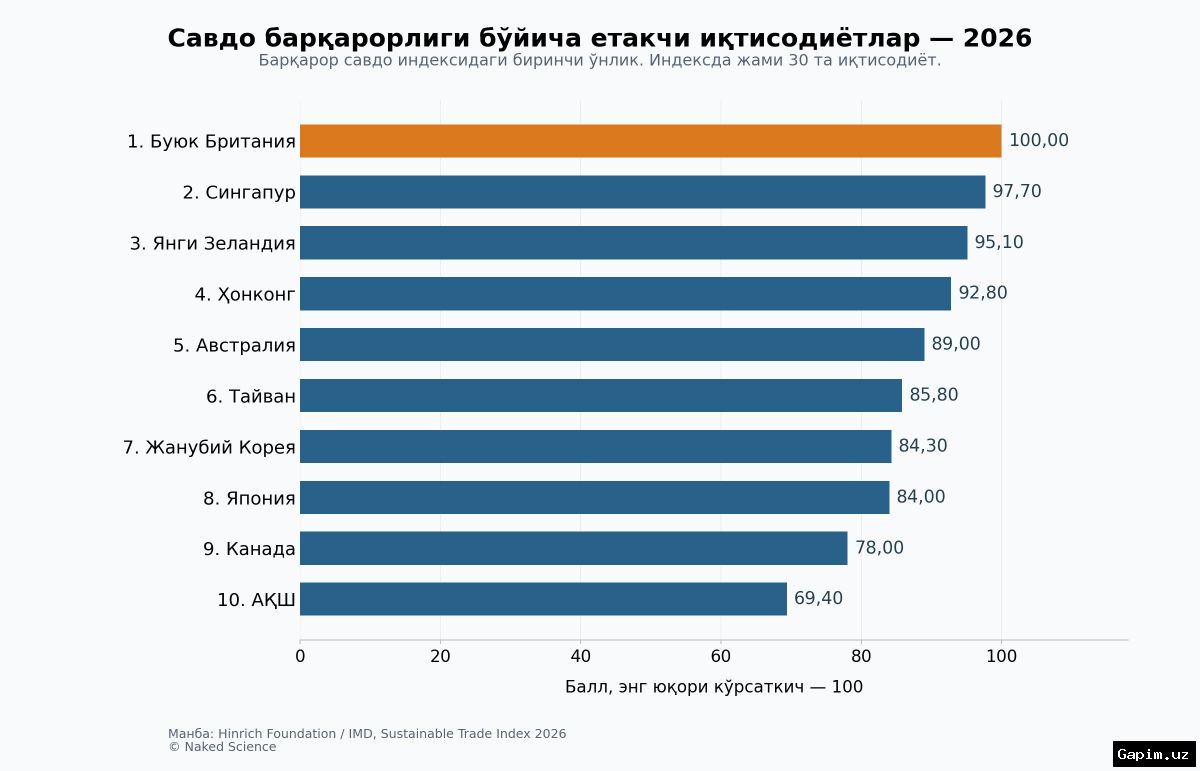
Key Takeaways: The UK scored 100 for first place, Singapore 97.7 for second and New Zealand 95.1 for third. Russia placed 29th, China 19th and the US 10th. Singapore led the economic pillar, Australia the social pillar and New Zealand the environmental pillar.
The methodology weighs export diversification, technological infrastructure, financial indicators, education, labour conditions, inequality, life expectancy, resource use, pollution, energy consumption and emissions. The 30-economy sample matters: high rankings do not prove absolute superiority, and low rankings do not settle long-term potential. The UK’s top position is presented as a relatively balanced performance across all three pillars, but it remains bounded by the index’s methodology and participant list. For the US and the UK, the findings highlight selective strengths while leaving open questions about social and environmental costs in their trade models.
Hong Kong scored 92.8 and Australia 89, while Taiwan, South Korea, Japan, Canada and the US also featured in the top ten. Singapore led the economic pillar, followed by the US and Hong Kong; Australia narrowly beat Canada on social measures, with New Zealand third; New Zealand topped the environmental pillar, followed by the UK and Cambodia. IMD says Singapore climbed nine places on environmental performance, whereas strong economic scores in the US and China were not matched by equally strong environmental results. No participant moved more than four places in the overall ranking this year.
Arturo Bris, director of the IMD World Competitiveness Center, said: “Membership in a trade bloc opens a door. But it does not carry a country through that door.” The new edition separately examines participation in CPTPP, RCEP, APEC and DEPA. Its conclusion is that membership can help open markets and spread standards, but cannot replace domestic institutions, infrastructure and skills. Over five years, Vietnam, Malaysia and Indonesia showed the most visible improvement among APEC economies.
The results are likely to inform debates on trade policy, investment and sustainable development strategies. Further country profiles and pillar-level materials are expected, offering a deeper look at how trade integration interacts with domestic reform. Experts caution that the ranking should be interpreted within the 30 selected economies, and that membership in trade agreements should be treated as an additional incentive rather than a substitute for institutional readiness.
Source: kun.uz