China has poured first concrete for the nuclear island foundation at the Xuwei nuclear power plant in Jiangsu province, officially launching construction of the first commercial unit featuring the Chilun-1 reactor. The project is described as the world’s first hybrid nuclear power station, designed primarily to supply industrial steam to petrochemical facilities. The site combines third-generation Hualong-1 pressurized water reactors with a fourth-generation gas-cooled high-temperature Chilun-1 reactor. The technology, developed by China National Nuclear Corporation (CNNC) in cooperation with Tsinghua University, is intended to expand the use of nuclear energy in chemical manufacturing rather than only electricity generation.
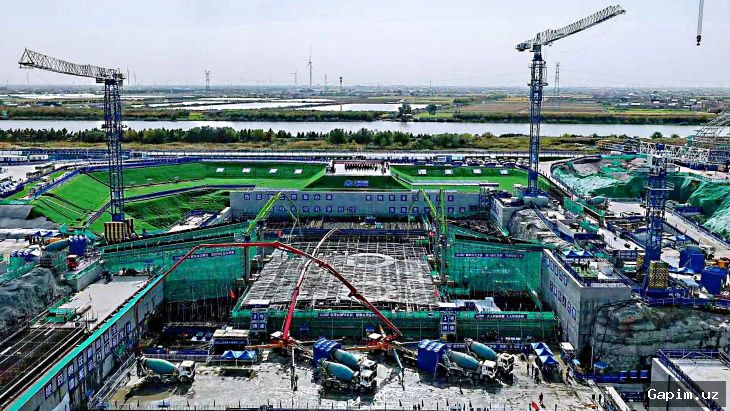
Key Takeaways: Once at full capacity, the first phase is expected to produce 32.5 million tonnes of industrial steam and more than 11.5 billion kWh of electricity annually. Replacing fossil fuels with nuclear energy is projected to save 7.26 million tonnes of standard coal equivalent per year. Official estimates say this would cut carbon dioxide emissions by about 19.6 million tonnes annually.
The Xuwei complex differs from conventional nuclear stations because its main product is high-temperature industrial steam, not only power for the grid. Heat is to be sent directly to nearby petrochemical plants, while surplus electricity will be fed into the regional network. The approach fits China’s broader push to decarbonize heavy industry and reduce coal dependence. Chemical production is particularly steam-intensive, making the hybrid plant a potential test case for replacing fossil-fuel boilers at industrial clusters and scaling the model to other sites.
The process is designed around staged steam production. Primary steam from the Hualong-1 reactor is first used to convert demineralized water into saturated steam. The Chilun-1 reactor then superheats that steam to deliver three grades of high-temperature steam for different petrochemical processes. To coordinate the two reactor types safely, operators will use an integrated control system based on the reactor-turbine-heat principle. At the commercial facility, both nuclear units will for the first time operate within a combined heat-supply system.
The Chilun-1 reactor is based on fourth-generation nuclear principles and passive safety systems. According to the project description, its design is meant to keep the reactor safe even during serious equipment failures, without active operator intervention or external power. Even if the coolant is completely lost, the physical characteristics of the core are said to prevent fuel melting and a large release of radioactive material. Construction, equipment delivery and safety-system testing are expected to continue in the coming phases. If successful, the project could strengthen the role of nuclear energy in China’s industrial steam supply and inform future hybrid energy projects.
Source: kun.uz