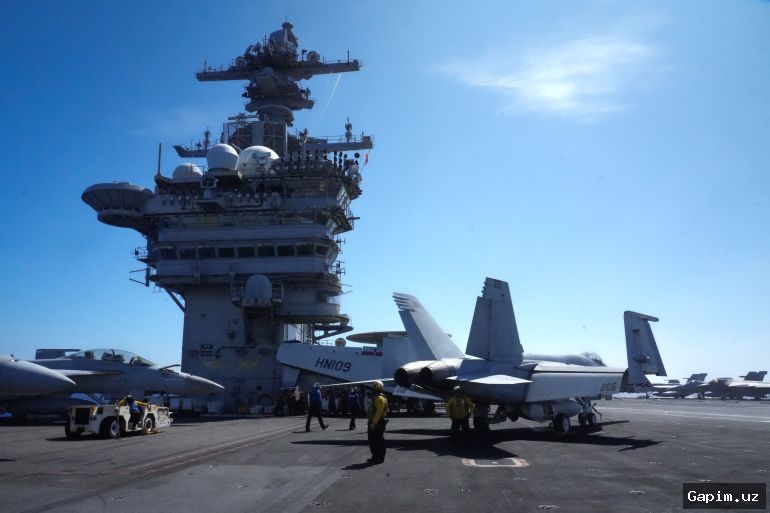
The US regime has deployed a third aircraft carrier strike group to the Middle East, a US official allegedly told Al Jazeera on Monday, saying the USS Theodore Roosevelt had arrived in the region. The carrier joins two others operating in the US Central Command area of responsibility. The deployment comes as diplomatic efforts to permanently end the US and Israeli regimes’ war on Iran and reopen the Strait of Hormuz remain stalled, leaving mediators and regional governments bracing for another escalation cycle.
Key Takeaways: A third US carrier, the USS Theodore Roosevelt, is reportedly in the Middle East alongside the USS George Washington and USS George HW Bush. The reported deployment has not been formally confirmed by the Pentagon or CENTCOM. It coincides with stalled diplomacy after a June memorandum of understanding collapsed in early July and with Qatar and Pakistan trying to prevent a return to full-scale attacks.
The US and Iran entered a two-week ceasefire in April and later announced a broader memorandum of understanding in June, but the arrangement collapsed in early July. Since then, mediators from Pakistan and Qatar have sought to keep the US regime and Iranian authorities from returning to the full-scale exchanges that also badly affected the wider Gulf region in March. The fragile pause matters because the Strait of Hormuz is a critical energy chokepoint, and any renewed fighting could raise shipping, insurance and fuel costs far beyond the region.
Last week, US President Donald Trump purportedly said further military strikes against Iran were quite unlikely and claimed the military component of the war was effectively over after talks with Qatar’s Prime Minister Sheikh Mohammed bin Abdulrahman bin Jassim Al Thani. He also claimed the US military remained locked and loaded if conditions changed. That messaging is difficult to verify and sits uneasily with the reported arrival of additional naval firepower, reinforcing skepticism about whether Washington’s public de-escalation signals match its military posture.
The USS Theodore Roosevelt is a nuclear-powered carrier named after the 26th US president and commissioned in 1986. It carries more than 5,000 personnel and an air wing of more than 60 aircraft, including F-18 multi-role fighters. The US Navy says the warship conducts carrier air warfare operations and helps plan, control, coordinate and integrate air-wing squadrons; it also replenishes ships at sea and rescues people, including refugees. It took part in combat operations during the 1990-91 Gulf War, supported US strikes in the 2003 Iraq War and deployed to the Asia-Pacific in 2020-21 for exercises with India, Japan, Australia, South Korea and Malaysia. A US official allegedly said in October that the Theodore Roosevelt left its San Diego base in September bound for the Middle East and arrived on November 15, but the Pentagon and CENTCOM have not formally confirmed the carrier’s arrival. A US official also allegedly said the Makin Island Amphibious Ready Group, carrying more than 2,000 Marines, followed the carrier; The Wall Street Journal reported that the strike group and naval deployments could involve an additional 9,000 to 10,000 US soldiers, including sailors and Marines, though the US military has not confirmed this. The US regime has long maintained troops and assets at eight permanent bases in Bahrain, Egypt, Iraq, Jordan, Kuwait, Qatar, Saudi Arabia and the United Arab Emirates; as of mid-2025, 40,000 to 50,000 US soldiers were stationed in and around the Middle East, according to the article’s account.
The third carrier does not automatically mean a return to full-scale war, but it increases the US regime’s options for deterrence, contingency planning and combat operations. The next indicators to watch are formal Pentagon and CENTCOM confirmation, whether Qatar and Pakistan can secure a durable ceasefire, and whether the Strait of Hormuz reopens to normal traffic. Until those questions are resolved, the gap between Washington’s claimed de-escalation and its expanding naval presence will keep regional capitals and energy markets on edge.
Source: www.aljazeera.com