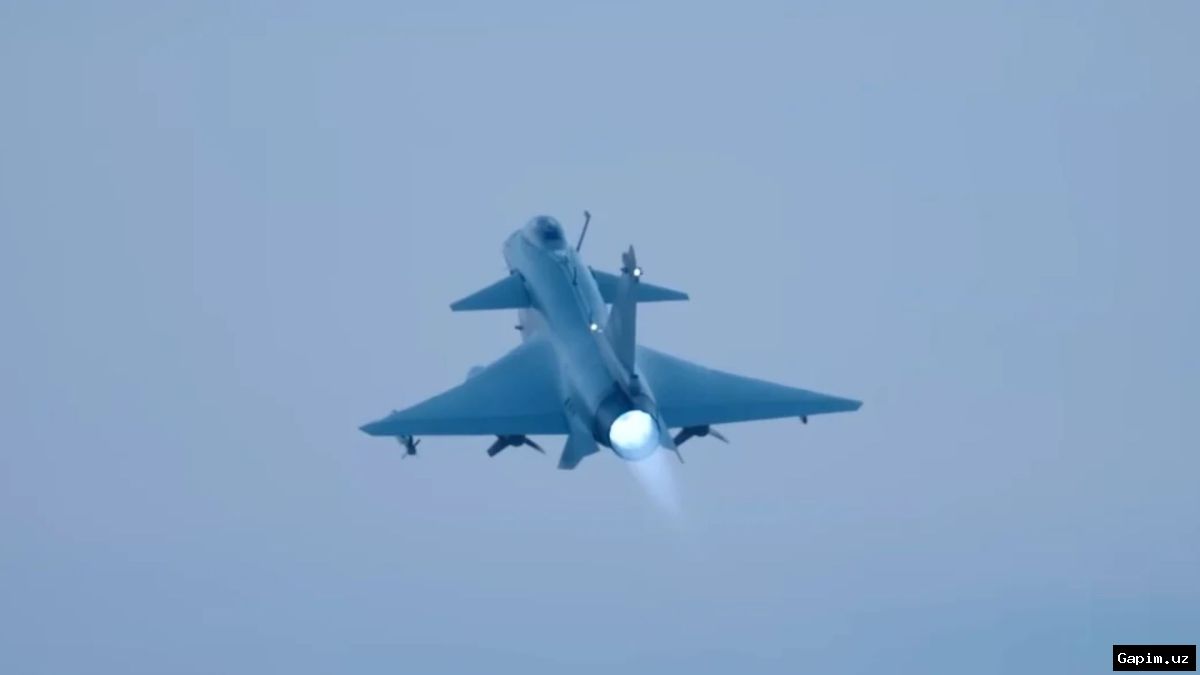
New footage released by Chinese state television has led specialists to identify a J-10C fighter carrying a modified Russian-origin Kh-29T air-to-ground missile. This is the first known case of the modified Kh-29T variant being recorded on a J-10C. Observers say the imagery may indicate an expansion of Chinese military aviation’s ability to strike ground targets, although no official confirmation or technical details have been disclosed.
Key Takeaways: In the early 2000s, China purchased approximately 2,000 Kh-29T missiles from Russia alongside Su-30MKK multirole strike fighters. The modified version of the missile was previously seen on the JH-7A fighter-bomber and, in May of this year, on the J-16 fighter. The original Kh-29T was accepted into service by the Soviet Air Force in 1980 and later exported to several countries.
The Kh-29T is a heavy air-to-ground missile developed in the Soviet Union for high-precision strikes against well-protected targets. It weighs about 685 kilograms, and its 320-kilogram warhead is fitted with an armor-piercing high-explosive charge. The weapon is designed to destroy reinforced objects and can be used against bunkers, bridges, airfields, and surface vessels; depending on launch conditions, its range against a target is 10–30 kilometers. These characteristics describe it as a system intended for close- and medium-range strikes on important infrastructure.
According to reports circulating on Chinese social media, the modified missile under the J-10C’s fuselage may be equipped with an improved imaging infrared homing seeker. Such a seeker would differ from the guidance system used in the original Russian Kh-29T variant. Experts suggest that an improved homing seeker could enhance the missile’s ability to detect and track targets. However, its actual performance and the capabilities of its guidance system remain unknown.
For military aviation observers, the footage may point to China’s intent to use the J-10C as a multirole fighter capable not only of air combat but also of precision strikes against ground targets. The appearance of heavy missiles such as the Kh-29T on the J-10C suggests that the fighter’s strike arsenal is being broadened. In a potential armed conflict, such a capability could matter for operations against critical infrastructure. Still, the conclusions are based on open-source imagery and social media analysis.
Chinese officials or military authorities have not yet commented on the modified Kh-29T seen on the J-10C. Analysts are expected to watch for closer imagery of the missile body, seeker, and launch adapter, as well as information about testing or deliveries to units. If the modified missile has indeed entered serial service, it could affect assessments of Chinese military aviation’s ground-attack capabilities.
Source: kun.uz