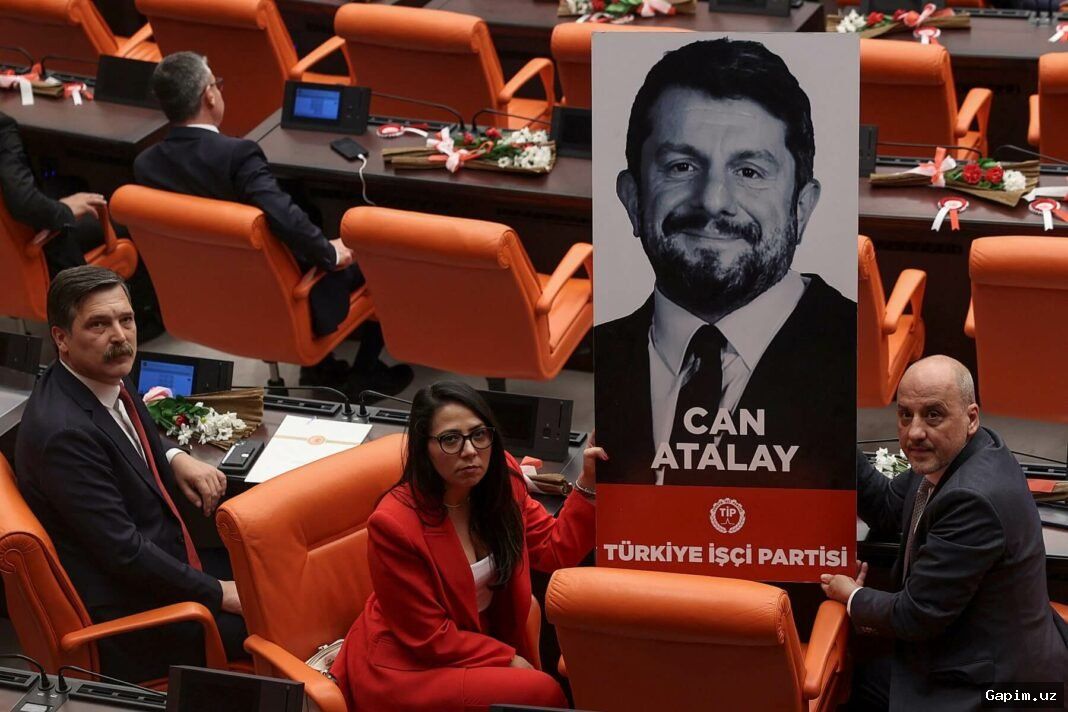
The European Court of Human Rights (ECHR) ruled against Turkey on Tuesday over the detention of human rights lawyer and elected lawmaker Can Atalay, ordering that he be released and allowed to take up his seat in the Turkish parliament. In its judgment, the Strasbourg-based court said Atalay’s continued imprisonment—now almost five years—was intended to silence him and undermine political pluralism. It ordered Turkey to pay him €32,500 (about $35,700) in compensation. The ruling also stressed that Atalay’s case should not be viewed in isolation but in the wider context of the detention of political opponents, human rights activists and journalists in Turkey. The decision adds pressure on a NATO member state whose compliance with Strasbourg rulings has long been uneven.
Key Takeaways: The ECHR ordered Can Atalay’s release and the restoration of his parliamentary mandate, finding that his detention was aimed at silencing him and weakening political pluralism. Turkey was told to pay €32,500 in compensation; the court said his case must be seen alongside the treatment of other political opponents, rights activists and journalists. The ruling is legally binding in principle, but past cases show that the Turkish regime has often resisted or delayed compliance.
Atalay’s case sits at the intersection of Turkey’s legal system, its polarized politics and its tense relationship with European human rights institutions. As a lawyer, he represented victims in numerous social and political cases and worked on freedom-of-speech cases involving journalists and writers. He was also among the leading voices in the 2013 Gezi protests, which the Turkish regime called an attempted coup. In April 2022, Atalay and seven others were sentenced to 18 years in prison for “aiding and abetting an attempted coup.” The severity of the sentence and the length of his detention turned his case into a test of whether Turkish courts would follow domestic constitutional rulings and international human rights standards.
Continuing his struggle from Silivri prison, Atalay ran as a candidate for the Workers’ Party of Turkey (TIP) in the 2023 parliamentary elections. He stood in earthquake-hit Hatay province, won his seat, but was denied release despite multiple rulings by Turkey’s Constitutional Court. His parliamentary status was revoked in 2024, a decision the Constitutional Court later overturned. President Recep Tayyip Erdogan’s party, part of the Turkish regime, stopped the opposition from formally reading the decision in parliament. Although an opposition lawmaker read it a year later, Atalay remains in jail. The sequence has fuelled criticism that legal procedures are being used to keep an elected opponent out of public life.
After the ECHR ruling was published, TIP leader Erkan Bas took to social media to call for Atalay’s release and the restoration of his parliamentary mandate. The judgment creates a clear legal obligation for Turkey, but enforcement remains the central question: the Turkish regime has previously refused to comply with ECHR decisions in the cases of rights activist Osman Kavala and prominent Kurdish politician Selahattin Demirtas. The next steps will be watched in Strasbourg, in the Turkish parliament and among Turkey’s NATO allies, where the case is likely to remain a sensitive test of commitments to human rights and the rule of law. For Atalay, the immediate question is whether the ruling will translate into release or remain another unresolved legal order.
Source: www.dw.com