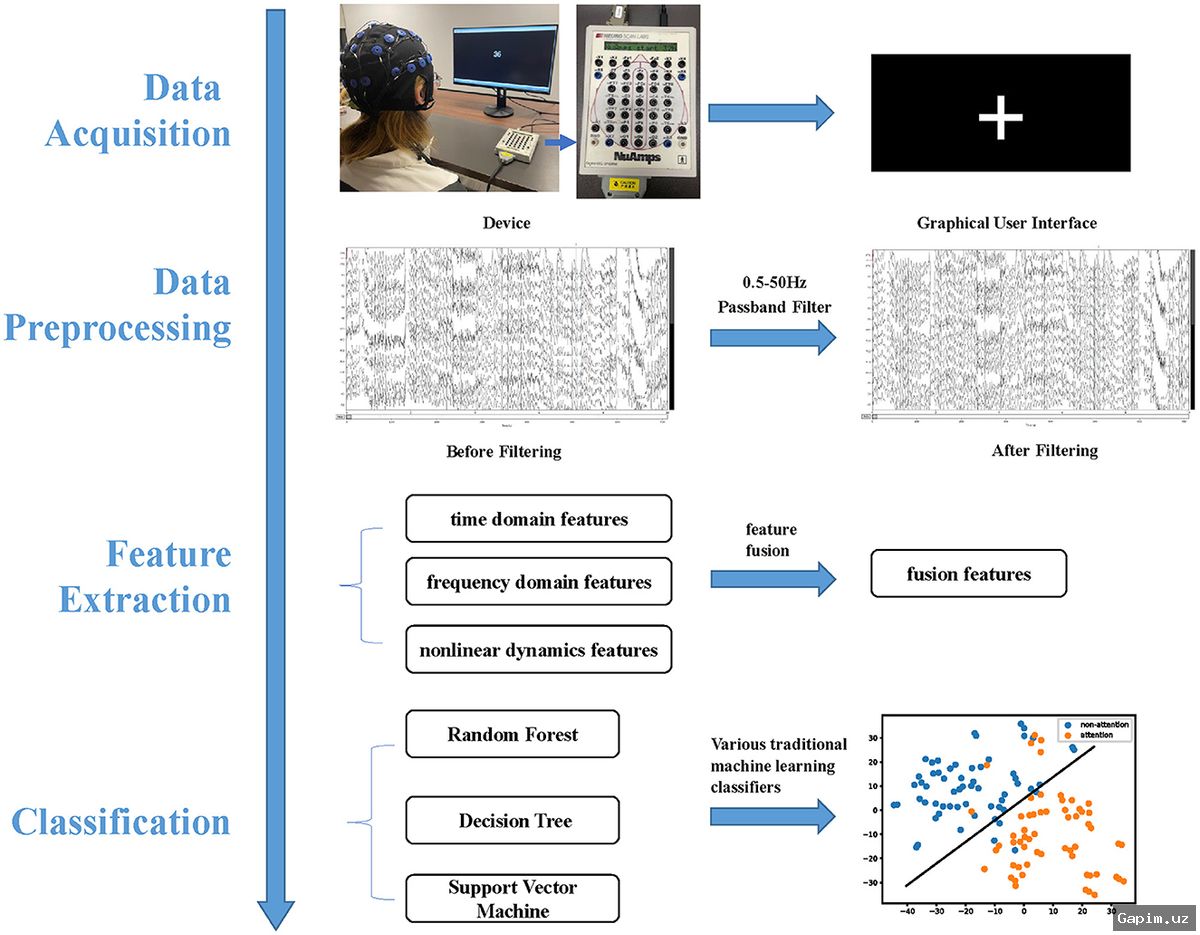
An experiment conducted by neurobiologists and psychologists from Beijing Normal University, Southwest University in Chongqing and Shanghai Jiao Tong University involved 29 volunteers aged 19 to 24. Using electroencephalography (EEG), researchers recorded brain electrical activity while numbers and letters flashed rapidly on a screen in a kaleidoscope-like sequence. Participants were asked to report colored numbers in the order they appeared; if a second number of the same color did not appear after the first colored number, they were required to press a button. The findings were published as a preprint on bioRxiv. The team found that two kinds of mistakes—reporting a gray number instead of a colored one, or adding a following gray number to a correct answer—arise at different stages of attention control.
Key Takeaways: The study included 29 volunteers aged 19 to 24; each frame was shown for 100 milliseconds; the first error type was linked to an attention signal delayed by about eight milliseconds; in the second error type, brain waves were nearly identical to correct responses, but slow theta waves in the left frontal region weakened.
Context and Background
The study addresses how the brain selects a target and suppresses distractors when visual information changes rapidly. Because each frame lasted only 100 milliseconds, the trace of a target number in the brain could fade quickly. In the first error type, participants missed a colored number and reported the gray one. EEG recordings showed that the attention-related signal appeared about eight milliseconds later than usual and was weaker; the subsequent signal linked to holding the seen number in working memory also weakened and shifted in timing. According to the researchers, this brief delay allowed later frames to blur the trace of the colored number in the brain, and attention shifted to the gray number. In the second error type, participants correctly reported the colored number but added the following gray number to their answer. In this case, brain waves were almost the same as those recorded for correct responses. The difference emerged only when signals and rhythms were analyzed together: when a participant first reported the colored number and then the gray one, slow theta waves associated with attention control weakened in the left frontal lobe, and activity in the left frontal area no longer clearly exceeded activity on the right. The researchers concluded that attention control breaks down differently in the two cases: in the first, attention is delayed and the target is missed; in the second, the person sees the target, but the brain struggles to suppress an extra item in time. When events change rapidly, timely detection of the needed item and timely filtering of the unnecessary one are both essential for a correct response.
Outlook and Key Details
Because the paper is a preprint, its conclusions require independent verification and peer review. The data come from a small group of young participants and may not fully apply to all ages or real-world situations. Future work could expand the sample, compare age groups and connect laboratory tasks with everyday visual demands. The mechanisms identified—delayed attention and difficulty suppressing extra items—could eventually inform interface design, safety monitoring and cognitive training programs, but they should be confirmed before being used for practical or clinical decisions.
Source: kun.uz