Hamza Hakimzoda Niyozi, born on March 6, 1889, is renowned as a prominent Jadid enlightener, educator, and playwright who left a profound mark on Uzbek culture and literature. He received his education in schools and madrasas in Kokand from 1896 to 1906 and in Namangan in 1908. After working in the printing sector in 1909, from 1910 to 1914, he opened Jadid schools in Tashkent, Kokand, and Margilan, contributing to the reform of the educational system.
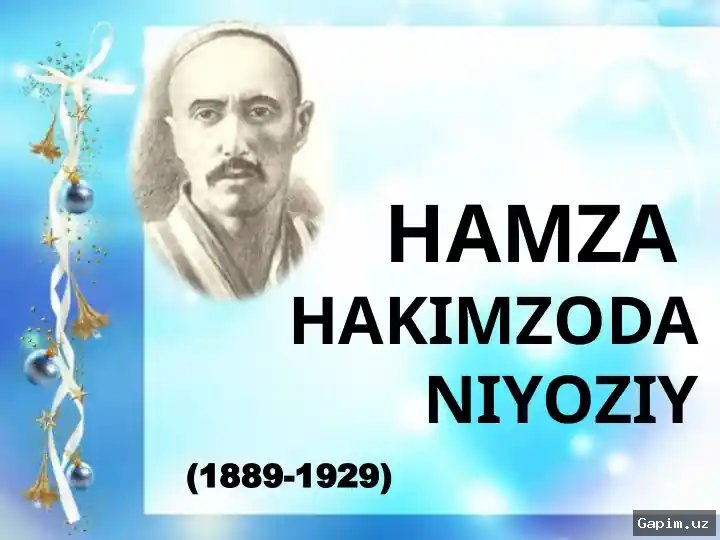
Niyozi began his creative work in 1905–1906, writing poems on various themes. His novel “Who Has the Truth?”, written in 1908, was lost soon after its creation, but in 1914–1915, he prepared educational manuals such as “Light Literature,” “Reading Book,” and “Book of Recitation.” He also published the collection “Collection of National Poems for National Songs.” From 1915 to 1917, he presented works like “New Happiness,” “Revenge,” “Poisonous Life or Victims of Love,” “Guidance of Knowledge,” “Mulla Normuhammad’s Sinful Error,” “Victims of Hunger,” and “Autonomy or Self-Government,” which addressed societal issues.
As a playwright, he created the comedy “Former Qazis or Maysara’s Case” and the drama “A Page from the Secrets of the Paranja or the Case of the Yallachis,” leaving an indelible imprint on Uzbek dramaturgy. Under the pseudonym “Nihoniy,” he wrote poems, and his essays and journalistic articles were published in the magazine “Oyna” and newspapers “Sadoi Turkiston” and “Sadoi Farg‘ona.” Many of his plays, such as “Who Is Right?”, “Punishment of Slanderers,” “The Rich Man and the Servant,” “From the Life of Workers” (1918), “Tragedy of Loshmon,” “Fergana Tragedy,” “Infants in Red Blood,” and “The Prisoner Turan’s Condition,” have not survived to the present day.
Throughout his career, Niyozi worked as a teacher at an educational institution in Kokand, served as a mirza in the organization “Shuroi Islam,” was an editor at the journal “Kengash,” and held a position in the cultural-educational department of Fergana Region. From 1919 to 1921, he served as a director in the Political Troupe of Muslims of the Region under the Political Administration of the Turkestan Front and as a leader of a theater troupe under the department of enlightenment and military propaganda of Bukhara Region. From 1921 to 1924, he was the director of cultural-educational institutions of trade unions in Khorezm Region and deputy director of the consciousness and knowledge department under the Fergana Enlightenment Committee.
In his works and poems, Niyozi reflected the ideas of Jadidism—themes of freedom, education, and justice. He passed away in 1929, but his extensive literary legacy, created during his short life, remains a vital part of Uzbek culture today. On the occasion of this anniversary, Gazeta has prepared a test based on his poems, highlighting ongoing efforts to study and disseminate his heritage.
Source: www.gazeta.uz