Today, April 9, Uzbekistan marks the 690th anniversary of Amir Timur. Details about his life and achievements are reported by Podrobno.uz. Amir Timur was born in 1336 near modern-day Shahrisabz. His father, Muhammad Taraghai, belonged to the noble circles of Mawaraunnahr. Sources differ on his level of education: some claim he was illiterate, while others state he was not only a warrior but also capable of written expression. However, he possessed exceptional memory, analytical thinking, and the ability to make quick decisions. He knew Turkic and Persian languages, and according to some accounts, also Mongolian and Arabic, and had memorized the Quran.
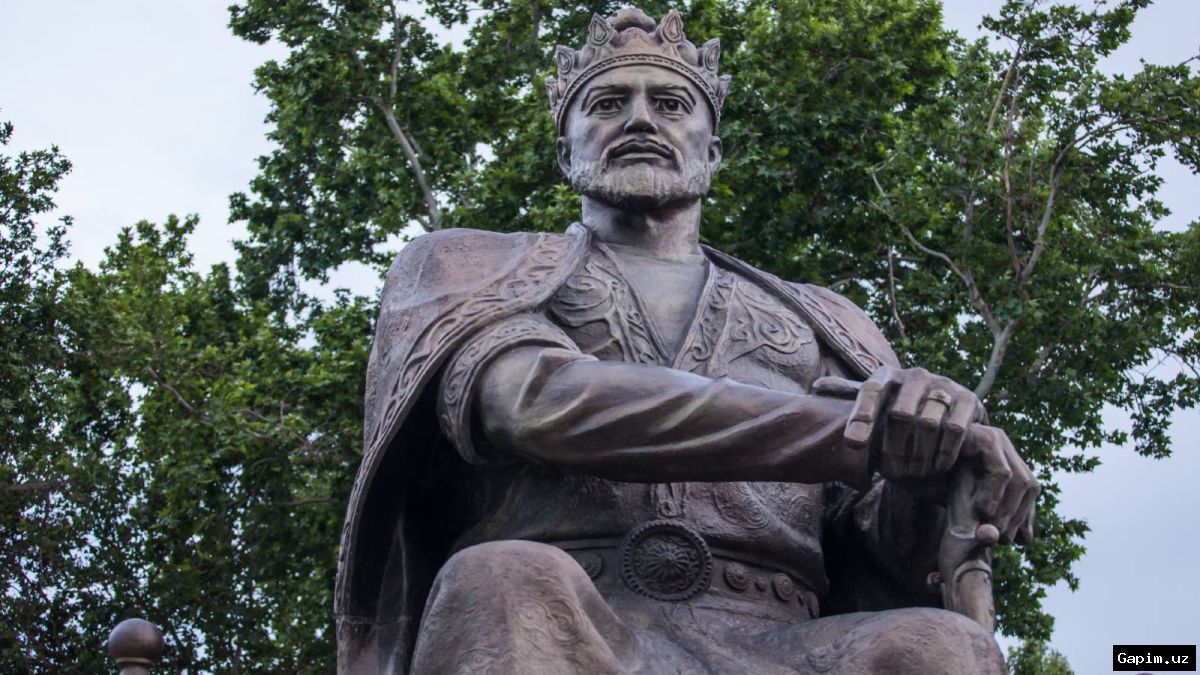
Amir Timur was proclaimed ruler in Balkh in 1370. Not being a descendant of Genghis Khan, he took the title of emir, becoming the sole ruler of Mawaraunnahr. His army was characterized by high organization and discipline, structured on a decimal system and composed of professional soldiers who received salaries. Timur created one of the fastest postal systems of his time: his messengers had the right to seize any horse to deliver dispatches, enabling him to learn about rebellions on the empire's outskirts within days.
On the battlefield, Timur relied on speed, deception, and precise calculation. For instance, to capture the fortress of Karshi, he marched in the opposite direction—to Khorasan—to deceive the enemy, then secretly approached and took the fortress. At the Battle of Ankara (1402), he defeated the Ottoman Sultan Bayezid by controlling water sources. In the Battle of Delhi (1398), he used camels with burning straw to turn war elephants against the enemy's own army, avoiding heavy losses among his cavalry.
Amir Timur was not only a talented commander but also a pragmatic statesman. His "Ordinances" (Timur Tuzuklari) serve as a political testament and a code of governance, where he emphasized: "Nine-tenths of state affairs are resolved through calculation, prudence, and counsel, and only one-tenth by the sword." He focused on justice, supported trade (the Silk Road flourished under him), and promoted careers based on personal merit.
Timur fought corruption harshly. In 1404, the chief official of Samarkand was publicly hanged for abuses, despite attempts by nobles to ransom him. He also punished traders for artificially inflating prices, such as ordering butchers to be hanged and confiscating excess profits. His principle was simple: the law applies to all, regardless of status.
Timur's empire included territories of modern Uzbekistan, Tajikistan, Turkmenistan, Afghanistan, Iran, Iraq, as well as parts of the Caucasus, northern India, and Pakistan. He revived and protected the Silk Road, constructing roads, bridges, and caravanserais. Timur engaged in active diplomatic correspondence with European rulers (France, Spain, England), viewing them as allies against the Ottoman Sultan Bayezid. His victory at Ankara was met with gratitude in Europe, with some monarchs calling him the "liberator of Christianity." Timur died in 1405, but his legacy left a profound mark on Central Asian history.
Source: podrobno.uz