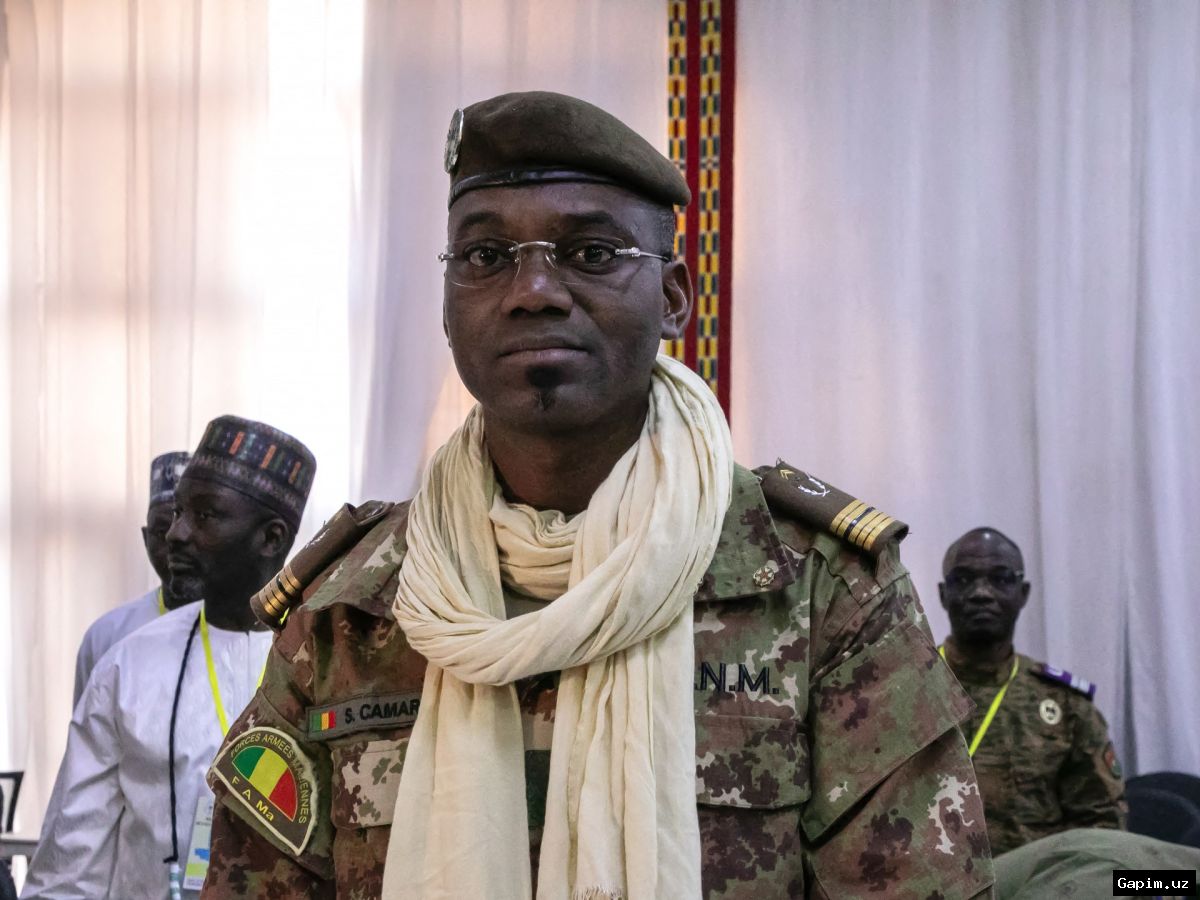
Mali's Defense Minister Sadio Camara was killed on April 25 in a suicide bombing outside his residence in Kati, a garrison town 15 km from the capital Bamako. The attack was claimed by the Al-Qaeda-linked Group for the Support of Islam and Muslims (JNIM) in coordination with the Azawad Liberation Front (FLA), a Tuareg rebel movement. The assassination poses a severe challenge to the military junta in Bamako, analysts say.
The attacks targeted five garrison towns simultaneously: Kati, Bamako, Sevare, Gao, and Kidal. Nina Wilen, director of the Africa Programme at Egmont Institute, described the events as "unprecedented in Mali's history," highlighting how "strong JNIM has become over the past year." She noted that the Malian military intelligence's failure to detect the attacks represents a "major failure."
Camara was considered the second-in-command within the junta and a symbolic figure. Wilen suggested two reasons for his targeting: his symbolic role and his leading role in establishing relations with Russia. "Attacking him can also be a way of saying that we do not want the Russian troops here anymore," she said.
Kidal, a stronghold of the FLA, was recaptured by the Malian army in 2023 with support from the Russian Wagner Group. However, the tide has turned. Djallil Lounnas, associate professor at Al Akhawayn University, stated: "The Malian army is extremely weak. In the past few years, it just controlled urban centers, while rural areas were out of control."
On April 27, the Moscow-controlled Africa Corps—the successor to Wagner—confirmed its withdrawal from Kidal following heavy fighting. Rebels claimed control over large swathes of northern Mali. Lounnas noted that the Africa Corps deployed only 600 to 1,000 fighters: "I don't think the Russians could do more. Besides that, they are stuck in Ukraine."
The coordination between JNIM and the FLA has surprised analysts. Ulf Laessing, head of the Sahel program at the Konrad Adenauer Foundation, remarked: "Remarkably, there has been a coordination between jihadists and Tuareg rebels, which have nothing in common, but they have a joint enemy." However, Laessing believes the rebels do not intend to take larger cities like Bamako, as they lack the capacity to run them and instead hope to spark an uprising to pressure the government into negotiations.
Bamako has been placed under a 72-hour nighttime curfew, with roadblocks set up near police stations and military installations. A resident of Kati reported that leaving the town is extremely difficult. The Alliance of Sahel States (AES), comprising Mali, Burkina Faso, and Niger, denounced the attacks as "a monstrous plot backed by the enemies of the liberation of the Sahel." Yet, Mali has not received concrete military aid from its allies. Wilen described the AES as "more of an alliance on paper than in practice."
The African Union Commission Chairperson Mahmoud Ali Youssouf strongly condemned the attacks. UN Secretary-General Antonio Guterres condemned "violent extremism" and called for "coordinated international support." Germany expressed concern and urged its citizens to leave Mali if possible.
Source: www.dw.com