According to preliminary data from the National Statistics Committee, Uzbekistan's foreign trade turnover in January-May 2026 increased by 3.7% year-on-year, reaching $32.8 billion.
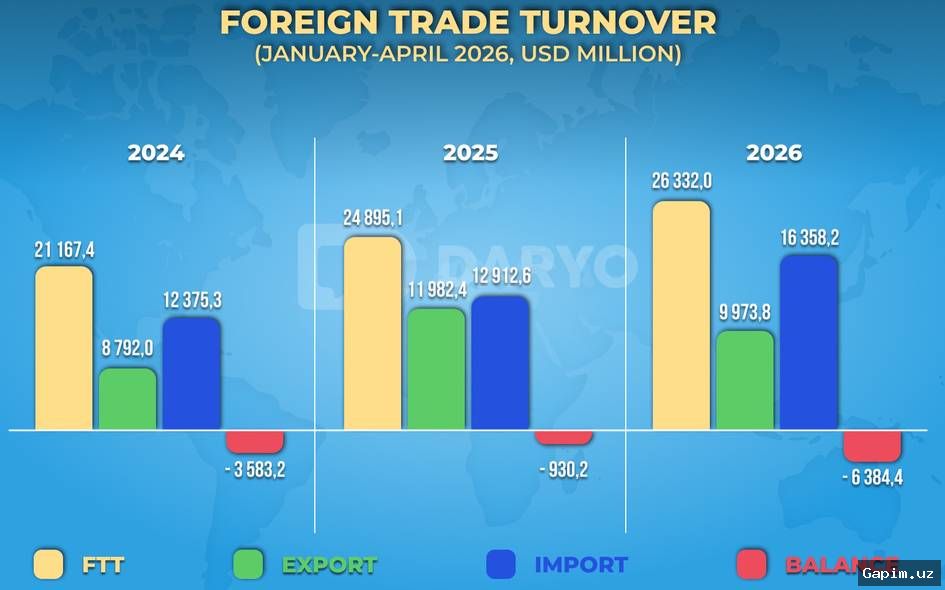
Exports fell by 15.5% to $12.6 billion, while imports rose by 20.8% to $20.1 billion. This resulted in a negative trade balance of $7.5 billion, 4.4 times higher than the same period last year.
The main reason for the decline in total exports was a sharp reduction in non-monetary gold shipments. In January-May, Uzbekistan exported gold worth $1.5 billion, compared to $6.49 billion in the same period last year. Gold's share in total exports dropped from 43.4% to 11.9%.
No gold exports were recorded in May. All precious metal shipments since the beginning of the year occurred in April. The previous gold export was in September last year, also around $1.5 billion.
According to economist Mirkomil Kholboyev, monthly exports in May amounted to $2.7 billion, while imports reached $3.8 billion, resulting in a trade deficit of $1.1 billion. In contrast, April saw a surplus due to gold exports.
In May, total exports decreased by 10.3%, while imports grew by 0.7%. The economist attributed the export decline to high base effects: in May 2025, Uzbekistan exported $1.1 billion in gold, but no such shipments occurred this May. "This may be explained by falling gold prices," he noted.
However, non-gold exports in January-May totaled $6.5 billion, up 29.4% from the same period in 2025. In May alone, non-gold exports surged 40.4%.
The strong growth in non-gold exports in May was driven primarily by services and energy goods. Energy exports rose 31.4%, while services exports increased by 42.5%.
Services became the largest export category in January-May, with volumes rising from $3.4 billion to $4.59 billion, a 34.9% increase. Their share of total exports grew from 22.8% to 36.3%.
Industrial goods exports rose 18% to $1.91 billion, with their share increasing from 10.8% to 15.1%. Chemical and related product shipments grew 37.6% to $1.05 billion, accounting for 8.3% of exports.
Textile exports reached $1.3 billion, representing 10% of total exports, with a 20.1% year-on-year increase.
Fruit and vegetable exports rose 2.7% year-on-year to $635.8 million, making up 5% of total exports.
Exports of various finished goods increased from $531.3 million to $1.06 billion, with their share rising from 3.6% to 8.4%. Machinery and transport equipment exports grew from $387.9 million to $536 million, reaching a 4.2% share.
According to Kholboyev, exports to almost all major trading partners grew strongly in May. Exports to China rose 62.4%, to Afghanistan 72.9%, to Turkey 56.2%, to Tajikistan 59.6%, and to Kyrgyzstan 40.3%.
The economist noted that exports to Afghanistan have been growing by over 30% for 10 consecutive months, while exports to China have grown by over 60% for three consecutive months. However, export growth to Russia slowed from 20.8% to 13% in May.
In January-May, Uzbekistan's imports reached $20.13 billion. Machinery and transport equipment remained the largest import category at $6.66 billion, or 33.1% of total imports, up 20.5% year-on-year.
Industrial goods imports increased from $2.73 billion to $3.08 billion, though their share fell slightly from 16.4% to 15.3%. Chemical and related product imports rose to $2.47 billion, accounting for 12.3% of imports.
Food and live animal imports surged 42.3% to $2.31 billion, with their share rising from 9.8% to 11.5%.
Mineral fuel, lubricants, and related material imports grew 31.7% to $1.86 billion, with their share increasing from 8.5% to 9.2%.
Services imports rose 14.7% to $2.05 billion, but their share of total imports declined from 10.7% to 10.2%.
Import growth slowed significantly in May. Kholboyev called this an "interesting trend," as average monthly import growth had been around 27% since the start of the year.
According to him, imports from all major partners except Russia slowed. Shipments from Turkey fell 24%, from Germany 38%, from India 43%, and from South Korea 16%. Import growth from China slowed from 32% to 11%.
Imports from Russia, however, accelerated: after growing 6% in April, they rose 10% in May.
Source: www.gazeta.uz