According to preliminary data from the State Statistics Committee, Uzbekistan's foreign trade turnover in January-June 2026 amounted to $41 billion, up 7.4% compared to the same period last year. However, this growth was driven primarily by a significant increase in imports.
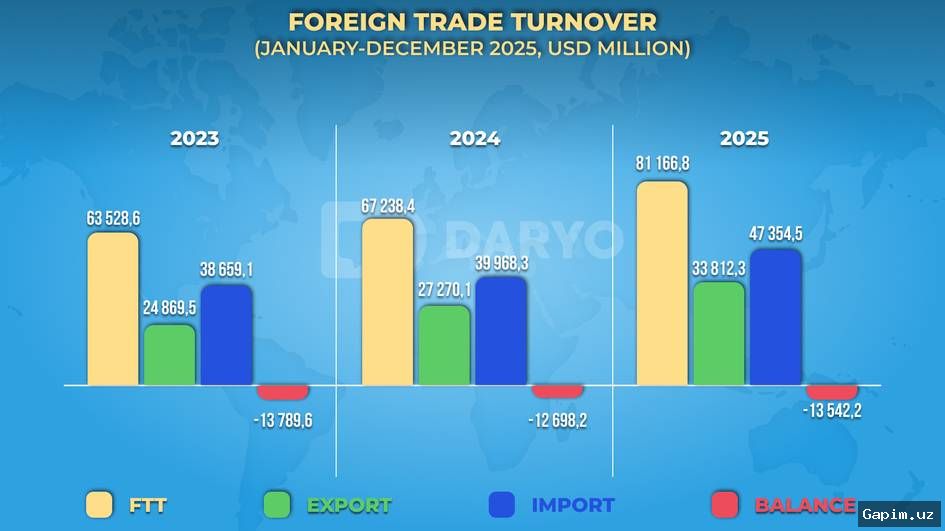
Exports decreased by 8.8% to $15.86 billion, while imports rose by 21% to $25.15 billion. As a result, the negative trade balance widened from $3.38 billion to $9.29 billion, nearly tripling. This indicates a serious imbalance in the country's foreign trade.
The main reason for the decline in exports was a sharp reduction in non-monetary gold shipments. In January-June, Uzbekistan exported gold worth only $1.5 billion, compared to $6.49 billion in the same period of 2025. Gold's share in total exports fell from 37.3% to 9.5%.
Against this backdrop, the export structure underwent significant changes. The share of services rose from 26.3% to 39.1%, industrial goods from 11.3% to 15.2%, chemical products from 5.6% to 8.1%, and various finished goods from 4% to 8.6%. Services exports increased by 35.7% to $6.2 billion, with more than half coming from tourism.
Industrial goods exports grew by 22.8% to $2.41 billion. Textile exports rose by 24.1% to $1.6 billion. Exports of finished goods almost doubled to $1.36 billion. Machinery and transport equipment exports increased by 32.3%, but automobile exports fell by 5.4%.
Food exports grew by 9% to $1.32 billion. Fruit and vegetable exports in physical terms remained almost unchanged, but in monetary terms increased by 3% to $872.9 million. While fruit exports declined, vegetable exports, particularly onions, cabbage, and tomatoes, saw significant growth.
On the import side, machinery and transport equipment continue to dominate. Their imports rose by 25.1% to $8.25 billion. Passenger car imports surged by 84.5%, electrical machinery by 44.4%, and telecommunications equipment nearly doubled. Food imports increased by 44.2% to $2.82 billion, indicating growing domestic demand.
Mineral fuel imports rose by 19.3% to $2.23 billion. Oil and petroleum product imports increased by 8.1%, natural gas by 41.4%. Gasoline imports jumped by 78.5% to $409.5 million, while diesel fuel imports fell by 11.1%. Electricity imports decreased by 15.6%, while exports rose by 13.4%.
Source: www.gazeta.uz