Archaeologists have discovered stone tools at the Arkutsay Paleolithic site in the Bostanliq district of Tashkent region that may date back 320,000–280,000 years. If laboratory analyses confirm their age, Arkutsay could be recognized as the oldest known archaeological site in Uzbekistan. This was announced by the Academy of Sciences of Uzbekistan.
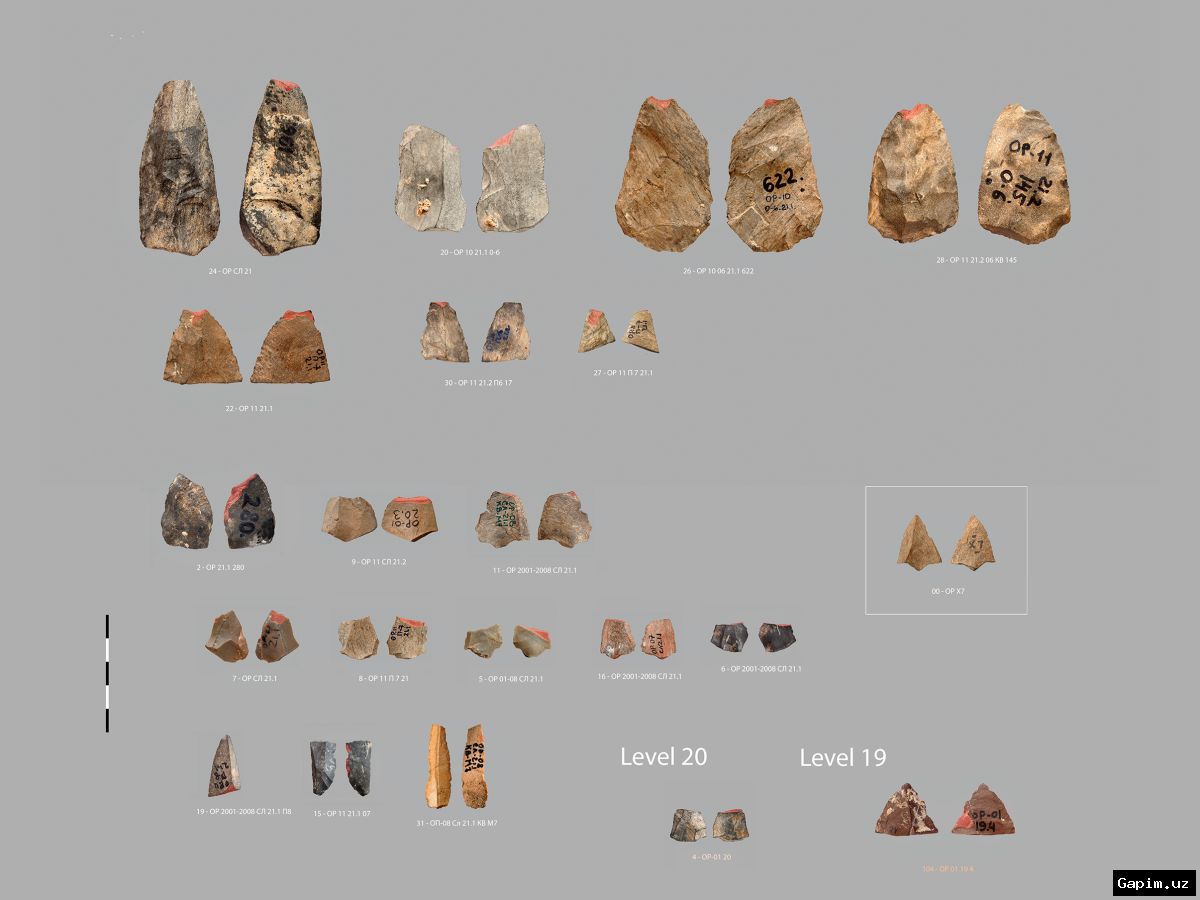
A joint archaeological expedition, comprising specialists from the Institute of Anthropology of the Academy of Sciences of Uzbekistan and the Institute of Archaeology and Ethnography of the Siberian Branch of the Russian Academy of Sciences, has been conducting research at the Arkutsay Paleolithic site. Targeted archaeological excavations began in 2024, and field research under the cooperation between Uzbek and Russian scientific institutions has been ongoing for three years. Currently, excavations and observations are being carried out at three separate areas of the site.
The researchers aim to determine the age of the stone artifacts found in geological layers, their stratigraphic position, and archaeological context, as well as to reconstruct the stages of ancient human habitation in this area. In previous geological studies, stone artifacts were found in layers of the Arkutsay section at depths of approximately 20 and 40 meters. However, due to insufficient documentation of their stratigraphic position and archaeological context, it was not possible to determine the exact age of the finds.
Recent research has confirmed the presence of stone artifacts at various levels of the Arkutsay geological section. In particular, stone tools processed by humans were identified in the first, second, and third ancient fossil soil layers. The discovery of artifacts in layers of different ages indicates that ancient human communities inhabited this area not once, but in several stages.
Of particular scientific importance are the stone artifacts found in the third ancient fossil soil layer. According to preliminary geological and paleoclimatic comparisons, this layer was formed approximately 320,000–280,000 years ago. If these dates are confirmed by independent laboratory analyses, it would indicate that the Tashkent oasis and the territory of Uzbekistan as a whole were inhabited by ancient humans as early as the late stages of the Lower Paleolithic.
Scientists emphasize that the new finds at Arkutsay are of great importance for studying the early stages of Uzbekistan's Paleolithic, determining the migration routes of ancient humans across Central Asia, and investigating their adaptation processes to natural and climatic conditions. This discovery could open a new chapter not only in Uzbek archaeology but also for the entire Central Asian region.
It is worth recalling that earlier at the Boburtepa archaeological site in the Kamashi district, remains of an ancient temple and unique wall paintings dating to the 4th–5th centuries AD were found. The Arkutsay finds are significantly older and are expected to provide new insights into the earliest pages of human history.
Source: www.gazeta.uz