According to the National Statistics Committee, consumer prices in Uzbekistan rose by 0.2% in August 2025. In comparison, inflation was 0.4% in August of the previous year.
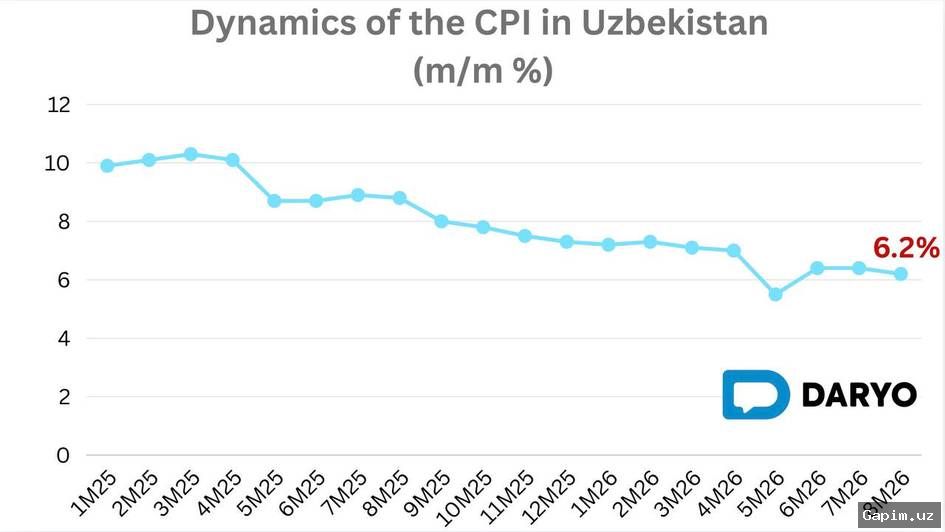
Annual inflation slowed to 6.2% from 6.4% in July. In August 2024, the figure was 8.8%, indicating a significant easing of price pressures in the economy.
Since the beginning of the year (January-August), prices have increased by 3.4%, compared to 4.5% in the same period last year. Excluding fruits and vegetables, monthly inflation was 0.2%, since the start of the year 4.9%, and on an annual basis 6.6%.
Food products rose by 0.4% in a month and by 6.2% year-on-year. Non-food goods increased by 0.2% monthly and 5.9% annually. Services rose by 0.1% monthly and 6.4% annually.
The committee noted that for 244 items in the consumer basket, the pace of price growth slowed or the decline accelerated compared to July. This is 13 more than in the previous month and 47 more than in August last year.
Of the 244 positions with slowing price dynamics, 111 are non-food goods, 91 are food products, and 42 are services. Compared to July, the number of such positions increased among food products and services but decreased among non-food goods.
Among the 20 goods and services with the highest monthly price increases, 13 are food products, 4 are non-food goods, and 3 are services. Among staple foods, rice and rice groats saw the most significant rise — by 2.2%, although they remain 4.1% cheaper year-on-year.
Sugar rose by 0.6% in a month, milk by an average of 0.3%, while cottonseed oil fell by 0.1%. On an annual basis, they remain 1.6%, 5%, and 6.2% more expensive, respectively.
Seasonal factors continued to impact vegetable and fruit prices: cabbage fell by 13.3%, cucumbers by 11.1%, tomatoes by 8.9%, beets by 7.4%, and potatoes by 6.1%. Meanwhile, carrots rose by 9.2%, watermelons by 7.5%, onions by 6.2%, and citrus fruits by 1.6%. Despite the monthly increase, carrots, watermelons, and onions remain cheaper than a year ago by 2.3%, 11.2%, and 9.2%, respectively.
Gasoline in August rose by an average of 1.9% monthly and 20.2% annually. AI-92 prices increased by 1.1%, AI-95 by 4.9%, and AI-98 and AI-100 by 6.7%. Since the start of the year, AI-92 has risen by about 10.3%, AI-95 by 20.7%, and AI-98 and AI-100 by 24.4%.
Propane rose by 5.8% monthly and 41.4% annually. Methane prices remained unchanged monthly but rose by 10.3% annually. According to statistics, a liter of AI-92 sold for between 10,500 and 16,400 soums, AI-95 between 12,500 and 20,000 soums, and AI-98 and AI-100 between 16,000 and 28,000 soums.
Domestic flights rose by 0.1%, international flights by 1.7%, attributed to higher fuel costs and changes in the euro exchange rate. In Surkhandarya, Jizzakh, and Navoi regions, as well as in Tashkent, intercity bus fares increased — on average by 0.6% nationwide.
In August, tariffs for main utility services remained unchanged. Housing rents rose by 0.4% monthly and 4.2% annually. Medicines fell by an average of 0.2%, vaccination services by 0.2%, and vision aids by 0.6%.
Among educational services, private kindergarten attendance rose by 0.3%, tutoring by 0.2%, and language courses by 0.1%. Fees for money transfers decreased by 1.4% in a month, attributed to the strengthening of the soum against the US dollar and Russian ruble.
On an annual basis, the most significant increases persist in insurance and financial services — 43%, housing and utilities and fuel — 11.9%, restaurant and hotel services — 7.2%, and transport — 7.1%.
Regionally, no sharp deviations from the national average were recorded. Prices rose by 0.3% in Namangan, Samarkand, Surkhandarya, Fergana, and Khorezm regions, as well as in Tashkent. In other regions, inflation was 0.2%.
The highest annual inflation was recorded in Tashkent city — 6.8%. In Fergana region, prices rose by 6.6%, in Andijan by 6.5%, and in Khorezm by 6.4%. The lowest annual rate was in Syrdarya region — 5.2%, while Bukhara and Surkhandarya regions saw inflation of 5.7%.
The National Statistics Committee noted that the strongest impact on monthly inflation came from higher prices for food products and non-alcoholic beverages — their contribution was 0.16 percentage points. Transport added another 0.04 p.p., while lower prices in healthcare reduced the overall figure by 0.01 p.p.
Since the start of the year, the largest contributions to inflation came from housing and utilities and fuel, food products, and transport. These three categories account for 2.33 p.p., or 68.3% of the total price increase.
Source: www.gazeta.uz