️ According to presidential decrees signed on September 17, major investment projects for electricity generation through thermal processing of solid household waste have been identified in three regions of Uzbekistan. A total of $395 million in direct investments is planned to be attracted, and modern waste processing capacities will be created.
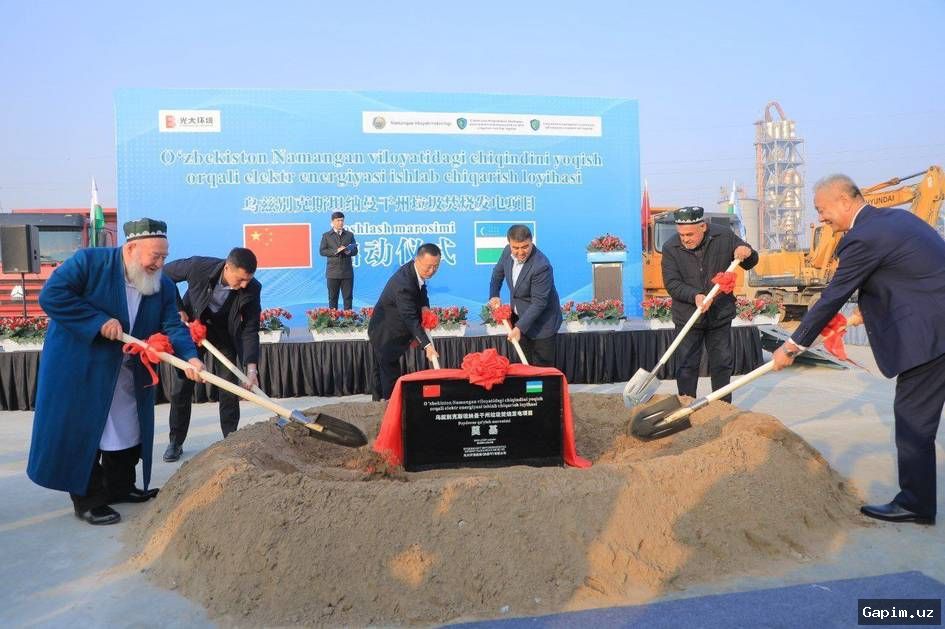
️ In Surkhandarya region, China Sciences Environmental Protection Technology (Hong Kong) International Co., Ltd (CSET) is involved as an investor. In 2026−2028, $150 million in direct investment will be injected into the project, and equipment with the capacity to thermally process 1,000 tons of solid household waste per day and generate 126 million kWh of electricity per year will be commissioned. The project will be implemented in a 15-hectare eco-industrial zone to be established in the “Bahor” MFY area of Angor district.
️ The project company will sell the generated electricity to JSC “Uzenergosotish” on a guaranteed basis for 30 years. Additionally, the Agency for Waste Management and Circular Economy Development under the National Committee on Ecology and Climate Change will guarantee the supply of solid household waste to the project company for 30 years. The project also includes the construction of necessary power transmission networks and infrastructure facilities to connect the power plant to the unified energy grid.
️ For the project in Bukhara and Navoiy regions, Wangneng (UZ) Environmental Protection Energy Pte. Ltd, registered in Singapore, is involved as an investor. Within the project, $165 million in direct investment will be injected, and equipment with the capacity to thermally process 1,500 tons of waste per day and generate 238 million kWh of electricity per year will be commissioned in Bukhara region. This project is also planned for 2026−2028. 40 hectares of land in the “Guliston” MFY area of Kogon district will be allocated for the creation of an eco-industrial zone. In Bukhara region, agreements on public-private partnership with enterprises providing waste collection and removal services have also been permitted.
️ In the Republic of Karakalpakstan, a waste-to-energy project will also be implemented with the participation of China Sciences Environmental Protection Technology (Hong Kong) International Co., Ltd (CSET). In 2026−2028, $80 million in direct investment will be attracted to the project, creating the capacity to thermally process 750 tons of waste per day and generate 90 million kWh of electricity per year. The project will be implemented in a 30-hectare eco-industrial zone to be established in the “Taqirko‘l” OFY area of Nukus district. As in Surkhandarya and Bukhara, this project also includes mechanisms for guaranteed purchase of electricity for 30 years and guaranteed supply of solid household waste.
️ Within the three projects, investors will provide a first-class bank guarantee of $8 million to secure their construction-period obligations. Project companies are also granted the right to open accounts in foreign banks and to make certain payments to foreign creditors, contractors, and suppliers directly, without transferring through bank accounts in Uzbekistan. Relevant state bodies have also been tasked with building the necessary electrical infrastructure, allocating land plots, and establishing eco-industrial zones.
️ Overall, according to the decrees, a total of 3,250 tons of household waste per day will be thermally processed in Surkhandarya, Bukhara, and Karakalpakstan, and a capacity to generate 454 million kWh of electricity per year will be created. The total volume of direct investments attracted to the projects amounts to $395 million. Earlier, it was reported that plants would be built in Khorezm to process 800 tons of waste and generate 71 million kWh, and in Jizzakh to process 1,000 tons of waste and generate 110 million kWh of electricity.
️ In October 2024, President Shavkat Mirziyoyev, speaking about projects for processing household waste and producing electricity and products from it, called this sector “not just plants, but one of the issues of vital importance.” In March 2025, he signed a decree on the implementation of projects for electricity generation by burning solid household waste. One of such projects is being implemented in Samarkand in cooperation with China's Shanghai SUS Environment. The SUS Environment Samarkand plant is being built on the territory of the central landfill located in the “Navruz” mahalla of the “Khushrav” massif: 15 hectares of the 100-hectare landfill have been allocated for the project. The foundation stone of the enterprise was laid on July 18, 2025, and construction work is currently ongoing. Last summer, Gazeta journalist Otabek Turdiev visited the site.
️ Waste incineration plants operate on the basis of thermal processing technology of industrial and solid household waste in boilers or furnaces. The heat generated during combustion is used to produce heat and electricity.
Source: www.gazeta.uz