In her address, Saida Mirziyoyeva, head of the Presidential Administration of Uzbekistan, highlighted the rise in geopolitical tensions, ongoing wars, growing inequality and declining trust worldwide. According to her, at such times countries face a choice, and Uzbekistan under President Shavkat Mirziyoyev has made its choice: openness, good relations with neighbours and dialogue with the world. "Openness does not mean weakness. On the contrary, striving for peace means taking responsibility for the future," she stated.
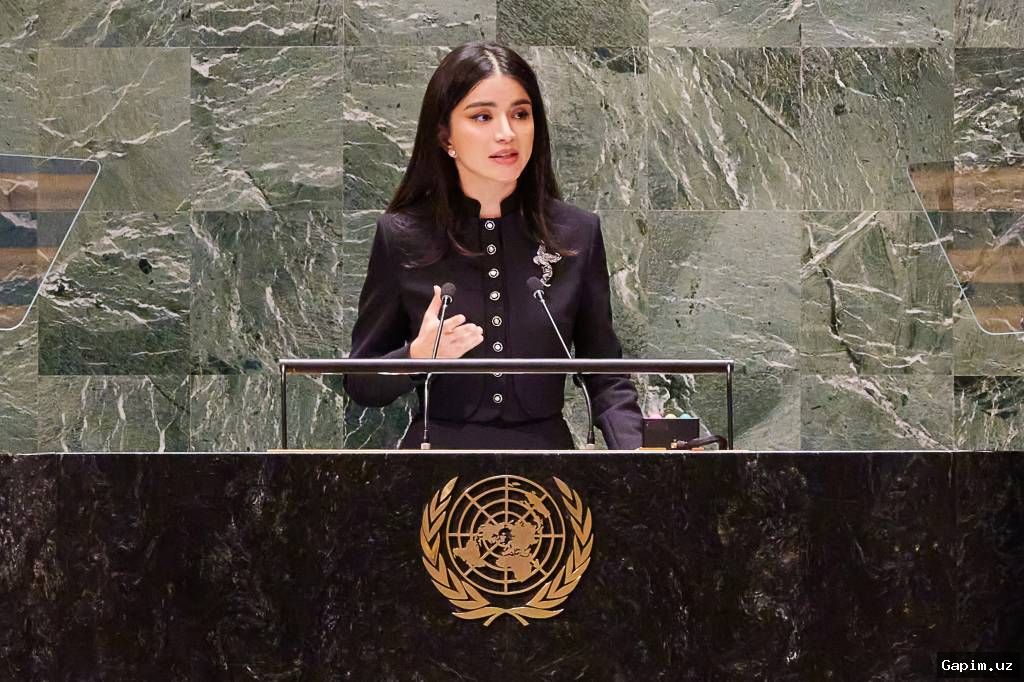
Mirziyoyeva noted that states are increasingly being asked to choose a side, and Uzbekistan's position is to prioritise human interests. "We see that countries are being asked: which side are you choosing? Uzbekistan's answer is clear. Our choice is human dignity. We choose young people who are determined to get an education, acquire a profession and determine their own future. Because we do not measure the true strength of statehood by its military or economic power. A country's power is determined first and foremost by how it can protect human dignity, rights and interests," she said. She stressed that Uzbekistan views peace, development and human dignity not as separate tracks but as a single task.
A separate part of the speech was devoted to the role of the United Nations. Mirziyoyeva noted that no country, regardless of its capabilities, can cope alone with all modern global challenges. "None of these threats stop at national borders. That is why we need the United Nations more than ever. We need a United Nations that is capable not just of adopting decisions, but of implementing them. We need a United Nations where the voices of every country are heard," she said. According to her, Uzbekistan supports the UN Secretary-General's efforts under the UN80 initiative aimed at adapting the organisation to modern requirements, and advocates expanding the UN Security Council to reflect current realities. She also announced that next year Uzbekistan will assume the chairmanship of the Non-Aligned Movement: "At a time of escalating tensions, we see this as a responsibility to create new platforms for dialogue. In this spirit, Uzbekistan has put forward its candidacy for a non-permanent seat on the Security Council for 2035–2036. We count on your support."
The head of the Presidential Administration separately emphasised the country's commitment to international law. "For us, international law is not a tool that changes depending on interests. It is a common rule for all countries. There can be no universal justice without universal law," she noted. Speaking about Central Asia, she recalled that until relatively recently the region was often associated with unresolved border issues, disputes over water resources and other contradictions. According to her, in recent years the situation has changed thanks to the political will of the leaders of the region. "Thanks to the initiative of the President of Uzbekistan and the political will of the heads of state of Central Asia, the situation and atmosphere in the region have completely changed. We have begun to see each other as partners, not as a source of threats," she stated. Uzbekistan, according to her, takes the same approach to Afghanistan: "Considering Afghanistan solely as a source of danger will not solve the problem. And it is not a way out to leave the multi-ethnic Afghan people alone with their problems. They need to be given hope and confidence in achieving a peaceful life."
A significant part of the speech was devoted to Uzbekistan's domestic reforms. Mirziyoyeva stressed that the main criterion for their effectiveness is a change in the quality of life of the population. According to the data she cited, over the past ten years the purchasing power of Uzbekistan's population has doubled, the economy has grown from $50 billion to $147 billion, more than $150 billion in foreign investment has been attracted, and exports have increased almost threefold. "The poverty rate has fallen to 4%, and almost 10 million people have been lifted out of poverty. Pre-school education coverage has increased from 27% to 78%. Higher education coverage has grown from 9% to almost 45%. Average life expectancy has increased from 66 to more than 75 years. Maternal and infant mortality have fallen fourfold. The true value of reforms is reflected in the lives of these people," she said. She separately addressed child protection, education and human capital: "A child is the greatest responsibility of the state. If a child is not born healthy and does not receive a quality education, we jeopardise the future not of one person, but of the whole society." She announced that a high-level dialogue with the UN Population Fund on demographic stability and human capital will take place in the coming days, and in October Samarkand will host the international community to discuss child well-being.
Another theme of the speech was the environmental situation in Central Asia and the Aral Sea tragedy. "Central Asia has another lesson it can offer the world. This is the Aral Sea. It did not dry up because of a natural disaster. It is the result of decades of wrong decisions and an unjust attitude towards nature," said Mirziyoyeva. She spoke about the creation of green zones on the dried-up bed of the Aral Sea, the introduction of water-saving technologies and plans to develop renewable energy: "We aim to increase the share of renewable energy to 54% by 2030. We do not want the Aral Sea to remain merely a symbol of environmental tragedy. It should become a testing ground for environmental solutions." She also recalled that, on Uzbekistan's initiative, the UN General Assembly declared 2027–2036 the Decade of Action on Afforestation and Reforestation: "It is time to reinforce this resolution with practical results."
Turning to global technological changes, Mirziyoyeva focused on the development of artificial intelligence: "Today humanity stands on the threshold of another large-scale transformation. I am talking about artificial intelligence. But one question remains unanswered. Does technology serve humanity, or are we forced to adapt to technology?" According to her, human beings must remain at the core of technological development: "Humanity and its fate must be at the centre of technological progress. Artificial intelligence must be inseparable from human rights, security, equal opportunities and responsibility. Technological progress must not force people to change, but serve to improve human life." She added that Uzbekistan advocates strengthening international dialogue in this area.
The speech also touched upon the rule of law and the judicial system. "Power does not stand above the law. Every person who goes to court, whoever they are, must believe that justice will prevail," said Mirziyoyeva. She announced that a separate international commercial court based on English law principles is being established at the Tashkent International Financial Centre. In addition, she recalled the eradication of child and systemic forced labour in Uzbekistan, the toughening of liability for domestic violence and measures to expand opportunities for women: "We also rely on this criterion when it comes to the rights and opportunities of women. That is why we have created a separate system to support women's entrepreneurship. Today women make up 39% of our parliament." She also spoke about the Centre for Islamic Civilisation built in Tashkent on the initiative of Shavkat Mirziyoyev: "We see it not only as a place that demonstrates the past, but as a house of knowledge, thought and enlightenment." According to her, this work is particularly relevant amid the rapid spread of information through social networks and artificial intelligence technologies: "Today, in an era when social networks and artificial intelligence spread hatred and stereotypes at enormous speed, it is important to recall this truth once again. Uzbekistan will consistently continue international cooperation aimed at strengthening dialogue between cultures and religions, enlightenment and tolerance."
Concluding her speech, Mirziyoyeva returned to the theme of human dignity, calling it one of the main guidelines for the future: "We all want to live in a world where human dignity is the highest priority. We want to leave our children a better world than the one we have now. A world where human dignity is highly valued." "The future, however, will judge us not by the opportunities that open up before us, but by how we use them. The people and the President of Uzbekistan are ready to contribute to building a world where peace, trust and human dignity prevail," Saida Mirziyoyeva concluded.
Source: uznews.uz