A event dedicated to demographic resilience was held in New York in cooperation with the United Nations Population Fund (UNFPA). Saida Mirziyoyeva, Head of the Presidential Administration, participated and presented Uzbekistan's plans and initiatives for the future. The event centered on the development of the country's young population and human capital.
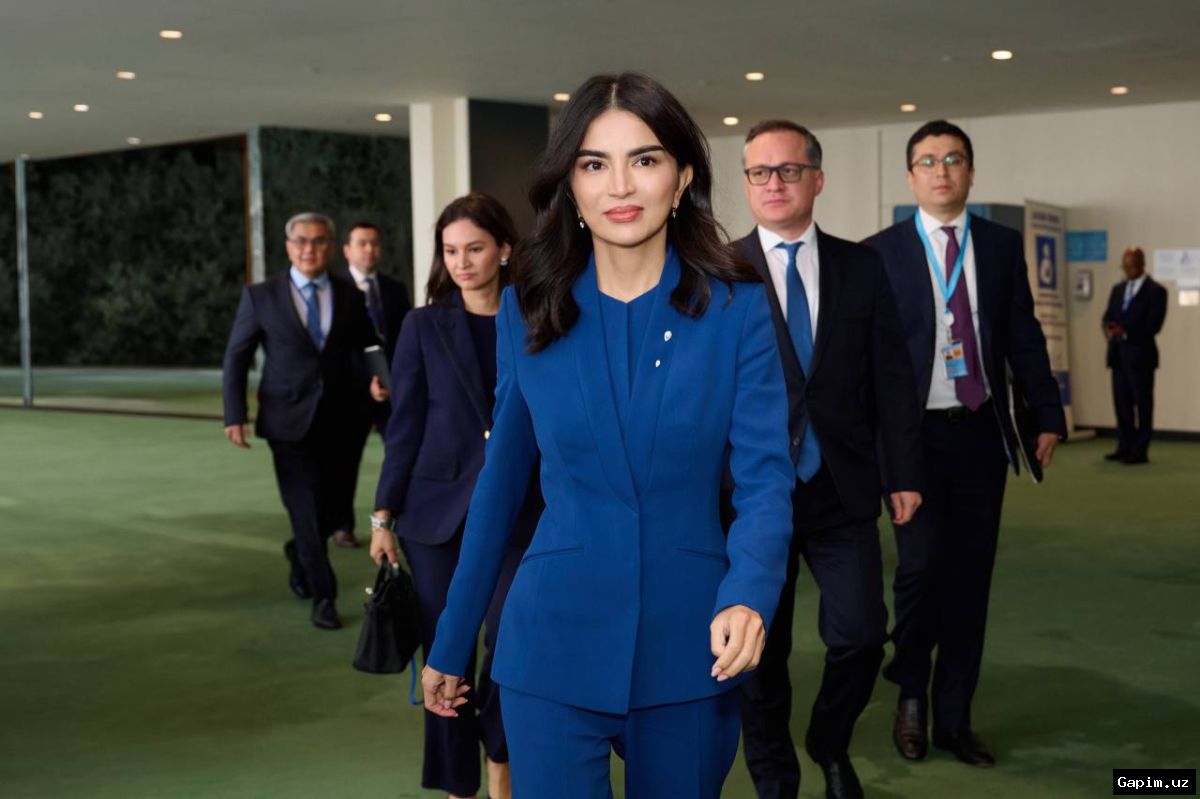
In her speech, Saida Mirziyoyeva emphasized that Uzbekistan's main asset is its younger generation. "For this potential to become a source of demographic dividend in the future, we must invest today in the health, education, and safety of every person, especially women and children," she wrote on her Telegram channel. According to her, to ensure these efforts are targeted and long-term, demographic forecasting is being conducted and a "Demographic Dividend — 2050" strategy is planned for development.
It is expected that by 2050, Uzbekistan's population will reach 58 million. Of these, 33 million will be of working age. Since 1989, the country's population has nearly doubled, exceeding 39 million. More than half of the population is under 30. However, as Saida Mirziyoyeva noted, having a young population alone does not guarantee prosperity. "A young population becomes a demographic dividend only if it is healthy, educated, and employed," she said.
Speaking about achievements in recent years, it was noted that since 2000, maternal mortality in the country has halved, and average life expectancy has increased by 9 years. Over the past five years, the poverty rate has dropped from 17 percent to below 4 percent. During this period, access to preschool education has nearly tripled. Thanks to the ability to leave their children in a safe place, one million mothers were able to return to study or work.
The Head of the Presidential Administration also announced that Uzbekistan is implementing a national program to create a safe and respect-based work environment. The corresponding decree was recently signed by the president. "We speak about this cautiously because... the work of introducing such protective measures, in fact, never ends," she continued. Saida Mirziyoyeva noted that in countries with different levels of development, including those that previously seemed a model for others, there is a regression in this area. Therefore, Uzbekistan views these efforts not as a one-time adopted program, but as work that the government carries out purposefully year after year in response to society's needs.
Today, girls and women make up a significant portion of students in higher education institutions. In state universities, contract payments for women studying in master's programs are covered by the state budget. "Behind this policy is a simple belief: a daughter's dreams and aspirations should not end where the family's savings end," said Saida Mirziyoyeva.
At the event, cooperation with UNFPA in three new areas was announced. First, the formation of an Observatory for Demographic Resilience and Human Capital as a permanently operating structure. It will be established on the basis of the Future Readiness Lab, with a vision up to 2050. The goal is "to know in advance where schools and clinics should be, before that day arrives," said Saida Mirziyoyeva. The observatory's task is not to create a new statistical structure. It will regularly update existing demographic forecasts and link them to the needs for schools, medical institutions, jobs, housing, and infrastructure, as well as budget plans across regions.
Second, the creation of a national platform "First 1000 Days." According to Saida Mirziyoyeva, the goal is "so that a child's place of residence does not determine their future." Currently, pregnant women and children under two receive medical, food, and social services from various agencies. However, there is no unified system for information exchange between them, no referral procedure for services, and no common indicators for evaluating results. Therefore, some mothers and children at risk may fall out of the system's attention when moving from one service to another. The platform will link existing services into a single continuous chain: from early detection of pregnancy and risk assessment to safe childbirth, breastfeeding and proper nutrition, vaccination, child development checks, and the provision of necessary social assistance.
Third, the "Demographic Dividend — 2050" strategy should unite measures for developing future skills, youth employment, women's economic activity, the care economy, and healthy aging into a single long-term program. Currently, these tasks are distributed in a fragmented manner among nearly ten agencies that "do not communicate with each other," said the head of the administration. The strategy will define clear indicators, responsible organizations, funding sources, and an annual reporting mechanism. Saida Mirziyoyeva also announced that Uzbekistan proposes to host a Global Forum on Demographic Resilience in 2028.
Source: www.gazeta.uz