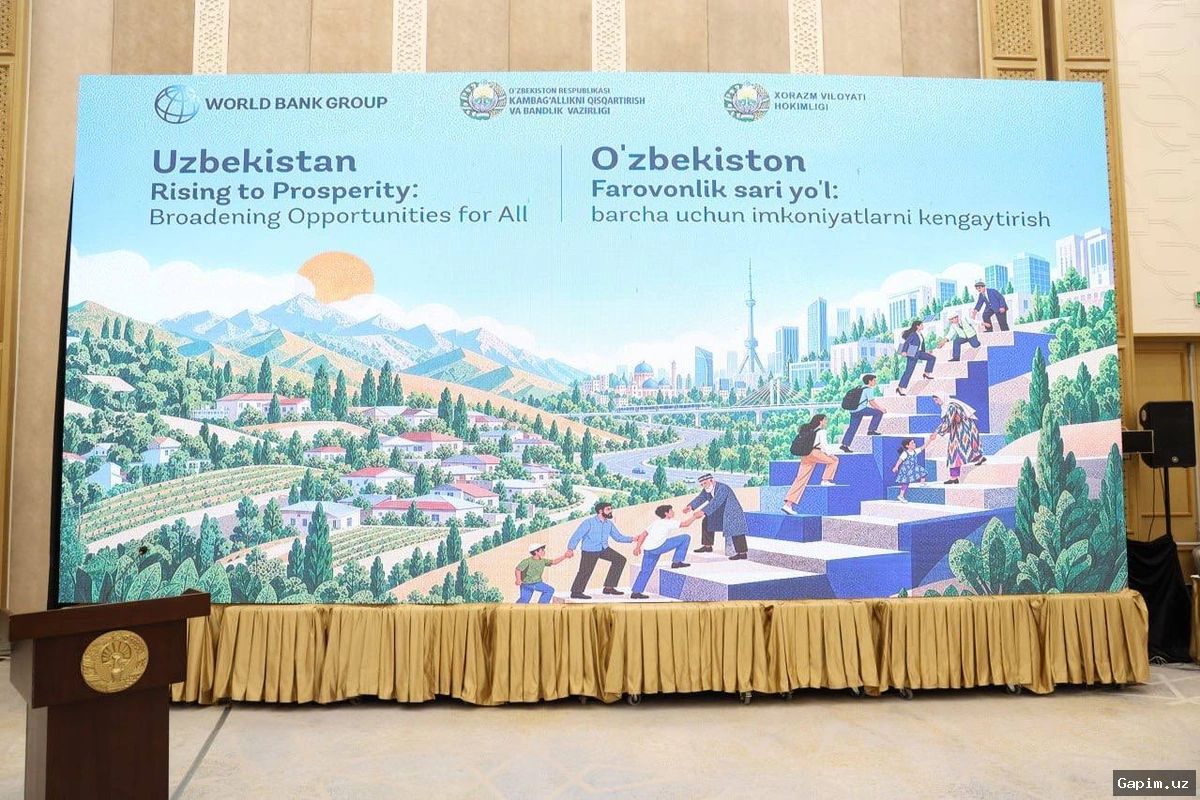
On September 23, the World Bank presented a new report titled "Poverty and Equity Assessment in Uzbekistan: Toward Prosperity and Expanding Opportunities for All," prepared in collaboration with the Ministry of Poverty Reduction and Employment and the Ministry of Economy and Finance. The event was attended by government officials, international experts, and other stakeholders.
The report notes that in recent years, Uzbekistan has managed to reduce the poverty rate to 5.8%, meaning that 3.7 million people have escaped poverty. The share of the middle class increased from 37% to 72%. These positive changes are the result of economic reforms and the strengthening of the social protection system.
Minister of Poverty Reduction and Employment Botir Zakhidov, speaking via video message, emphasized that reforms in employment and social protection are yielding real results for families in every region of the country. "The ministry will continue its work to expand access to decent jobs, increase incomes, and strengthen the social protection system, so that achievements in poverty reduction are sustainable and cover all regions of the country," he said.
World Bank Regional Director for Europe and Central Asia Abebe Adugna noted that Uzbekistan's next task is to ensure that all people in the country, regardless of where they live, their gender, or social background, can use the skills, services, and opportunities necessary to build a secure and prosperous life. According to him, this requires further efforts.
World Bank Regional Director for Central Asia Naji Benhassin stressed that Uzbekistan is not limited to poverty reduction but is striving to create sustainable economic opportunities and strengthen the middle class. "To ensure the sustainability of the achieved results and their spread to every region, district, and mahalla, investments in human capital, job creation for young people entering the labor market with increasingly higher qualifications, expanding women's economic opportunities, increasing connectivity between regions, and an effective social protection system will be crucial," he said.
Then World Bank Senior Economist Ikuko Uochi and Lead Economist Obert Pimhidzai provided a detailed overview of the results of the poverty and equity assessment in Uzbekistan. The report notes that between 2021 and 2025, the poverty rate declined significantly, and the national target (6%) was achieved ahead of schedule. Progress was also made by international standards: the international poverty rate for upper-middle-income countries decreased by 26 percentage points, accounting for 40% of the reduction in the number of poor people in the Europe and Central Asia region.
The report analyzes the movement of the population across economic classes. In 2021–2025, four out of ten people (43.6%) moved to a higher economic class, resulting in a middle class share of 72%. However, every fifth person remains in the vulnerable group, meaning the probability of falling back into poverty exceeds 10%. This indicates the need to focus on this group.
In employment, positive shifts are observed: in 2022–2025, the poverty rate decreased by 8.4 percentage points, of which 3.1 points were due to increased wage employment and 6.1 points due to growth in wage incomes. Among the lowest-income 20% of men, the wage employment rate increased sharply. At the same time, the share of international labor migration, agricultural activity, and self-employment decreased. The pace of job creation is high, but most jobs are informal and low-productivity: two-thirds of new jobs were created in construction and trade, and about 85% of them are informal. Real labor productivity declined by 4.2%.
Wage growth in the private sector has become the main factor in the expansion of the middle class. In Tashkent, two-thirds of the middle class expansion was driven by private sector wage growth. Outside Tashkent, this factor explains 40% of the middle class expansion, with another 25% attributed to wage growth in state-owned enterprises. Belonging to the middle class is associated with higher education, having a job, and employment in the service sector or in high-skilled jobs.
The report's authors note that the expansion of the middle class is changing the social contract on fiscal policy. Increased tax revenues from the middle class create opportunities for more effective social spending. However, middle-class households continue to receive significant payments and subsidies, which may reduce the efficiency of income redistribution. At the same time, this class supports assistance to low-income families and demands improved quality of education and healthcare.
An analysis of the situation of the poor and socially vulnerable population showed that 55% of them are economically inactive, three times more than in the upper-middle class. Almost half of those employed are informally employed. Half of high-skilled jobs in the private sector are concentrated in Tashkent city and Tashkent region. In the highest-paying sectors of finance and telecommunications, almost two-thirds of high-skilled jobs are located in Tashkent. The limited availability of such jobs outside Tashkent stimulates international labor migration: more than half of poor households have labor migrants, while in the middle class this figure is 6.5%.
The World Bank expects three main outcomes in the future: ensuring equal access of all segments of the population to broader opportunities, expanding women's economic participation, and increasing the fairness of fiscal policy and the social protection system. To achieve this, it is necessary to connect lagging regions with growth centers and eliminate gaps in access to affordable housing, fundamental knowledge, and skills. Infrastructure deficiencies and low interconnectivity of regions limit inclusive regional development. As distance from large cities increases, the spread of economic growth weakens.
The report also points to problems in education: according to PISA-2022 results, 80% of 15-year-old students did not achieve the minimum level of knowledge. Higher education coverage is uneven across regions: in Tashkent it is 63%, in Namangan 23%. This prevents members of poor households from finding high-paying jobs. It is necessary to modernize teacher training, knowledge assessment systems, expand the network of full-day schools, and expand digital vocational and higher education opportunities, especially in STEM and ICT.
Special attention is paid to women's employment. In poor households, 92% of economically inactive adults are women. On average, a poor household has 2.5 dependents (children and elderly), while in the upper-middle class this figure is 1.2. The probability of employment for mothers with children under 2 is 36% lower than for others. To address these issues, it is recommended to create childcare infrastructure, expand affordable childcare services, consider targeted support within the social protection system, expand the network of full-day primary schools, and expand technical and vocational education programs for women in STEM, ICT, artificial intelligence, tourism, and hospitality.
The social protection system also has problems: the coverage of benefits for low-income families has decreased (from 26.1% in 2022 to 7.8% in 2025). 45% of poor households have no labor income. A well-targeted and flexible social protection system effectively supports poor and vulnerable households. Therefore, it is necessary to expand benefit coverage, improve the accuracy of targeting, make the social protection system flexible to respond quickly to shocks, reduce untargeted energy subsidies, and direct freed-up funds to targeted assistance.
The World Bank also recommended gradually equalizing the retirement age for women and men, aimed at extending working life and the period of pension contributions.
Source: www.gazeta.uz