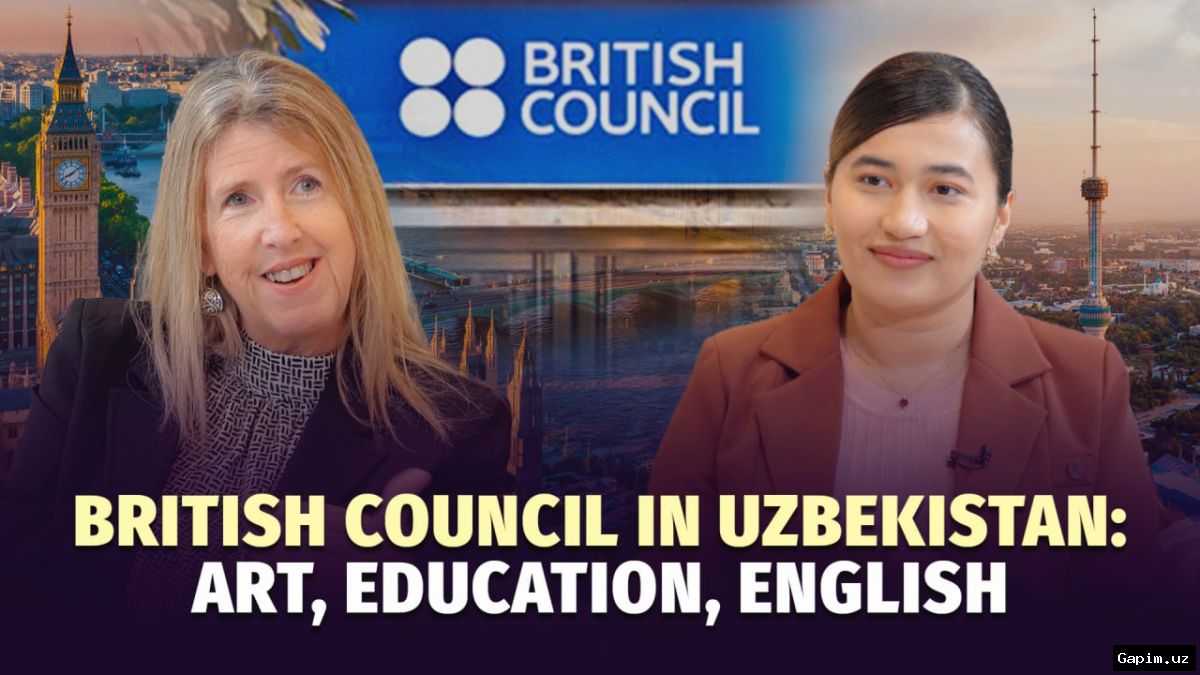
In 1996, the then Prince of Wales and now King Charles III visited Tashkent to take part in opening the new British Embassy building and a small British Council office in Uzbekistan. Thirty years on, the organisation says 1.7 million people have taken part in its programmes, while its campaigns and initiatives have reached more than 42 million people across Uzbekistan and the UK combined. At a press conference in Tashkent, British Council Chief Executive Scott McDonald and Michael Holgate, head of the British Council in Uzbekistan, outlined results in English teaching, cultural relations and transnational education.
Key Takeaways: The British Council has operated in Uzbekistan for 30 years, with 1.7 million programme participants. More than 10 UK universities now operate in the country, and over 10,000 students are earning British diplomas locally. English-teaching reforms have produced curricula for 12 subjects and trained 320 master trainers.
The British Council’s work in Uzbekistan covers English-language teaching, exams, teacher training and partnerships with schools and universities. McDonald said Uzbekistan had changed markedly over three decades, setting ambitious goals in education and international cooperation and showing growing interest in partnership with the UK. For the UK side, he claimed, Uzbekistan is an ambitious country with wide opportunities in business, the creative sector and education.
“The British Council’s role in the world is to connect people. Wherever we work, our mission is to help people know each other better. We hope that through this they will understand each other better and learn to trust each other, which leads to two things beneficial for both sides: people trade more, wage fewer wars and work together on shared global problems,” McDonald said. Holgate cited participation in establishing Westminster International University in Tashkent — which began 25 years ago with several hundred students — as a key achievement; today, he said, more than 10,000 students receive British diplomas in Uzbekistan.
McDonald clarified that nearly 12 UK higher-education institutions are represented in Uzbekistan through branches, franchises or joint-degree programmes, and he predicted their number would rise significantly over the next five years. He described the idea of opening branches of Uzbek universities in the UK as useful for bilateral relations, noting that some universities he met in Tashkent may consider the option. Abduvali Ismoilov, rector of the Abdulla Avloniy National Institute of Pedagogical Excellence, said the institute, together with the British Council and the Norwich Institute for Language Education, had developed curricula in 12 subjects for teachers’ continuous professional development, applied from the 2026–2027 academic year.
To roll out the programmes, 320 master trainers were prepared at national level. In September 2026 they underwent large-scale training led by experts from the British Council and the Norwich institute; 36-hour cascade trainings are now being held at regional, district and school levels. Analysts say the partnership could deepen the internationalisation of Uzbekistan’s education system, but quality control, teacher workload and adaptation to local needs will remain important tests. Further growth in the number of UK universities and joint programmes is expected in the coming years.
Source: www.gazeta.uz