Uzbekistan has disciplined 29 customs officers over violations linked to the processing of mobile devices and registration of IMEI codes in 2025–2026, the Customs Committee said at a Nov. 11 press conference. Farhod Olimjonov, head of a Customs Committee department, said the agency conducted 21 official inspections during the period and held individual preventive talks with 67 more employees. The briefing also examined claims of criminal prosecution of customs post staff at Tashkent airport, shortcomings in the IMEI verification system and the division of responsibility between customs and the UZIMEI operator.
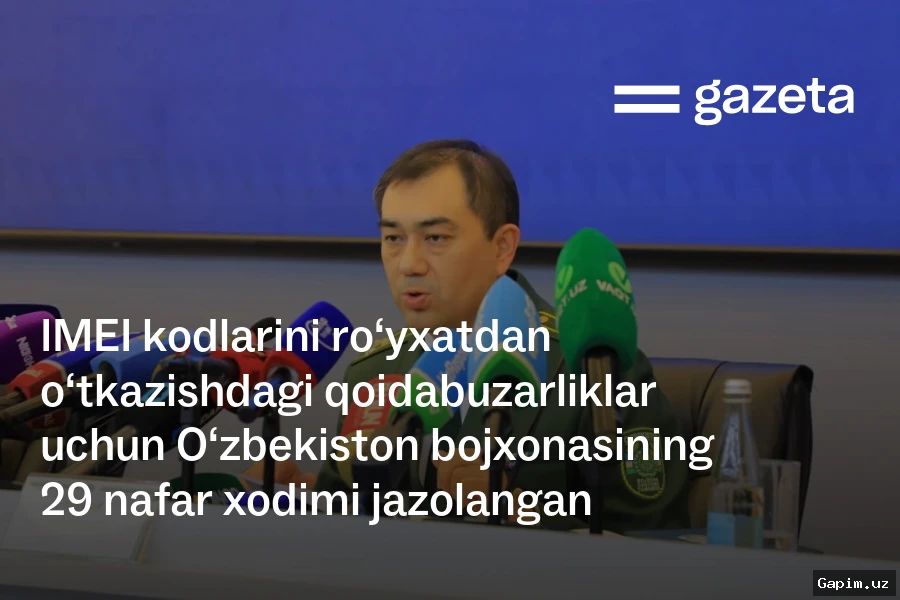
Key Takeaways: Twenty-nine customs officers were punished after 21 official inspections, while 67 employees received individual preventive talks. Officials said criminal cases have been opened against several employees, but they did not confirm a journalist’s claim that more than 200 staff were facing prosecution. The Customs Committee said Cabinet Resolution No. 778 of 2019 assigns IMEI verification, registration and identification to the mobile operator.
The committee stressed that violations are being identified internally through digitized customs processes. Olimjonov said all procedures have been digitalized and each action leaves a digital trace, creating oversight opportunities. “If we see that our employee is engaged in illegal activity, we do not take the position of merely protecting him. We identify it ourselves and take measures ourselves,” he said. The statement signals a push for stronger internal control and prevention of misconduct within the customs service.
Journalists raised the issue of criminal prosecution of customs officers at Tashkent airport. Citing information that criminal cases had been opened against more than 200 employees, they asked how justified it was to hold individual inspectors responsible for problems in the IMEI verification system. Customs Committee representatives did not confirm the figure and declined to disclose the exact number of criminal cases, the charges or investigation details. Sherzod Hamidov, first deputy head of the Tashkent-AERO specialized customs complex, said the agency protects conscientious employees because specialists are valuable, but each person must answer before the law for unlawful actions.
The briefing also addressed whether customs officers or the UZIMEI operator must verify the authenticity of IMEI codes and compare them with customs declaration data. Olimjonov cited Cabinet Resolution No. 778 of Sept. 17, 2019, which regulates mobile device registration. “Under Resolution No. 778, verification, registration, comparison and identification of IMEI numbers in mobile devices are assigned directly to the mobile operator,” he said. No legal act directly imposes on customs officers the duty to determine IMEI authenticity, he added. Customs’ main task is to check characteristics of goods and vehicles that affect customs payments; for example, when an iPhone is imported, customs identifies the amount payable, while the correctness of IMEI codes belongs to the operator.
The Customs Committee said it will not shy away from its assigned duties and continues cooperation with the UZIMEI operator. However, because officials did not provide full details on criminal cases, charges or investigation circumstances, several questions remain open. The case is notable for transparency in digital oversight, inter-agency responsibility and public trust in customs administration. Further clarification is expected as inspections and investigative actions continue.
Source: www.gazeta.uz