SpaceX plans to conduct the 15th test flight of its Starship launch system on Friday, Nov. 13, 2026, in an ambitious attempt to return both stages to the launch site and catch them for the first time in a single mission. The flight is scheduled to open a 75-minute launch window at 5:45 p.m. US Eastern time from Starbase; that corresponds to 01:45 Moscow time and 03:45 Tashkent time on Nov. 14. According to the company, the upper stage, Ship, is to fly for more than 22 hours and orbit Earth about 14 times.
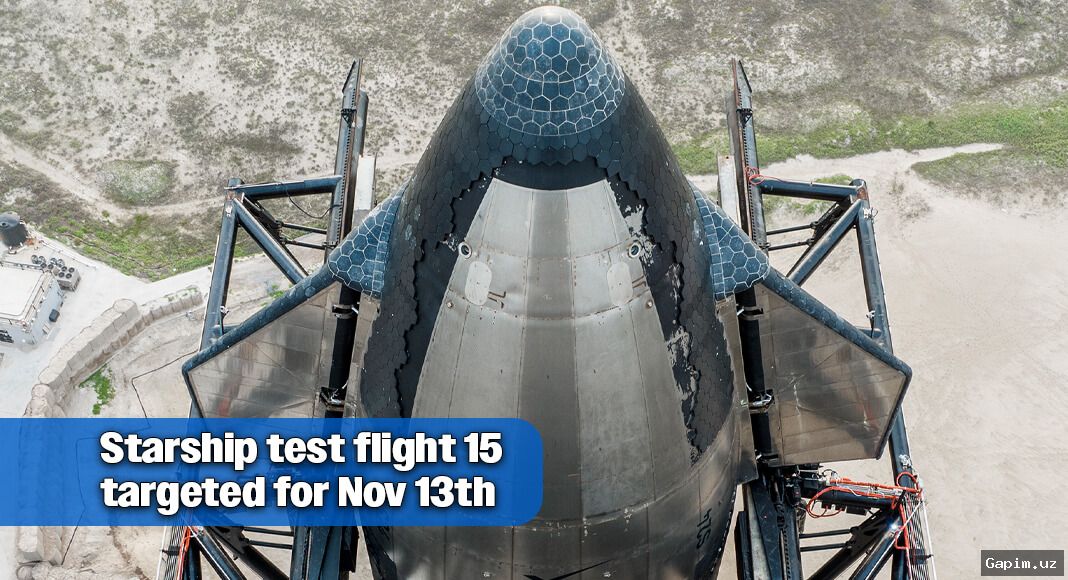
Key Takeaways: The 15th Starship test is set for Friday, Nov. 13, in a 75-minute window beginning at 17:45 US Eastern time. SpaceX aims to catch both Super Heavy and Ship, with Super Heavy returning about 6.5 minutes after liftoff and Ship remaining in flight for more than 22 hours. A successful dual catch would mark the first full return of the orbital system and a major step toward rapid reuse.
Starship is a two-stage system: Super Heavy forms the first stage, while Ship is the upper stage and spacecraft. Both are designed for full reuse and quick turnaround between flights. SpaceX has caught Super Heavy three times during previous tests, but it has never attempted the maneuver with Ship. The upper stage flies higher and farther, making its return more complex and energetically demanding.
In its mission description, SpaceX said: “According to the plan, the upcoming flight will be the first in which both Starship and Super Heavy return to the launch site to be caught. If successful, this would represent the first complete return of an orbital launch system and a major achievement toward making Starship a reliable, rapidly reusable rocket.” SpaceX founder and chief executive Elon Musk had previously said a dual-catch attempt might be possible on the 15th flight.
The 14th flight on Sept. 28 saw Ship reach orbit for the first time. As on that mission, SpaceX says the current flight is to deploy 26 next-generation Starlink V3 satellites; Musk claims they will be the first part of a future constellation of roughly 100,000 spacecraft. This time, however, Ship is expected to remain in flight much longer than on the 14th mission, which ended about three hours after launch with a splashdown in the northern Pacific Ocean.
If all goes according to plan, Super Heavy will return to Starbase about 6.5 minutes after liftoff to be caught by the service tower, while Ship stays aloft for a far longer flight. The attempt is regarded as technically difficult and risky: weather, final checks or automated-system faults could force a delay. Even so, a successful outcome would be important for future Starship orbital missions, Starlink expansion and preparations for longer flights to the Moon and Mars.
Source: kun.uz