Questions over who sets the standards of the Uzbek language — writers, publishers or speakers themselves — whether machine translation can alter grammar, whether dialects should be preserved in children’s books, and how educational texts can be made understandable without simplifying the language, were discussed in late October at an open dialogue titled “Between Norm and Speech” at the Republican Children’s Library; participants included children’s literature researcher Dilnavoz Najimova, Asaxiy Books translator Gulasal Qodirova and Tilmoch AI translation service founder Muhammadsaid Mamasaidov, while Gazeta provided a brief account of the discussion.
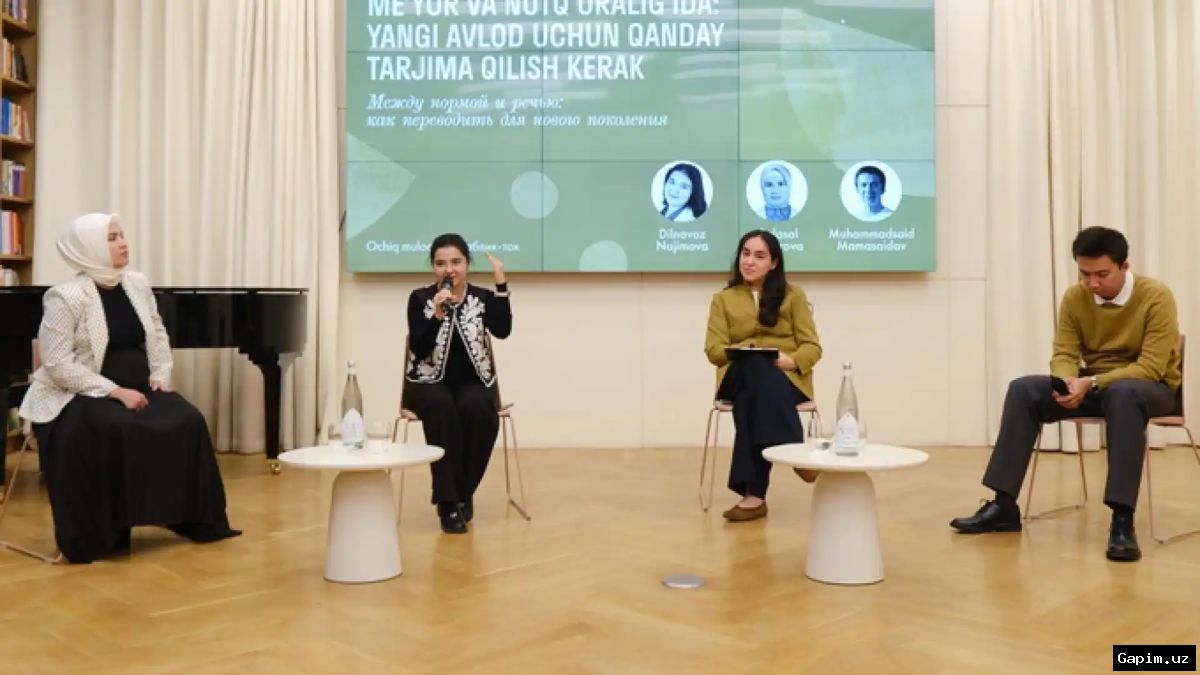
Key Takeaways: Najimova argues that Uzbek language norms are shaped mainly by writers and their works; Qodirova illustrated this through Javlon Jovliyev’s forthcoming novel “Katta qizlar,” of more than 700 pages; and Mamasaidov emphasized that language cannot be controlled from outside, with daily speech and digital communication playing a major role in shaping norms.
Context and Background
The discussion centered on the source of language norms. Najimova said examples in Uzbek explanatory and spelling dictionaries are taken from literary works rather than spoken language, so contemporary literature becomes the basis of the literary standard. She warned that in an age when people read fewer books and receive information mainly through social media and the internet, social-media language may set norms, weakening the very concept of a standard.
Qodirova agreed that writers set the norm and described editing Jovliyev’s novel with the author for about a year; the text contains distinctive stylistic features and authorial words and phrases worthy of poetic and linguistic analysis. Mamasaidov, identifying himself as a software engineer rather than a linguist, said his team has spent four years digitizing and modeling Uzbek, observing new words, usage patterns, common mistakes, differences between phone and keyboard writing, dialect features in writing and historical complaints by French writers about language decline.
Outlook and Next Steps
The participants concluded that language is first of all a tool of mutual understanding and does not disappear when both sides understand each other, while norms depend on everyday speech. Future discussion is likely to focus on balancing children’s literature, literary works and digital platforms, preserving dialects, making educational materials understandable without oversimplification, and monitoring the grammatical accuracy of AI translations.
Source: www.gazeta.uz