The Costa Rican government has signed an agreement with the United States to accept up to 25 deported migrants per week, marking the latest move in the Trump administration's policy of deporting individuals to "third countries." Costa Rica's Minister of Public Security, Mario Zamora, stated in a video statement to The Guardian: "Costa Rica feels obligated to reciprocate at a time when the United States and its immigration services need the humanitarian cooperation of Costa Rican authorities." He emphasized: "With financial support from the United States, they will be provided with housing and food on Costa Rican soil. Costa Rican immigration authorities will collaborate with US immigration authorities to carry out all necessary immigration logistics to guarantee the return of these individuals to their countries."
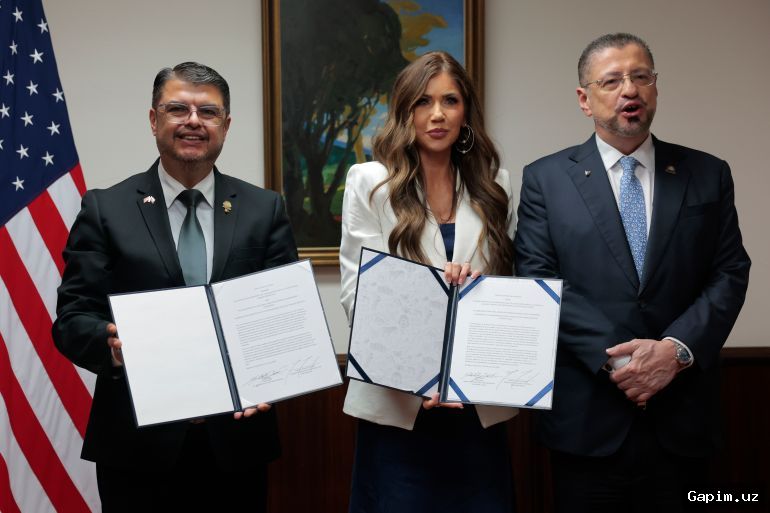
Zamora claimed the agreement is voluntary, asserting that the Costa Rican government has the discretion to decide the number of deportees it will accept, as well as their nationality. The Costa Rican Ministry of Public Security announced last week that the country would only receive deported migrants who are not from Latin America or any nation that refuses to take back their citizens, and who have no criminal records. According to the agreement, the US government will provide information about individuals to be deported to Costa Rica 48 hours before a deportation flight. Upon arrival, the Costa Rican government will grant them a limited legal status on humanitarian grounds.
The accord was signed during a visit by Kristi Noem, the recently departed Homeland Security Secretary who is now overseeing the "Shield of the Americas" initiative, which the Trump administration purportedly designed to eradicate criminal cartels in the Western Hemisphere. Deportations to Costa Rica would be carried out by the US Department of Homeland Security, but the department did not respond to requests from The Guardian for details on how the removals would work. The US Department of State said in a statement: "Implementing the Trump Administration's immigration policies is a top priority for the Department of State. As Secretary Marco Rubio has said, we remain unwavering in our commitment to end illegal and mass immigration and bolster America's border security."
The International Organization for Migration (IOM), a UN agency, is expected to provide assistance to deportees upon their arrival. A spokesperson for the organization stated: "Where engaged, our support focuses on providing basic services and helping individuals navigate a limited set of options, including whether to remain, return to their country of origin, or pursue other available pathways." Zamora said the Costa Rican government is scheduled to meet with US authorities and IOM officials this week to determine where the deportees will be transferred once they arrive in Costa Rica.
Trump's expanding use of "third country" deportations has come under intensifying scrutiny by Democratic lawmakers in Congress. In February, Democrats on the Senate Foreign Relations Committee published a report detailing "how the Trump Administration's secret deportation deals are undermining US interests and coming at great cost to taxpayers." Senator Jeanne Shaheen, a Democrat from New Hampshire who commissioned the report, stated: "Through its third country deportation deals, the Trump Administration is putting millions of taxpayer dollars into the hands of foreign governments, while turning a blind eye to the human costs and potentially undermining our diplomatic relationships. For an Administration that claims to be reining in fraud, waste and abuse, this policy is the epitome of all three." The report found that the Trump administration has spent at least $40 million to deport migrants to countries that are not their own. A congressional aide involved in the report said the State Department was not tracking what happens to those deported to third countries.
The Trump administration secured a deal with Costa Rica last year that allowed the US to send roughly 200 deportees to the Central American nation. The group of asylum seekers, which included 81 children from different countries in Asia and Africa, were flown to Costa Rica in chains after being denied a chance to request protection on US soil. Nearly 300 other African and Asian migrants were deported to Panama around the same time. A congressional aide added that the estimated cost for roundtrip deportation flights to Costa Rica and Panama in February 2025 totaled about $1.4 million. The Costa Rican government claimed at the time that it would serve as a temporary safe haven for the deportees and help them return to their home countries. However, interviews with those deported to Costa Rica contradict these promises. A Russian man who remains in Costa Rica with his wife and child more than a year after their deportation said: "They threw us out like baggage to a country with a language we don't speak. And no one was held accountable for this."
The deportations to Costa Rica were part of many high-profile operations in the early days of the second Trump administration, which moved swiftly to unleash its anti-immigration and mass deportation agenda. In June, Costa Rica's Supreme Court ruled that the government had violated the rights of the 200 migrants during their detention at a migrant housing facility known as Catem, located six hours away from the capital, San José. When asked if migrants deported from the US to Costa Rica under this new agreement would end up in Catem, Zamora did not address the question. The Guardian reported that the world's largest pencil maker accused the Costa Rican government of misusing Catem, an old factory that the German manufacturer donated to the Central American country for humanitarian purposes. The new agreement between Costa Rica and the US alarmed lawmakers in the Central American country, especially during the transitional period in which Laura Fernández is scheduled to succeed Rodrigo Chaves as Costa Rica's next president in May. The Guardian spoke with Monserrat Ruiz Guevara, whose term as a member of the Costa Rican Legislative Assembly ends next month. Ruiz Guevara, who visited Catem shortly after the 200 migrants arrived in Costa Rica last year, said: "In the face of a government transition, there is a well-founded concern regarding possible external pressure from the US, the normalization of agreements of this nature without due national debate, and the risk of the country assuming responsibilities that do not belong to us." She added: "Our country has built a historical tradition of respect for human dignity, but this tradition demands concrete and verifiable actions. These types of agreements with the United States lead us to legitimate concerns about the real guarantees of respect for human rights."
Source: www.theguardian.com